Sunday, May 28, 2006
Book shows and readings on the radio and Teev (and relative links):
Book Readings
(Mon-Fri 2pm, repeated 11pm, on ABC Radio National)
http://www.abc.net.au/rn/bookreading/default.htm
The Book Show
(Weekdays 10am, Sun 7.10pm on ABC Radio National)
http://www.abc.net.au/rn/bookshow/
Book Lust
(ABC TV, 10pm Tuesday)
http://www.abc.net.au/tv/guide/netw/200605/programs/AC0518V002D30052006T220000.htm
(This seems to be a one-off special. I read somewhere that there is an new TV show on soon on the ABC about books, but not sure when it starts or what it will be called).
Saturday, May 27, 2006
Wide Sargasso Sea
Jean Rhys
Um, hi. This is my first post. Nice to be here.
I kind of wagged work the other afternoon and did a bit of second-hand-bookshop-browsing and came away with quite an armful. One of which was Wide Sargasso Sea, which is one of those books I've vaguely heard of but were never really sure what it was about. Hint: there is no sea in it. It's an imagined pre-history of the first Mrs Rochester from Jane Eyre, aka the mad woman in the attic. In Jane Eyre, she is a gothic beast, unfeminine, mad, tropical, sensual, a perfect foil to Jane's purity and rationality.
Jean Rhys imagines her rather differently. Antoinette's a bit lost, a bit unloved, and very scared, living in Jamaica when the recent emancipation of the slaves has made white people unwelcome. The first part of the book covers part of her childhood, which is quite tragic and results in her mother going mad. The second part is written from the view of Mr Rochester, and if about his marriage, which he kind of falls into because he's greedy for money and Antoinette has plenty. During their honeymoon, things begin to go wrong. Rochester finds out he is a figure of fun for having married a woman with a family history of mental problems (probably from inbreeding), who also has black blood. Antoinette is desperate to make him love her, and resorts to voodoo, which doesn't work and leaves her angry, impotent and trapped.
The third part is set in England, and this is where the story crosses Jane Eyre. It's a strange book, because you already know the ending - mad woman, burning house - she can't escape her fate. But she knows she can't, and this makes her real, instead of the animal other that Charlotte Bronte imagined.
The writing creates a sense of dread and doom all the way through to the end. Reading it late at night gave me a bad case of the creeps. It's only 150 pages long, but packs a lot in.
Um, hi. This is my first post. Nice to be here.
I kind of wagged work the other afternoon and did a bit of second-hand-bookshop-browsing and came away with quite an armful. One of which was Wide Sargasso Sea, which is one of those books I've vaguely heard of but were never really sure what it was about. Hint: there is no sea in it. It's an imagined pre-history of the first Mrs Rochester from Jane Eyre, aka the mad woman in the attic. In Jane Eyre, she is a gothic beast, unfeminine, mad, tropical, sensual, a perfect foil to Jane's purity and rationality.
Jean Rhys imagines her rather differently. Antoinette's a bit lost, a bit unloved, and very scared, living in Jamaica when the recent emancipation of the slaves has made white people unwelcome. The first part of the book covers part of her childhood, which is quite tragic and results in her mother going mad. The second part is written from the view of Mr Rochester, and if about his marriage, which he kind of falls into because he's greedy for money and Antoinette has plenty. During their honeymoon, things begin to go wrong. Rochester finds out he is a figure of fun for having married a woman with a family history of mental problems (probably from inbreeding), who also has black blood. Antoinette is desperate to make him love her, and resorts to voodoo, which doesn't work and leaves her angry, impotent and trapped.
The third part is set in England, and this is where the story crosses Jane Eyre. It's a strange book, because you already know the ending - mad woman, burning house - she can't escape her fate. But she knows she can't, and this makes her real, instead of the animal other that Charlotte Bronte imagined.
The writing creates a sense of dread and doom all the way through to the end. Reading it late at night gave me a bad case of the creeps. It's only 150 pages long, but packs a lot in.
Sunday, April 30, 2006
Miss J has pleaded with Booklub members other than herself to post on their reading.... here goes, but I suspect my reading will be of limited interest to others at present:
"Baby Love" by Robin Barker
"Kidwrangling" by Kaz Cooke
"The Essential Guide for First-time Parents" by Dr Miriam Stoppard
You get the idea. Falling asleep on the couch by 9pm really puts a damper on your reading schedule. However, now that I am on maternity leave (whoohoo!), perhaps I'll have the time to read the following which I have lined up:
Virtual Light, by William Gibson
Mr Golightly's Holiday by Sally Vickers
and a few others that I started over the past few months...
"Baby Love" by Robin Barker
"Kidwrangling" by Kaz Cooke
"The Essential Guide for First-time Parents" by Dr Miriam Stoppard
You get the idea. Falling asleep on the couch by 9pm really puts a damper on your reading schedule. However, now that I am on maternity leave (whoohoo!), perhaps I'll have the time to read the following which I have lined up:
Virtual Light, by William Gibson
Mr Golightly's Holiday by Sally Vickers
and a few others that I started over the past few months...
Wednesday, April 26, 2006
Haruki Murukami - The Wind up Bird
So I've got a100 pages into this, right. And I know that Mr Murukami has a bit of a fan base out there in Booklub, but just to put the cat among the wind-up birds... I wonder if I find him cold, aloof, and just trying a little bit too, er, hard. Maybe. I'm enoying it because its all mysterious and has some very casual humour with the prophesy angle.. but is he overtly trying to create a spooky (but meaningless) atmosphere just for the sake of it? I read another one of his, completely forget the title because I'm a fairly crap book reviewer, but it was about a man with a long lost love, who owns a jazz club and feels a kind of duty to his wife not to track down his myterious lost love. This one seems to be about a jobless man who listens to jazz all day and is starting to worry he doesn't really know his wife that well at. Interesting, but cold. I sense perhaps he a is a little subversive with the attitude of his protagaonist, if we are to believe the stereotype of Japan, and the highly dutiful salaryman. So the way his men characters kind of glide through life might be a bit of a shock over there. Just guessing here. Maybe I've known one too many dissolute men for real, and don't get much of a kick out of fiction ones. Who knows. In the last two weeks I stayed up till the wee hours reading first Animal Moves by Barbara Kingsolver and then The Robber Brides -totally cliched chick books, and loved them both. Even shed a little tear at the first one. Will give you more run down next time.
So I've got a100 pages into this, right. And I know that Mr Murukami has a bit of a fan base out there in Booklub, but just to put the cat among the wind-up birds... I wonder if I find him cold, aloof, and just trying a little bit too, er, hard. Maybe. I'm enoying it because its all mysterious and has some very casual humour with the prophesy angle.. but is he overtly trying to create a spooky (but meaningless) atmosphere just for the sake of it? I read another one of his, completely forget the title because I'm a fairly crap book reviewer, but it was about a man with a long lost love, who owns a jazz club and feels a kind of duty to his wife not to track down his myterious lost love. This one seems to be about a jobless man who listens to jazz all day and is starting to worry he doesn't really know his wife that well at. Interesting, but cold. I sense perhaps he a is a little subversive with the attitude of his protagaonist, if we are to believe the stereotype of Japan, and the highly dutiful salaryman. So the way his men characters kind of glide through life might be a bit of a shock over there. Just guessing here. Maybe I've known one too many dissolute men for real, and don't get much of a kick out of fiction ones. Who knows. In the last two weeks I stayed up till the wee hours reading first Animal Moves by Barbara Kingsolver and then The Robber Brides -totally cliched chick books, and loved them both. Even shed a little tear at the first one. Will give you more run down next time.
Tuesday, April 25, 2006
Zadie Smith - On Beauty

Just finished reading this one. Thanks Mikey for perfect airoplane reading.
Liked it. Anyone else read it?
Sunday, March 12, 2006
"Nine Hours North" - Tim Sinclair
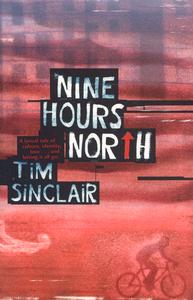
Nine hours north of everything I knew, of all my life that's made sense so far . . . Things stopped making sense from the moment Adam arrived in Japan - the conservative job, the shoebox apartment and the growing weight of his relationship with Sarah.
By the time Marianne arrives, he's been battery-caged for so long it all seems normal - but then she changes everything . . .
A bittersweet novel about finding the strength to move forward.
Nine hours north has just been released this February, published by Penguin and I must confess to be very excited about this book, not only because I know the author (albeit tangentially) as he is the son of my 1st year Biology lecturer *and* the husband of a dear friend of mine who I went to HS with, but also because it's the debut novel by a young Australian - Adelaidean no less!, AND because it's a verse novel. Remember Vickram Seth's 'The Golden Gate' or Matt Rubenstein's 'Solstice' or Dorothy Porter's wonderful 'The Monkey's Mask' and 'What a piece of work'?? Great verse novels, in a genre which is slimly populated but satisfying to read.
I think it's incredibly brave to be a writer, and even more brave to be a poet. Poetry! Who does that these days, when everything is meant to be useful and contribute to production of bright and shiny things that you can eat or wear or drive or renovate? For that reason alone I am committed to buying the work of contemporary poets / poetic fiction (I just made that genre up) writers - good to support the dreamers, so we remember how to dream.
Anyway, this book is set in Japan, characters are early twenties Australians teaching English as part of a youthful adventure away from home post-uni. They are in a relationship but things are getting weary. Captures those few years (longer??) when the acting out of a working life feels like playing dress ups, it can be done with irony, it is still so new, and uni life still feels so close. When you just know that you will never wear a suit and be old and be boring. The interesting thing about their relationship is that they seem to be developing quite different attitudes to their life, about what is important and how to live it.
I must confess that parts were uncomfortable reading for me in terms of candid insight into the mind of a male partner who is increasingly dissatisfied a few years into a relationship - I think I was a bit defensive about his judgement about Sarah. I did also wonder if it was going to be a 2-D 'my girlfriend's so boring I need a wild adventure' story - but it wasn't, it didn't end up being this, the characters fleshed out with much more realistic too-ings and fro-ings of feeling. It effectively built up tension as you wonder what will happen to topple the domestic order. It rolls along, with cycling becoming a theme of the book - Adam and Sarah united in their use of bikes for commuting to work and also as the mode of travel they choose for their long-planned touring holiday around Japan.
Definitely worth a read, and may especially apppeal to those who are into bikes, who have had a 'coming of age' relationship, have visited Japan, who have been confused about their feelings for someone, and who like wry, simply stated poetry. Proof that poetry doesn't have to be abstract and fey and hard to access. Buy a copy! Give a copy to a friend! :)
Authors website
"Olivo Oliva" - Phillipe Poloni
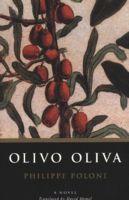 Turns out my local library service runs this you beaut service called 'Book Express' for city commuter types. A stall at the train station complete with network accessed laptop, a friendly and informative person on the other side of the stall, and a bunch of books and audio books to borrow. All this between 5.30ish and 7ish am. And me lugging a laptop and some reading for work but glad of any excuse not to do that and be immersed in fiction instead. Sipping coffee, reading, it’s almost like being on a moving café rather than a mode of transport. Almost.
 I borrowed a couple, one was “Olio Oliva” by Phillipe Poloni (1997 Stoddart publishing). Read it that day, was one of those sparsely type fonted slim books that you just whip through (especially when you are on your derrière for 4 hours with no distractions).
It starts with the relationship between an olive tree and its olives. Describes the anguish of an olive wanting to be free of the tree, the trees contempt for its ‘droppings’, the tree as patriarch. The gist of the story then is boy meets girl, boy beds girl, olive tree drops olive from great heights into the steamy sea of lovemaking below, girl has olivish baby. Sounds a bit like ‘Leolo’ that Italian movie where conception takes place in the back of a tomato truck? Yes, I thought that too. It’s all about the olive in Sicily, the role of landowners versus the landless poor, resentment, fear of losing hold of power, and ultimately revenge. The writing was lovely, sparse and poetic, translated from the Italian by David Homel. It did remind me of Calvino in some of its language but perhaps that is just due to the meandering, observational, dreamy nature of the writing, and the playing with words - or maybe it’s just that these are probably the only Italian authors I’ve read (that’s a bit tragic – so anglocentric in what I read…). It captured a very languid feeling of a slow, hot, worn out Sicily rather well, and gave an interesting picture of the successive waves of invaders that have moved through that part of the world, and the layering of culture and religion that takes place as a result.
Characters? The sicario in the new country. Some quirky ancient craftsmen accompanied by a donkey, who has his own bank account and gets paid the lions share of their fee. Hunchbacked moralists who guard over unwed mothers in crumbling ruins. The patriarch who is superstitious and ruthless in protecting his empire. Some of these characters reminded me of people from Loius de Berniers novels – they are irrational and contradictory and flawed and colourful.
This is a bit like a gentle, lazy, loping fairy tale, which doesn’t deliver much in the way of ‘action’, and everything that happens has already been foretold at the start. Even the end is a kind of poetic anticlimax. However, this is entirely in keeping with the setting of the tale, and what it says are the characteristics of that place – so this kind of works.
It made me want to go lie under an olive tree and eat pasta and drink wine.
‘The young olive tree had a soul. It was possessed of a memory. A kind of heredity. Awkwardly, it paraded the military pride of its ancestors. Poor little tree! It was but a simple domesticated olive producer among the million of other domesticated Mediterranean copies, all planted in rigorously straight rows. No more petalism! Doric temples a thing of the past! Polytheist ceremonies accompanied by chanting and pungent Levantine incense – all obsolete. Its leaf would no longer serve as a model for those early Christian mosaicists who decorated their catacombs, late at night, illuminated by the oil of its fruit. All that had happened, long ago… All that belonged to another time. The scion was a heraldic tree no more, but the object of intensive rationalised agriculture. And the haughty olive tree knew nothing of that!’ (p.4)
Sunday, March 05, 2006
Sunday, February 26, 2006
"The only people for me are the mad ones, the ones who are mad to live, mad
to talk, mad to be saved, desirous of everything at the same time, the ones
who never yawn or say a commonplace thing, but burn, burn, burn, like
fabulous yellow roman candles exploding like spiders across the stars and in
the middle you see the blue centerlight pop and everybody goes "Awww!"
Jack Kerouac - "On The Road"
to talk, mad to be saved, desirous of everything at the same time, the ones
who never yawn or say a commonplace thing, but burn, burn, burn, like
fabulous yellow roman candles exploding like spiders across the stars and in
the middle you see the blue centerlight pop and everybody goes "Awww!"
Jack Kerouac - "On The Road"
Tuesday, February 21, 2006
Good Books on Cat and Girl.
Love this comic. And look, soon appearing in a book! This is now on my ever growing 'when I get paid' wishlist.
Love this comic. And look, soon appearing in a book! This is now on my ever growing 'when I get paid' wishlist.
Monday, February 06, 2006
Art & Lies
Art Objects, Jeanette Winterson

I read these two books recently, in that order. Art and Lies is fiction, Art Objects is a book of short essays, and whilst they cover some similar territory, ideas on what art is and how it fits within life, and in particular within our culture of corporate consumer capitalism, I think that Art & Lies is probably the more beautiful read. That said, all of Winterson's prose is essentially poetry, and I find it a joy to read even when I think she has been opinionated, bombastic or arch - maybe especially then!

Art and Lies had great passages of beautiful prose which I would memorise if I had the dedication to do so. Kind of like the type of literary tattoo I would get it you could print words into the ether around you rather than images into flesh. There is one passage about the sea, in Art and Lies, which is particularly wonderful. the story looks at what it is to be a woman artist (painter, writer) - to grapple with expactations and sexual politics and double standards. One of the characters is the female Picasso in modern day England grappling with family expectations and the presumption of madness, one is Sappho the poet who exists both as the historical figure and modern day lover, one is Handel, a surgeon who loves opera and God and is deemed quaint and archaic by his colleagues.
"There's no such thing as autobiography, there's only Art and Lies"
Handel struggles to feel, to allow expression of his passions, to be authentic to himself in the midst of corporate culture - which has art merely as accessory, gross consumption but no tasting of what is consumed, lack of appreciation, of wonder. He is afforded staus and position, but leaves it to nurture his soul. The women are awash with passion and talent, but constrained by the self-serving interests of father/brother (in Picasso's story) or Church and misrepresentation (in Sapppho's story).
The story weaves around in a way that plays with time and place - gently a story emerges. It is not a linear, pointed, fast and obvious plot by any means, but more like a beautiful symphony which takes you along and connects directly with your subconscious. If you've read other worksby Winterson you wil be familiar with the style. If you haven't, I suggest Sexing the Cherry, or The Passion as great starting points. For the sake of categorisation, some people apply labels such as 'Magic Realism' to her work (see the absolute shocker of an entry on Wikipedia - boy did someone not like this writer when they wrote that!), but this is a descriptor the author rejects.
I think essentially this is a piece on authenticity - of spirit, of being authentic to ones true nature, and of the repurcussions that may transpire as a result of expressing authenticity in an world more comfortable with thoughtless reproduction. It is a pretty damming reflection on how society deals with creative women, and on how muted and rationed feeling and expression is in a culture dictated by the market.
From Art & Lies:
"It is so easy to be a brute and yet it has become rather fashionable.."
"It's comforting, my busy life, left alone with my own thoughts I might find that I have none"
"...Such habits and a contemplative nature, have not fitted me for a world that knows neither restraint nor passion. the fatal combination of indulgence without feeling disgusts me. Strange to be both greedy and dead"
"I confess that I am frightened of the sea.There is the sailor sea and the commercial sea, the oil well sea and the fishy sea. The sea that tests the land through sub-lunary power. The rise and fall of the harbour sea and the sea that exists to make maps look prettier. But the functional sea is not the final sea. There is that other sea simply itself. A list of all the things that the sea does is not what the sea is...."
"Some people find this book very difficult. What do you say to that?
Why should literature be easy? Sometimes you can do what you want to do in a simple, direct way that is absolutely right. Sometimes you can't. Reading is not a passive act. Books are not TV. Art of all kinds is an interactive challenge. The person who makes the work and the person who comes to the work both have a job to do. I am never wilfully obscure, but I do ask for some effort. Certainly Art and Lies is my most closed piece of work. Perhaps it is hermeneutic, though no more so than plenty of books by plenty of guys .It was written at a time when I was looking inwards not outwards. It is thickly layered, concentrated and often dark. But it's a book not a crime. If you don't like it, don't read it." (From the authors website)
Winterson on Art Objects:
"it's a verb not a noun. Art objects to the lie against life that it is pointless and mean. The message coloured through time is not lack but abundance, Not silence but many voices. Art, all art is the communication cord that cannot be snapped by indifference or disaster. Against the daily death it does not die." (From the authors website)
Quotes from the book:
"To suggest that the writer, painter, the musician, is the one out of touch with the real world is a doubtful proposition. It is the artist who muct apprehend things fully, in their own right, communicating them not as symbols but as living realisties with the power to move."
"For the artist,any artist, poet, painter, musician, time in plenty and an abundance of ideas are the neccassary basics of creativity. By dreaming and idleness and then by intense self-discipline does the artist live. The artist cannot perform between 9 and 6, five days a week, or if she sometimes does, she cannot gaurantee to do so. Money culture hates that. It must know what it is getting, when it is getting it, and how much it willcost. The most tyrannical of patrons never demanded from their protegees what the market now demands of artists; if you can't sell your work regularly and quickly, you can ither starve or do something else. The time that art needs, which may not be a long time, but which has to be its own time, is anathema to a money culture. money confuses time with itself. That is part of its unreality." (pp138-9).
Art Objects, Jeanette Winterson

I read these two books recently, in that order. Art and Lies is fiction, Art Objects is a book of short essays, and whilst they cover some similar territory, ideas on what art is and how it fits within life, and in particular within our culture of corporate consumer capitalism, I think that Art & Lies is probably the more beautiful read. That said, all of Winterson's prose is essentially poetry, and I find it a joy to read even when I think she has been opinionated, bombastic or arch - maybe especially then!
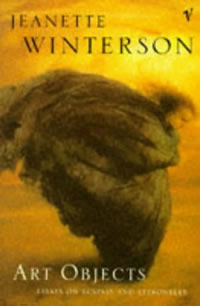
Art and Lies had great passages of beautiful prose which I would memorise if I had the dedication to do so. Kind of like the type of literary tattoo I would get it you could print words into the ether around you rather than images into flesh. There is one passage about the sea, in Art and Lies, which is particularly wonderful. the story looks at what it is to be a woman artist (painter, writer) - to grapple with expactations and sexual politics and double standards. One of the characters is the female Picasso in modern day England grappling with family expectations and the presumption of madness, one is Sappho the poet who exists both as the historical figure and modern day lover, one is Handel, a surgeon who loves opera and God and is deemed quaint and archaic by his colleagues.
"There's no such thing as autobiography, there's only Art and Lies"
Handel struggles to feel, to allow expression of his passions, to be authentic to himself in the midst of corporate culture - which has art merely as accessory, gross consumption but no tasting of what is consumed, lack of appreciation, of wonder. He is afforded staus and position, but leaves it to nurture his soul. The women are awash with passion and talent, but constrained by the self-serving interests of father/brother (in Picasso's story) or Church and misrepresentation (in Sapppho's story).
The story weaves around in a way that plays with time and place - gently a story emerges. It is not a linear, pointed, fast and obvious plot by any means, but more like a beautiful symphony which takes you along and connects directly with your subconscious. If you've read other worksby Winterson you wil be familiar with the style. If you haven't, I suggest Sexing the Cherry, or The Passion as great starting points. For the sake of categorisation, some people apply labels such as 'Magic Realism' to her work (see the absolute shocker of an entry on Wikipedia - boy did someone not like this writer when they wrote that!), but this is a descriptor the author rejects.
I think essentially this is a piece on authenticity - of spirit, of being authentic to ones true nature, and of the repurcussions that may transpire as a result of expressing authenticity in an world more comfortable with thoughtless reproduction. It is a pretty damming reflection on how society deals with creative women, and on how muted and rationed feeling and expression is in a culture dictated by the market.
From Art & Lies:
"It is so easy to be a brute and yet it has become rather fashionable.."
"It's comforting, my busy life, left alone with my own thoughts I might find that I have none"
"...Such habits and a contemplative nature, have not fitted me for a world that knows neither restraint nor passion. the fatal combination of indulgence without feeling disgusts me. Strange to be both greedy and dead"
"I confess that I am frightened of the sea.There is the sailor sea and the commercial sea, the oil well sea and the fishy sea. The sea that tests the land through sub-lunary power. The rise and fall of the harbour sea and the sea that exists to make maps look prettier. But the functional sea is not the final sea. There is that other sea simply itself. A list of all the things that the sea does is not what the sea is...."
"Some people find this book very difficult. What do you say to that?
Why should literature be easy? Sometimes you can do what you want to do in a simple, direct way that is absolutely right. Sometimes you can't. Reading is not a passive act. Books are not TV. Art of all kinds is an interactive challenge. The person who makes the work and the person who comes to the work both have a job to do. I am never wilfully obscure, but I do ask for some effort. Certainly Art and Lies is my most closed piece of work. Perhaps it is hermeneutic, though no more so than plenty of books by plenty of guys .It was written at a time when I was looking inwards not outwards. It is thickly layered, concentrated and often dark. But it's a book not a crime. If you don't like it, don't read it." (From the authors website)
Winterson on Art Objects:
"it's a verb not a noun. Art objects to the lie against life that it is pointless and mean. The message coloured through time is not lack but abundance, Not silence but many voices. Art, all art is the communication cord that cannot be snapped by indifference or disaster. Against the daily death it does not die." (From the authors website)
Quotes from the book:
"To suggest that the writer, painter, the musician, is the one out of touch with the real world is a doubtful proposition. It is the artist who muct apprehend things fully, in their own right, communicating them not as symbols but as living realisties with the power to move."
"For the artist,any artist, poet, painter, musician, time in plenty and an abundance of ideas are the neccassary basics of creativity. By dreaming and idleness and then by intense self-discipline does the artist live. The artist cannot perform between 9 and 6, five days a week, or if she sometimes does, she cannot gaurantee to do so. Money culture hates that. It must know what it is getting, when it is getting it, and how much it willcost. The most tyrannical of patrons never demanded from their protegees what the market now demands of artists; if you can't sell your work regularly and quickly, you can ither starve or do something else. The time that art needs, which may not be a long time, but which has to be its own time, is anathema to a money culture. money confuses time with itself. That is part of its unreality." (pp138-9).
Sunday, February 05, 2006
"Kafka on the Shore" - Haruki Murakami
This is the story of a teenage boy, who runs away from home in an attempt to escape his father's prophesies (curses). The boy also wonders about the fate of his mother and sister, who left when he was four never to be seen again. There is an interlocking story of an old man who has not been "quite right" since an incident when he was a boy during WW2, but gained the ability to talk to cats. A series of events interlock the stories of these two as they both travel from Tokyo to one of Japan's Western islands, introducing new characters along the way who help out the characters in their times of need.
There are interesting twists and contrasts - the simple, illiterate man blindly leading a truck driver who ends up being enlightened by his journey; the man who can only live in the present and the lady who can only live in her memories; Colonel Sanders and Johnny Walker appearing to the book's characters to ensure the carrying out of fated events; night time dreams that run into reenactments of events from many years before; and fish raining from the sky.
I enjoy Murakami books, and this is the third I have read. They all have some common elements - trips into the metaphysical, misfit characters of the Japanese kind, use of simile and metaphor, bold truisms buried in the text, references to whiskey drinking, eating and cooking, music, and graphic descriptions about the male sexual function (wanking, sex, nocternal emissions or fantasizing). [I could do with less on the latter, but then, he's a male author so I expect that he writes with some authority on the topic. It's written in a factual way, as a normal part of the life of the male characters, rather than being in anyway pornographic].
This novel has all the above elements. This had some lovely truisms in it... I marked the pages so I could quote them:
This is the story of a teenage boy, who runs away from home in an attempt to escape his father's prophesies (curses). The boy also wonders about the fate of his mother and sister, who left when he was four never to be seen again. There is an interlocking story of an old man who has not been "quite right" since an incident when he was a boy during WW2, but gained the ability to talk to cats. A series of events interlock the stories of these two as they both travel from Tokyo to one of Japan's Western islands, introducing new characters along the way who help out the characters in their times of need.
There are interesting twists and contrasts - the simple, illiterate man blindly leading a truck driver who ends up being enlightened by his journey; the man who can only live in the present and the lady who can only live in her memories; Colonel Sanders and Johnny Walker appearing to the book's characters to ensure the carrying out of fated events; night time dreams that run into reenactments of events from many years before; and fish raining from the sky.
I enjoy Murakami books, and this is the third I have read. They all have some common elements - trips into the metaphysical, misfit characters of the Japanese kind, use of simile and metaphor, bold truisms buried in the text, references to whiskey drinking, eating and cooking, music, and graphic descriptions about the male sexual function (wanking, sex, nocternal emissions or fantasizing). [I could do with less on the latter, but then, he's a male author so I expect that he writes with some authority on the topic. It's written in a factual way, as a normal part of the life of the male characters, rather than being in anyway pornographic].
This novel has all the above elements. This had some lovely truisms in it... I marked the pages so I could quote them:
"Like someone excitedly relating a story only to find the words petering out, the path gets narrower the further I go, the undergrowth taking over."
" 'From my own experience, when someone is trying very hard to get something, they don't. And when they're running away from something as hard as they can, it usually catches up with them. I'm generalising, of course.' "
" 'Are the Japanese God and the foreign God relatives, or maybe enemies?'
'How should I know?'
'Listen - God only exists in people's minds. Especially in Japan, God's always been kind of a flexible concept. Look at what happened after the war. Douglas MacArthur ordered the devine emperor to quit being God, and he did, making a speech saying he was just an ordinary person. So after 1946 he wasn't God any more. That's what Japanese gods are like - they can be tweaked and adjusted. Some American chomping on a cheap pipe gives the order and presto change-o - God's no longer God. A very postmodern kind of thing. If you think God's there, He is. If you don't, He isn't. And if that's what God's like, I wouldn't worry about it.'
'OK...' "
Wednesday, December 28, 2005

"Food and Cooking" by Harold McGee
Got this for christmas. This is more like a reference book - read bits from time to time, then put it aside for another session. The book is broken down into food ingredient types, for example: dairy, eggs, cereal grains, legumes, fruit, vegetables, meats, alcohol, sugars & confectionary etc.
I have started reading the first chapter about milk & dairy. It starts off talking about the evolution of milk in Mammals, then how and when humans started using milk (with archeaological evidence cited), and how selective breeding and herding started to take place and where (not just cows - buffalo, yak, camel, sheep and goat also). From there it discusses health benefits and shortfalls, lactose intolerance and dairy allergies. Then how the animal produces milk and its components, unfermented products, fermented produces (yoghurt etc) then finally, cheeses. You get the idea.
This is a very detailed book with info on the above type of stuff plus origins of food words from ancient languages and dialects. I have had a flip through the chapter on doughs and batters, and there is detail there on the gluten molecule, how it forms and how it gives rise to dough elasticity for example, and how cooking changes the chemistry and texture of a dough or batter. There is also discussion on how humans might have developed grinding and later milling to produce flour, and how flatbreads would have changed the way grains were eaten, and later evolved to all the other types of breads on the planet today. Haven't even got to noodles and pasta yet. I find this facinating, and suspect this book might stay on the coffee table for many years yet. There aren't any recipes that I can see (maybe a few basics such as custards), but reading it will make you more aware of how not to treat certain ingredients and how our customs for eating things evolved over the past thousands of years.
Good book to request/buy for foodies on that special birthday coming up.
Sunday, December 11, 2005
Zorro - Comienza de la leyenda, Isabelle Allende
I'm only up to page 28 but just wanted to make a quick comment on trying to read in my (hopefully one day) second language. First up, its a giant pain in the arse. But of course, rewarding like most things that require effort. I bought a nice glossy print of the "South American" edition in a frenzied, over-ambitious attempt at immersion in Spanish. Also the shop attendant cornered me immediately after the very sexy poster had caught my eye in Buenos Aires' main shopping mall, and I had a limited repetoir of responses.
Anyway, I'm taking it super slow with of course a companion dictionary to hand. Luckily the edition has nice wide margins as the first 15 pages are covered in scrawled english translations. To begin with I managed 1.5 - 2 pages per night, with perfect quiet and a nice comfortable spot in our apartment. Its an interesting exercise that is a good reminder of what it must be like for kids to learn to read. At first its just a mass of jumbled data, and the effort to unscramble just one paragraph which turns out to be a description of some landscape and layout of a 18th Century mission hardly seems breaking into a sweat over. So I got very disheartened and left it for a month. Now I've tried again in our wintery mountain hostel, and have got to the point where I'm keen to find out the next twist of the story (Allende is good for that), so am encouraged to go again. Having put the pencil away and using a mix of guessing, looking up, asking Chris, and skiping the occaisonal hard sentence, I'm gradually getting faster.
And the most pleasant surprise, being the point of this post, is that the author's voice still rings lound and clear through the text, just like I know and love. Of course, Allende writes her original manuscript in Spanish. Having become familiar with her flights of imagination, her earthy, off-handed descriptions of the foibles of human personalities, rich sensuality often quickly followed by a sharp bit of sature, in English, I am now incredibly impressed with the act of translation in which brings all this through from the original. In this case, its the kind of book I could knock off in English in about a full day and a half of reading (with meals breaks), as it seems to have the rollicking pace of a cheeky adventure story. Also, in plodding along at a snails pace, the mechanics of the writing shows more than usual, because I've got to take the sentences apart to even work out what tense they are in, if they are someone's thoughts, a description, or part of the plot.
So as not to spoil the story.. so far the scene's been set in one of the more humanist missions in California, run by a Spanish monk, an attack by a coalition of the surrounding tribes, defended by the dashing Alejandro de la Vega, and an intruiging surprise.. ! Its exciting and I'm looking forward to the next few hundred pages. At this rate I've calcualted being finished by about August 2007.
I'm only up to page 28 but just wanted to make a quick comment on trying to read in my (hopefully one day) second language. First up, its a giant pain in the arse. But of course, rewarding like most things that require effort. I bought a nice glossy print of the "South American" edition in a frenzied, over-ambitious attempt at immersion in Spanish. Also the shop attendant cornered me immediately after the very sexy poster had caught my eye in Buenos Aires' main shopping mall, and I had a limited repetoir of responses.
Anyway, I'm taking it super slow with of course a companion dictionary to hand. Luckily the edition has nice wide margins as the first 15 pages are covered in scrawled english translations. To begin with I managed 1.5 - 2 pages per night, with perfect quiet and a nice comfortable spot in our apartment. Its an interesting exercise that is a good reminder of what it must be like for kids to learn to read. At first its just a mass of jumbled data, and the effort to unscramble just one paragraph which turns out to be a description of some landscape and layout of a 18th Century mission hardly seems breaking into a sweat over. So I got very disheartened and left it for a month. Now I've tried again in our wintery mountain hostel, and have got to the point where I'm keen to find out the next twist of the story (Allende is good for that), so am encouraged to go again. Having put the pencil away and using a mix of guessing, looking up, asking Chris, and skiping the occaisonal hard sentence, I'm gradually getting faster.
And the most pleasant surprise, being the point of this post, is that the author's voice still rings lound and clear through the text, just like I know and love. Of course, Allende writes her original manuscript in Spanish. Having become familiar with her flights of imagination, her earthy, off-handed descriptions of the foibles of human personalities, rich sensuality often quickly followed by a sharp bit of sature, in English, I am now incredibly impressed with the act of translation in which brings all this through from the original. In this case, its the kind of book I could knock off in English in about a full day and a half of reading (with meals breaks), as it seems to have the rollicking pace of a cheeky adventure story. Also, in plodding along at a snails pace, the mechanics of the writing shows more than usual, because I've got to take the sentences apart to even work out what tense they are in, if they are someone's thoughts, a description, or part of the plot.
So as not to spoil the story.. so far the scene's been set in one of the more humanist missions in California, run by a Spanish monk, an attack by a coalition of the surrounding tribes, defended by the dashing Alejandro de la Vega, and an intruiging surprise.. ! Its exciting and I'm looking forward to the next few hundred pages. At this rate I've calcualted being finished by about August 2007.
Wednesday, November 30, 2005
Hey! A friend from Adelaide came and stayed the other week and it turns out he's just starting to get into reading fiction. I was so excited I was like a librarian, I fossicked in my book shelves and leant him 5 *must reads* (he refused to take any more due to potential OH&S issues with lugging any more around). Made me wonder... what are the must reads?? Which 5 authors would you say were indespensable? And what about wonderful books - any that you think people would be seriously missing out on if they haven't read?
Saturday, October 29, 2005
"Up the Duff" by Kaz Cooke
An hilarious - yet informative - week by week breakdown of pregnancy. Completely lacking in assumptions about the circumstances of the reader - you could be single, married, have a same-sex partner, or whatever, and you shouldn't feel too excluded reading this book (tell me if I'm wrong here, if you have found otherwise). Not like some of the more traditional pregnancy books/mags full of pictures of hetero couples in bike pants rehearsing birthing positions as if they are on a higher plane and coping perfectly well with the totally freaky set of circumstances they find themselves in. (Despite being a hetero-married-up-the-duff woman, that is not the sort of pregnancy book I want to read).
Each week you get a run down of what is happening inside, and amusing fictional diary of a pregnant character to make you laugh, then a factual section that summarises useful info and where you can go to get more information. I got as far as week 36 before the info on giving birth, epidurals and pain was getting a bit much for me - now I'll just wait until I'm ready to read those bits - but the book has a whole lot of helpful prompts... hints that you should organise an appointment something for 4-5 weeks time, that you should think about how you feel about testing for downs syndrome etc, or that you really need to have somewhere sorted for giving birth to the baby soon.
A fun and informative read.
An hilarious - yet informative - week by week breakdown of pregnancy. Completely lacking in assumptions about the circumstances of the reader - you could be single, married, have a same-sex partner, or whatever, and you shouldn't feel too excluded reading this book (tell me if I'm wrong here, if you have found otherwise). Not like some of the more traditional pregnancy books/mags full of pictures of hetero couples in bike pants rehearsing birthing positions as if they are on a higher plane and coping perfectly well with the totally freaky set of circumstances they find themselves in. (Despite being a hetero-married-up-the-duff woman, that is not the sort of pregnancy book I want to read).
Each week you get a run down of what is happening inside, and amusing fictional diary of a pregnant character to make you laugh, then a factual section that summarises useful info and where you can go to get more information. I got as far as week 36 before the info on giving birth, epidurals and pain was getting a bit much for me - now I'll just wait until I'm ready to read those bits - but the book has a whole lot of helpful prompts... hints that you should organise an appointment something for 4-5 weeks time, that you should think about how you feel about testing for downs syndrome etc, or that you really need to have somewhere sorted for giving birth to the baby soon.
A fun and informative read.
Thursday, October 27, 2005
Saturday, October 01, 2005
'Sea Change: Australians in pursuit of the good life'
Cindy Dowling 2004
By working faithfully eight hours a day you may eventuallly get to be boss and work twelve hours a day
- Robert Frost
Just skim read this to return to the library by the due date. Quite liked it.
An overview of trends about work modes in Australia (rise in part-time positions) and social scene-setting, followed by a bunch of case studies about 'downshifting ' (sounds a little like a nightclub in haymarket?) / 'downsizing' (sounds like cosmetic surgery?) and 'voluntary simplicity' movement/s. These case studies were nice - shortish summaries of the why, where and how of major life change that working Australians had taken - often with partner and family - to reduce stress, increase self-sufficiency, increase satisfaction, increase health and reduce impacts on the planet by changing the way they live. The case studies showed a diversity of approaches to this change - different cottage industries and part time work, intentional communities, working from home, volunteer work, growing their own food, learning to mend things, and 'portfolio careers' (bits and pieces of paid and unpaid activities to suit people's interests).
Examples of thoughts from the case studies:
'I would encourage people to follow their dream, for they will not fail. It may take many twists and turns but there is no failure in life, just the journey and the adventure of living. Do no harm to any and walk a moral ground and have respect for your walk and yourself. Like who you are and do not apologise for your dreams.'
(Catherine Johns, left teaching in the city to live off the land and run a pagan retreat for women)
What he avoids is work that he feels is of no benefit to the community or that will dominate his time at the expense of other pursuits..
(About Bob Rich, featured in another case study)
An overarching theme amongst the different stories was learning to live better with less - valuing lifestyle over income. A lot of the people interviewed felt that they were doing something positive not only for themselves and their relationships but also modelling a better life and instilling a better set of values (than had they stayed in full time work in the city) for their children. In that way the movement rejects the notion that self-less people work as hard as they can and make as much money as they can and that selfish, self indulgant, lazy types work less. I am of course especially interested in this from my own perspective of choosing part-time paid work this year. Interesting to look at the costs of full time employment on our bodies, relationships, families and communities versus the benefits we offer through having time available to share with other endeavours.
None of this is new thinking, of course, people have been reflecting on these issues in the west for decades, many people have chosen non-conventional working lives and opted for more sustainable lives. Nonetheless for many of us the currents of convention pulling our attentions and concerns into career and earning potential is quite strong - it takes courage to withstand this and reaffirm different values. The book was a nice reminder of the many different ways we can live out those values.
Cindy Dowling 2004
By working faithfully eight hours a day you may eventuallly get to be boss and work twelve hours a day
- Robert Frost
Just skim read this to return to the library by the due date. Quite liked it.
An overview of trends about work modes in Australia (rise in part-time positions) and social scene-setting, followed by a bunch of case studies about 'downshifting ' (sounds a little like a nightclub in haymarket?) / 'downsizing' (sounds like cosmetic surgery?) and 'voluntary simplicity' movement/s. These case studies were nice - shortish summaries of the why, where and how of major life change that working Australians had taken - often with partner and family - to reduce stress, increase self-sufficiency, increase satisfaction, increase health and reduce impacts on the planet by changing the way they live. The case studies showed a diversity of approaches to this change - different cottage industries and part time work, intentional communities, working from home, volunteer work, growing their own food, learning to mend things, and 'portfolio careers' (bits and pieces of paid and unpaid activities to suit people's interests).
Examples of thoughts from the case studies:
'I would encourage people to follow their dream, for they will not fail. It may take many twists and turns but there is no failure in life, just the journey and the adventure of living. Do no harm to any and walk a moral ground and have respect for your walk and yourself. Like who you are and do not apologise for your dreams.'
(Catherine Johns, left teaching in the city to live off the land and run a pagan retreat for women)
What he avoids is work that he feels is of no benefit to the community or that will dominate his time at the expense of other pursuits..
(About Bob Rich, featured in another case study)
An overarching theme amongst the different stories was learning to live better with less - valuing lifestyle over income. A lot of the people interviewed felt that they were doing something positive not only for themselves and their relationships but also modelling a better life and instilling a better set of values (than had they stayed in full time work in the city) for their children. In that way the movement rejects the notion that self-less people work as hard as they can and make as much money as they can and that selfish, self indulgant, lazy types work less. I am of course especially interested in this from my own perspective of choosing part-time paid work this year. Interesting to look at the costs of full time employment on our bodies, relationships, families and communities versus the benefits we offer through having time available to share with other endeavours.
None of this is new thinking, of course, people have been reflecting on these issues in the west for decades, many people have chosen non-conventional working lives and opted for more sustainable lives. Nonetheless for many of us the currents of convention pulling our attentions and concerns into career and earning potential is quite strong - it takes courage to withstand this and reaffirm different values. The book was a nice reminder of the many different ways we can live out those values.
Friday, September 23, 2005
http://www.bl.uk/onlinegallery/ttp/ttpbooks.html
.....and, they even talk! check em out. i am like a kid all over again (ok, maybe i never stopped being one).
.....and, they even talk! check em out. i am like a kid all over again (ok, maybe i never stopped being one).
Sunday, September 18, 2005
Finished two books in the last two days - both of them thanks to mrrmaid gal (book swapping - one of lifes sweetest pleasures??). One I finished reading up too late in a nun's bath - sounds debauched, really not - she was away on holidays I was being accomodated in Bathurst before a course. That book was 'leaving the saints' by Martha Beck - a book written by a woman brought up in the Church of the latter Day Saints (ie Mormons) who ends up leaving the church - in short because of the stifling power structure of the church as she experiences it (blocking freedom of speech for academics, threatening the livelihoods of those who are excommunicated or seen as dissidents), because of its complete lack of support for women and children survivors of sexual abuse (both due to the patriachal set up of the church which seems to support men over women in general, and because of the extra complication of using religious dogma such as forgiveness and banding together to protect the church to silence victims), and the very shaky and illogical precepts on which the church is built. It was an interesting story of her own spiritual journey, her emotional healing after her abusive childhood, her confusion about what aspects of her background to abandon and what to keep. It gave me a new perspective on life in Utah! Well worth a read - an easy read, lots of interesting historical asides, upbeat and funny in many sections despite the subject material which might sound completely depressing.
The second book I finished last night - listening to it on CD! Yes the Kombi kids have rediscovered audio books and I think I am the most recent recruit! Great idea - I have been listening to stories and painting these last few nights - much cooler than watching the teve I reckon. Aumstead Maupin's 'Night Listener'. It is a bit of a story within a story - a story of him writing the story of him writing the story kind of thing - circularish and interesting in how it plays with which aspects of a writeres life might get included in fiction, which bits might be made up and how fans can get confused by this and think that they know an author just through their character's. It is also a bit of an 'is this a hoax or not?' story as the author gets in contact with a young fan with an awful background who has written his own book. The plot thickens as our author bonds with the boy and then has questions arise about his authenticity. I wont say more, but it is a bit like Peter Carey's 'My life as a Fake' (see below) in the way it kind of develops along two paths - it could be real, it could be made up, you get just enough to keep both ideas seem plausible.. for a while. So in that way it is also about suspension of disbelief - why we sometimes want to believe despite the evidence.
I am about to send both of these books off to a few other people to read before they head back up north - hope that's ok grrls!!
The second book I finished last night - listening to it on CD! Yes the Kombi kids have rediscovered audio books and I think I am the most recent recruit! Great idea - I have been listening to stories and painting these last few nights - much cooler than watching the teve I reckon. Aumstead Maupin's 'Night Listener'. It is a bit of a story within a story - a story of him writing the story of him writing the story kind of thing - circularish and interesting in how it plays with which aspects of a writeres life might get included in fiction, which bits might be made up and how fans can get confused by this and think that they know an author just through their character's. It is also a bit of an 'is this a hoax or not?' story as the author gets in contact with a young fan with an awful background who has written his own book. The plot thickens as our author bonds with the boy and then has questions arise about his authenticity. I wont say more, but it is a bit like Peter Carey's 'My life as a Fake' (see below) in the way it kind of develops along two paths - it could be real, it could be made up, you get just enough to keep both ideas seem plausible.. for a while. So in that way it is also about suspension of disbelief - why we sometimes want to believe despite the evidence.
I am about to send both of these books off to a few other people to read before they head back up north - hope that's ok grrls!!
Subscribe to:
Posts (Atom)