(Reading, that is). Apparently, if you do, you'd be in good company. Recent Guilty Secrets survey (Apparently carried out by the UK organisation 'Spread the Word' as part of the lead up to National Book Day) reveals that 65% of respondents have lied about reading a book. (Erm, just to clarify, not lied about ever having read a book - that would be extra scary - I mean lied about having read a particular book).
And what are we pretending to read? Well, poor George would be turning in his 'doesn't anyone in this world understand irony' grave, because it's, dada, yes, 1984. Apparently 42% of people have lied about reading that one. Not that his dystopic view of dumbed down centrally controlled simpletons with a loose hold on truth has come true or anything (she says sweetly without any hint of malice).
Shortly followed by
2. War and Peace by Leo Tolstoy (31%)
3. Ulysses by James Joyce (25%)
4. The Bible (24%)
5. Madame Bovary by Gustave Flaubert (16%)
6. A Brief History of Time by Stephen Hawking (15%)
7. Midnight’s Children by Salman Rushdie (14%)
8. In Remembrance of Things Past by Marcel Proust (9%)
9. Dreams from My Father by Barack Obama (6%)
10. The Selfish Gene by Richard Dawkins (6%)
I can happily admit to not having read 2, having read 3 chapters of 3, random quotes from 4, nothing of 5-9, and actually not being able to remember if I've read #10 (Bsharp can you jog my memory - was that uni reading?). I did read 1984, but jeez it was a long time ago and I think I had to for school.
And if you do sometimes fake it, what really turns you on?
The Guardian reporting on the same survey says that when asked to name the writers they really enjoyed, 61% of people ticked JK Rowling and 32% John Grisham. I guess my guilty pleasure mystery novels (Chandler, Rankin, Grafton, Evanovich, McCall Smith and others)are on par with Rowling and Grisham. I really enjoy them for the 4 minutes it takes to read them, but does that mean I enjoy them the most out of everything I read? Or are books like lovers, and sometimes the ones that take longer to get there and are more unusual, surprising and multifaceted, awkward, challenging even, end up being the ones that change you, that linger on your mind?
Sunday, March 15, 2009
Tuesday, March 10, 2009
kids books
I was sad to read last week that Kilmeny Niland had died. As a kid, I had quite a few books illustrated by her and her twin sister Deborah*, most memorably Tell me a Tale, Haunts and Taunts, and Pancakes and Painted Eggs. These books were quite thick and full of a variety of stories, factual articles about traditions around the world, songs and poems, all with imaginative illustrations.
Some kids books stay in your mind all your life. Here are some of my favourite books from childhood that I still have (click to embiggen the pictures).


1,2,3: this was actually my brother’s book, but I always loved and still love the graphic design by Brian Wildsmith. The simplicity and the rich colours are beautiful.


Alison and the Bear: obviously I liked this one because it was about me! Or if not me, another little girl called Alison, who, despite everyone saying she can’t do it, goes out and captures a bear, using only peanut butter sandwiches. It has wonderful simple crayon-y illustrations that are very effective despite being mostly back and white. I only recently noticed that on the back, it notes that “This is a non-sexist children’s book, published by the Women's Movement Children's Literature Co-Operative”. Strange to think there was a time when an effort had to be made (though maybe with princess culture reasserting itself, it’s time for another round).


The Cock with the Golden Comb: this was one of four books that I had which were published in the USSR. They were about A4 sized and printed on cheap paper with no covers, and the back page was all in Russian. I have no idea how we got them. The writing was a bit stilted and had the quality of being a literal rather than literary translation. But as you can see, the illustrations were fantastic. The Cock with the Golden Comb one is a retelling of a singing rooster that is able to produce cakes and bread from a magical hand mill, and thereby brings good fortune and plenty to eat to a young brother and sister, and saves them from the wicked tsar.

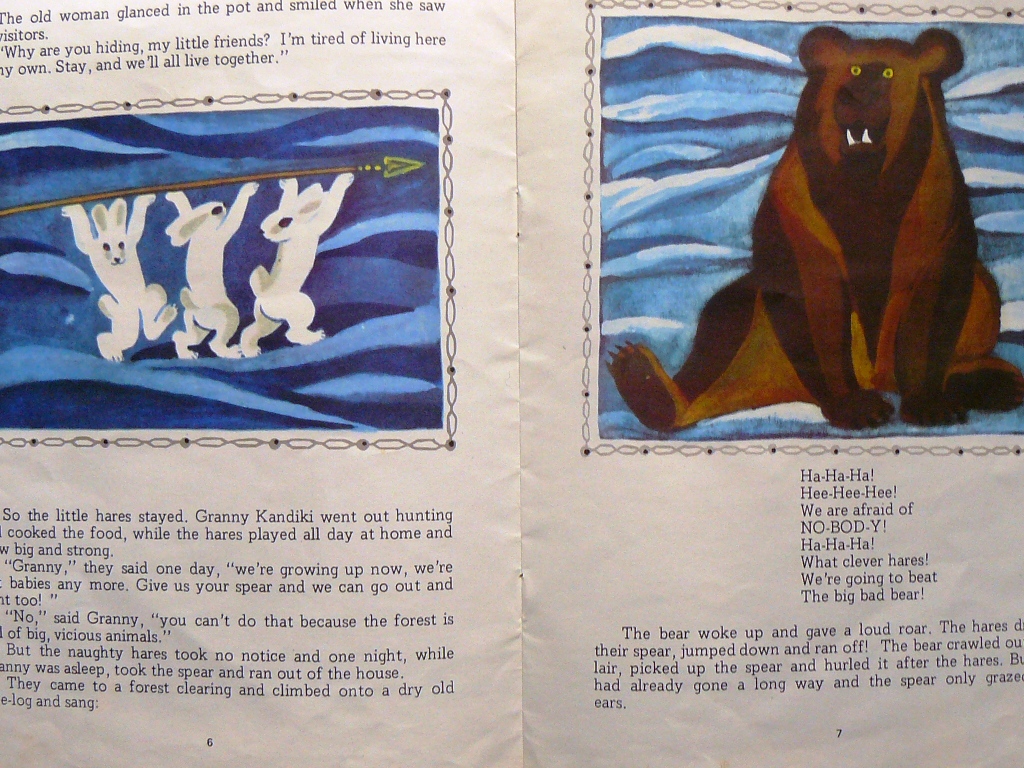
Another of these Soviet books was Life with Granny Kandiki : traditional stories from the far north of Russia, about talking bears, ravens that rescued babies, and why arctic hares have black tips on their ears, amongst other things.

My favourite of the Soviet books was The Brave Ant. Unfortunately I’ve lost this one, it had the grooviest illustrations of them all (think lots of green and tan and lime-yellow, and big loopy-psychedelic pictures of stylised ants). It was also the most propaganda-esque – it was all about the virtues of collectivism and how the ants working together managed to save the ant colony from being washed away by a flood. The ants called each other Comrade.

The Triumph of Jessie and Laura: this was given to my mum for her 10th birthday. It’s one of many in the genre of ‘plucky orphan girl dreams of being ballerina, suffers many setbacks, fate intervenes and makes her A Star!” That genre seems to have completely died – maybe ballet’s not such a popular vehicle for stardom in the age of Australia Idol? Or perhaps orphans aren’t as cool as they used to be? From memory, Jessie was the dancer and Laura wanted to be a writer. Laura also had consumption so spent a lot of time lying about coughing and bravely sacrificing her writerly earnings for ballet shoes instead of spending them on medicine. There was also some sort of wicked uncle and a kindly old anonymous gentleman who married Laura at the end. In fact, this is why the Non-Sexist Children's book was invented.
What were your favourite books as a kid?
*Australian literary trivia #7692: Deborah and Kilmeny Niland are the daughters of writers Ruth Park (The Harp in the South) and D’Arcy Niland (The Shiralee).
Some kids books stay in your mind all your life. Here are some of my favourite books from childhood that I still have (click to embiggen the pictures).

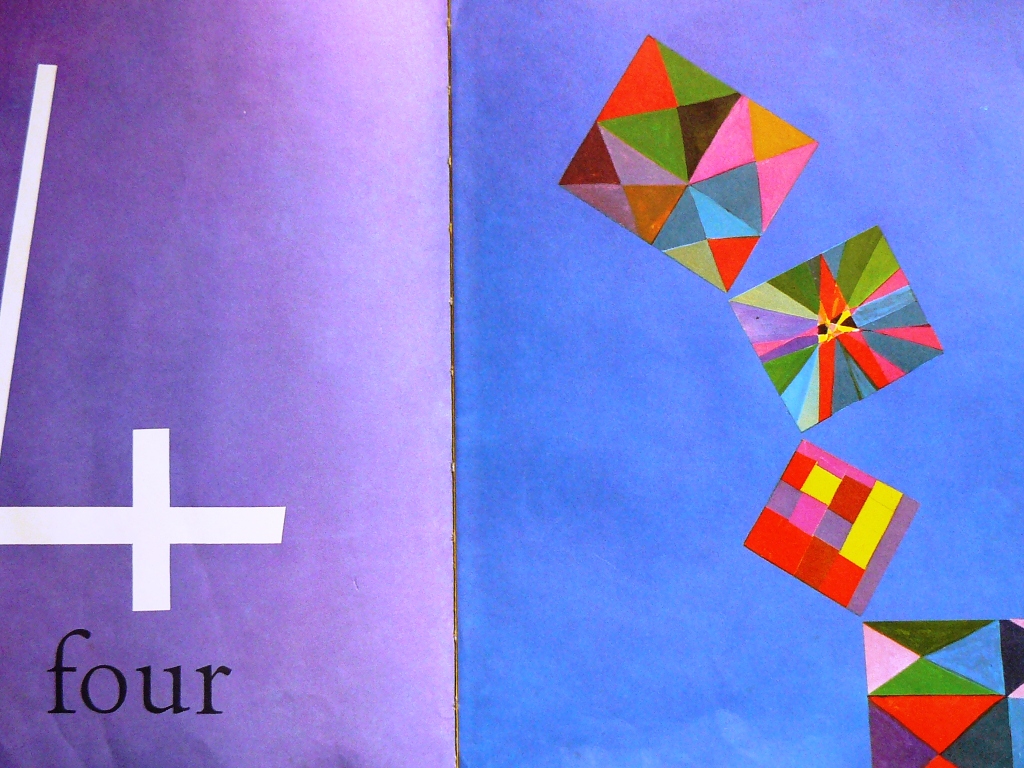

1,2,3: this was actually my brother’s book, but I always loved and still love the graphic design by Brian Wildsmith. The simplicity and the rich colours are beautiful.

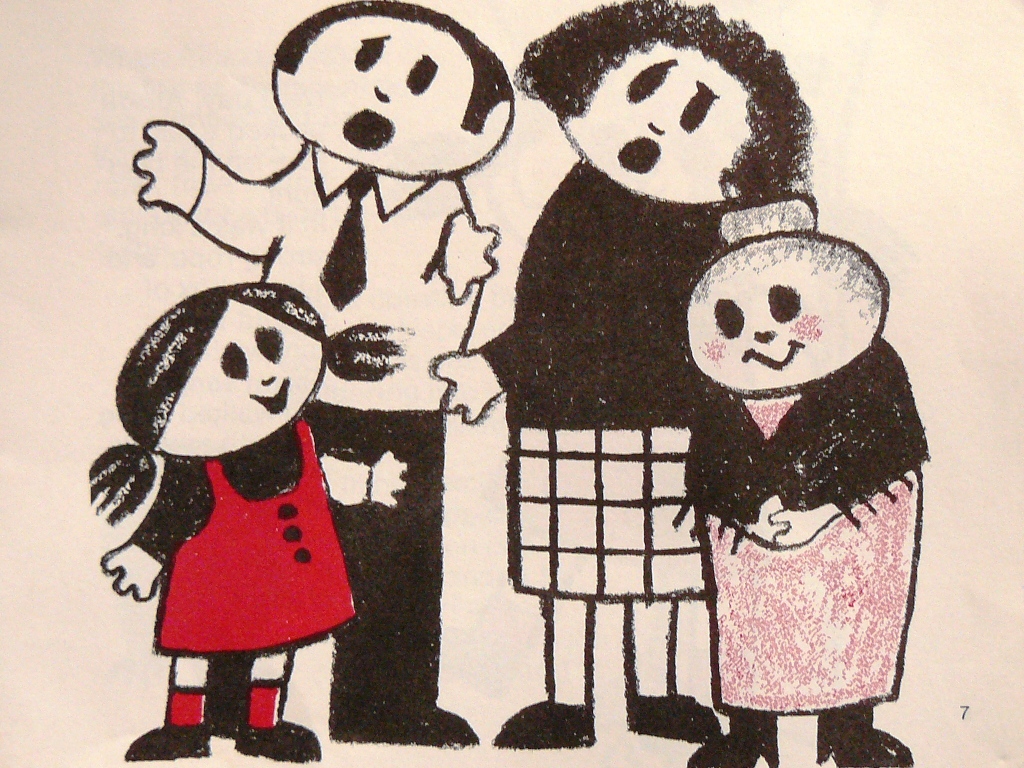

Alison and the Bear: obviously I liked this one because it was about me! Or if not me, another little girl called Alison, who, despite everyone saying she can’t do it, goes out and captures a bear, using only peanut butter sandwiches. It has wonderful simple crayon-y illustrations that are very effective despite being mostly back and white. I only recently noticed that on the back, it notes that “This is a non-sexist children’s book, published by the Women's Movement Children's Literature Co-Operative”. Strange to think there was a time when an effort had to be made (though maybe with princess culture reasserting itself, it’s time for another round).
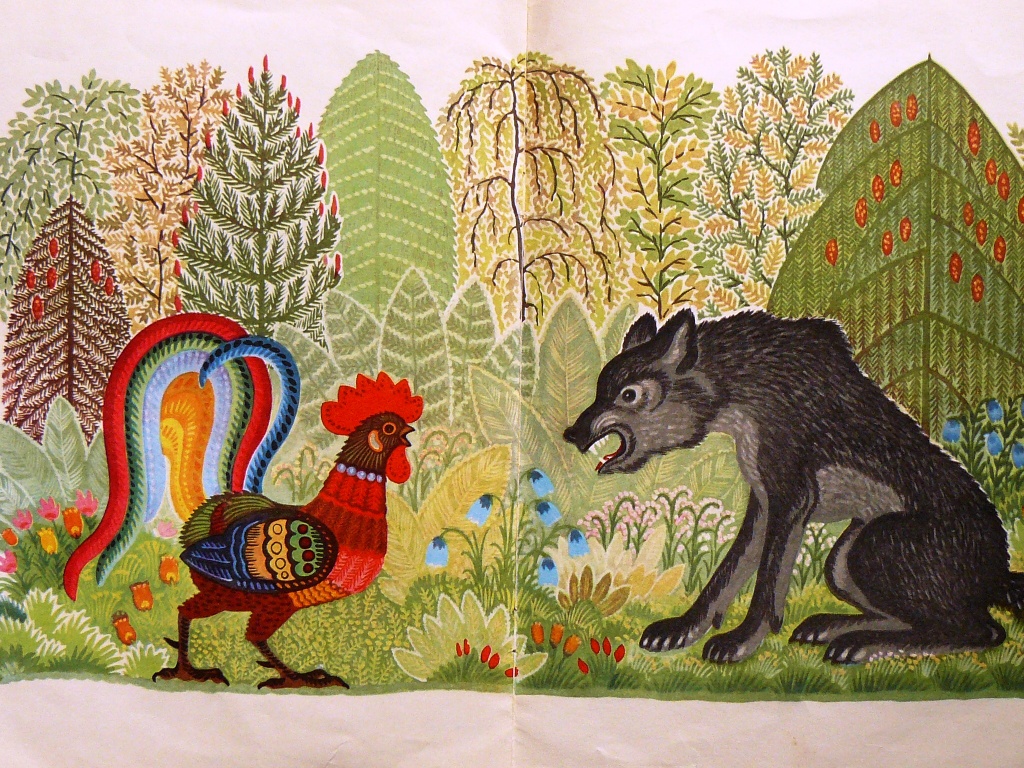


The Cock with the Golden Comb: this was one of four books that I had which were published in the USSR. They were about A4 sized and printed on cheap paper with no covers, and the back page was all in Russian. I have no idea how we got them. The writing was a bit stilted and had the quality of being a literal rather than literary translation. But as you can see, the illustrations were fantastic. The Cock with the Golden Comb one is a retelling of a singing rooster that is able to produce cakes and bread from a magical hand mill, and thereby brings good fortune and plenty to eat to a young brother and sister, and saves them from the wicked tsar.

Another of these Soviet books was Life with Granny Kandiki : traditional stories from the far north of Russia, about talking bears, ravens that rescued babies, and why arctic hares have black tips on their ears, amongst other things.
My favourite of the Soviet books was The Brave Ant. Unfortunately I’ve lost this one, it had the grooviest illustrations of them all (think lots of green and tan and lime-yellow, and big loopy-psychedelic pictures of stylised ants). It was also the most propaganda-esque – it was all about the virtues of collectivism and how the ants working together managed to save the ant colony from being washed away by a flood. The ants called each other Comrade.
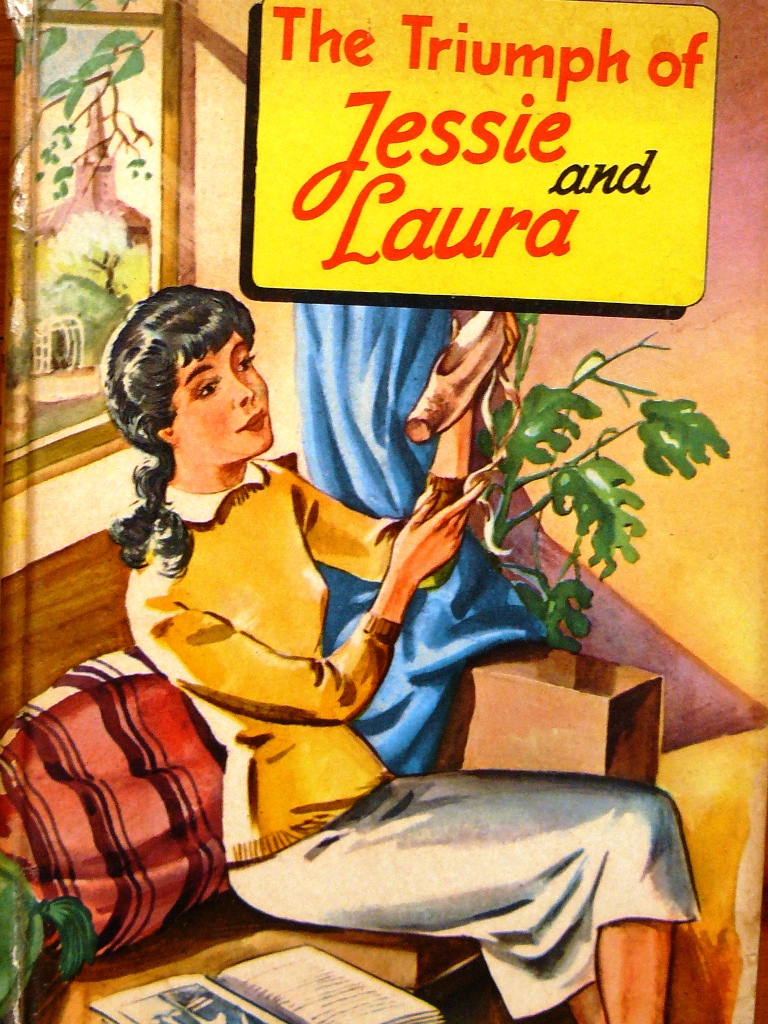
The Triumph of Jessie and Laura: this was given to my mum for her 10th birthday. It’s one of many in the genre of ‘plucky orphan girl dreams of being ballerina, suffers many setbacks, fate intervenes and makes her A Star!” That genre seems to have completely died – maybe ballet’s not such a popular vehicle for stardom in the age of Australia Idol? Or perhaps orphans aren’t as cool as they used to be? From memory, Jessie was the dancer and Laura wanted to be a writer. Laura also had consumption so spent a lot of time lying about coughing and bravely sacrificing her writerly earnings for ballet shoes instead of spending them on medicine. There was also some sort of wicked uncle and a kindly old anonymous gentleman who married Laura at the end. In fact, this is why the Non-Sexist Children's book was invented.
What were your favourite books as a kid?
*Australian literary trivia #7692: Deborah and Kilmeny Niland are the daughters of writers Ruth Park (The Harp in the South) and D’Arcy Niland (The Shiralee).
Friday, March 06, 2009
New book - Expressway
Those of you who are interested in analyzing or critiquing fossil-fuel-
based economies and ecologies may be interested in Sina Queyras's
brand new book EXPRESSWAY. This is a book I heard about on a Canadian list about literature and the environment.
I don't know Sina Queyra's work but it seems like she is a well regarded Canadian postmodern poet who consistently engages with interesting eco-social issues.
And... this book has a trailer! Maybe heaps of books do these days but to be honest I'd never seen one before now. Gotta love the music too - aaah acca dacca.
I think this is her blog.
(NB has mildly disturbing images - maybe steer clear if you've been involved in a horrific auto-accident)
based economies and ecologies may be interested in Sina Queyras's
brand new book EXPRESSWAY. This is a book I heard about on a Canadian list about literature and the environment.
I don't know Sina Queyra's work but it seems like she is a well regarded Canadian postmodern poet who consistently engages with interesting eco-social issues.
And... this book has a trailer! Maybe heaps of books do these days but to be honest I'd never seen one before now. Gotta love the music too - aaah acca dacca.
I think this is her blog.
(NB has mildly disturbing images - maybe steer clear if you've been involved in a horrific auto-accident)
Thursday, March 05, 2009
Well booklub has been progressing while I've been online elsewhere! Thought it might be a good time to do a summary of recent winter reading. Going on Miss J's theme, of the 'accidental book club' the first three are examples, of books that have just floated to me from saying to people (or them saying to me) can you lend me a book? Whatever you can spare, I'm going to cross the ocean so you might not get it back. You don't get really treasured reads that way, but you get sort of zeitgeist, recent stuff and just randoms too. In this way, we have a kind of informal book club among some greenpeace women. Basically a habit we're getting of circulating whatever books we buy amongst three or four chicks, as all of us are somewhat temporary residents in Europe. Then we sometimes talk about them in the pub.
The Reader (now a film with Kate Winslett in an oscar winning role) -Bernard Schillink. (from Cindy) This is a very quick read, quite engaging, and moves from a kind of risque love story from the first-person perspective of a young German school boy, to something else entirely. I think I'd still like to see the film, and my guess is they might tell the narrative in a different order, using flashback, which would be interesting. I found it very poignant and touching towards the end. It contains a sequence where two people have a connection only through letters for a period of time, which was particularly bitter-sweet for me, having experienced that somewhat.
Elizabeth Costello by JM Coetzee. (from the Christian)
Coetzee is very big in Australia I think, and has won a Nobel for literature. This book is more like a collection of long-ish essays, but put into the mouth of this fictional writer, Costello. I think JM is a man, and I generally like it when writers create a character of the opposite gender. In this book, the protagonist has won prestigious awards, and has an international following. In parts it left me a bit cold and thinking "what?, why has this narrative swerved off onto a long and somewhat scholarly discussion of vegetarianism, and what happened to the son who was just there a minute ago?". It's like Coetzee's using this book more as a clever thought-exercise than to convey a real story, and it is stretched a bit thin in some parts. Also, I didn't understand every reference so I got the feeling you just had to be more well read in the classics to really feel satisfied on all levels its operating. Jade, you might enjoy the exploration of ideas about animals and humans and their place in the world, as stand-along pieces - perhaps in extract!
White Tiger by Aravind Adiga (also from Cindy)
Won the Man booker prize last year. Indian writers who show us western culture against and eastern sensibility have been pretty popular (at least on my bookshelf!) for a few years. Zadie Smith's White teeth is one of my favourites and I've also enjoyed Buddha of Suburbia, Hari Kunzru's Transmission, God of Small things, and more. Actually I'm constantly trying to pick books that aren't actually about a middle class, 20th century, white woman or man in US/ UK or Australia. Can be tough at times. This one hasn't left such a lasting impression for me as those ones that come straight to mind. It's pretty bleak, about a guy raised in rural India and his quest to do better for himself, I think he ends up in Mumbai. Most of it is about the lead up to life-changing situation, I would say you could sum it up as an experience of total corruption, that then sets him on the path to being "successful." There's plenty to think about while you're reading, what is success really, what is it like to feel locked into a pre-determined life of obligations and duty. The main character suffers a whole lot of humiliations and defeats in the first part. He holds himself apart from others around himself, always wanting to be above them, incorruptible in a way. There's plenty of sly humour, and it pushes a couple of boundaries, like all good tales. But it's a fairly straightforward book - not sure if I'd put it in the big super-star awards category. But then I don't have to read and pick from the whole shortlist either!
Current: The Eternal Frontier - Tim Flannery (from the discount shop in Amsterdam)
Reading books like this is a bit 'back to my roots' of straight ecology - hundreds of pages of at times almost boring descriptions of waves of animal and plant evolution across the American continent. Tim has a kind of scientific sub-text though.. the growing weight of evidence that arrival of humans can dramatically alter a continent's fauna and environment, through intense hunting. Weirdly this is quite a controversial proposition amongst some circles, and that may be holding us back from actually recognising that we've (cough) -fucked the climate-! Anyway, this one is more a 'straight' monograph so far, on the creation of the plants, animals and people who inhabited America, up to Columbus's arrival in 1492. But throughout all his writing he wants to add the idea that humans can radically alter their environment, they are not just products of it - not so strange really, but somehow anathema to some branches of technology and science. Loving the geeky stuff about paleo-megafauna, also just getting into the section on evolution of cultures too.
Me talk pretty one day - David Sedaris (from the discount shop in Sydney)
Had high hopes for this one, got it second hand, saved it up for the plane ride home. I found his book "Dress your children in corduroy and denim" hilarious and just so 'out there' as he shared the more ridiculous sides of his own up-bringing. This book was written before that one, and was more self-conscious, less laugh-out-loud funny. Still worth a go while travelling, but I wouldn't bother buying if I were you.
The Reader (now a film with Kate Winslett in an oscar winning role) -Bernard Schillink. (from Cindy) This is a very quick read, quite engaging, and moves from a kind of risque love story from the first-person perspective of a young German school boy, to something else entirely. I think I'd still like to see the film, and my guess is they might tell the narrative in a different order, using flashback, which would be interesting. I found it very poignant and touching towards the end. It contains a sequence where two people have a connection only through letters for a period of time, which was particularly bitter-sweet for me, having experienced that somewhat.
Elizabeth Costello by JM Coetzee. (from the Christian)
Coetzee is very big in Australia I think, and has won a Nobel for literature. This book is more like a collection of long-ish essays, but put into the mouth of this fictional writer, Costello. I think JM is a man, and I generally like it when writers create a character of the opposite gender. In this book, the protagonist has won prestigious awards, and has an international following. In parts it left me a bit cold and thinking "what?, why has this narrative swerved off onto a long and somewhat scholarly discussion of vegetarianism, and what happened to the son who was just there a minute ago?". It's like Coetzee's using this book more as a clever thought-exercise than to convey a real story, and it is stretched a bit thin in some parts. Also, I didn't understand every reference so I got the feeling you just had to be more well read in the classics to really feel satisfied on all levels its operating. Jade, you might enjoy the exploration of ideas about animals and humans and their place in the world, as stand-along pieces - perhaps in extract!
White Tiger by Aravind Adiga (also from Cindy)
Won the Man booker prize last year. Indian writers who show us western culture against and eastern sensibility have been pretty popular (at least on my bookshelf!) for a few years. Zadie Smith's White teeth is one of my favourites and I've also enjoyed Buddha of Suburbia, Hari Kunzru's Transmission, God of Small things, and more. Actually I'm constantly trying to pick books that aren't actually about a middle class, 20th century, white woman or man in US/ UK or Australia. Can be tough at times. This one hasn't left such a lasting impression for me as those ones that come straight to mind. It's pretty bleak, about a guy raised in rural India and his quest to do better for himself, I think he ends up in Mumbai. Most of it is about the lead up to life-changing situation, I would say you could sum it up as an experience of total corruption, that then sets him on the path to being "successful." There's plenty to think about while you're reading, what is success really, what is it like to feel locked into a pre-determined life of obligations and duty. The main character suffers a whole lot of humiliations and defeats in the first part. He holds himself apart from others around himself, always wanting to be above them, incorruptible in a way. There's plenty of sly humour, and it pushes a couple of boundaries, like all good tales. But it's a fairly straightforward book - not sure if I'd put it in the big super-star awards category. But then I don't have to read and pick from the whole shortlist either!
Current: The Eternal Frontier - Tim Flannery (from the discount shop in Amsterdam)
Reading books like this is a bit 'back to my roots' of straight ecology - hundreds of pages of at times almost boring descriptions of waves of animal and plant evolution across the American continent. Tim has a kind of scientific sub-text though.. the growing weight of evidence that arrival of humans can dramatically alter a continent's fauna and environment, through intense hunting. Weirdly this is quite a controversial proposition amongst some circles, and that may be holding us back from actually recognising that we've (cough) -fucked the climate-! Anyway, this one is more a 'straight' monograph so far, on the creation of the plants, animals and people who inhabited America, up to Columbus's arrival in 1492. But throughout all his writing he wants to add the idea that humans can radically alter their environment, they are not just products of it - not so strange really, but somehow anathema to some branches of technology and science. Loving the geeky stuff about paleo-megafauna, also just getting into the section on evolution of cultures too.
Me talk pretty one day - David Sedaris (from the discount shop in Sydney)
Had high hopes for this one, got it second hand, saved it up for the plane ride home. I found his book "Dress your children in corduroy and denim" hilarious and just so 'out there' as he shared the more ridiculous sides of his own up-bringing. This book was written before that one, and was more self-conscious, less laugh-out-loud funny. Still worth a go while travelling, but I wouldn't bother buying if I were you.
Thursday, February 26, 2009
Trick or Treatment?
Written by a respected science journalist Simon Singh, and Britain's first professor of complementary medicine, Edzard Ernst, Trick or Treatment: Alternative Medicine on Trial claims to be "the definitive book on alternative medicine... honest, hard-hitting and impartial." I had high hopes.
The book has six chapters, the first of which has a discussion of the scientific method, clinical trials, and evidence-based medicine. This is important to set up the arguments of the next four chapters, each of which looks at the evidence for the efficacy of four branches of alternative medicine: acupuncture, homeopathy, chiropratice, and herbal medicine. Each of these chapters discusses the history of each therapy, how it is administered, and any clinical studies or other evidence of its effectiveness in treating certain conditions. Acupuncture and homeopathy get scathing reviews as being little more than placebos. Chiropractice scores on a few illnesses/conditions, and herbal medicine gets a conditional pass.
The final chapter tries to answer the question does it matter if alternative medicine is effective or ineffective, and then lists the "top ten culprits in the promotion of unproven and disproven medicine": celebrities, medical researchers, universities, alternative gurus, the media (twice), doctors, alternative medicine societies, government and regulators, and the World Health Organisation. There is also a substantial appendix with a short evaluation for each of a long list of alternative therapies (some of which I'd never heard of, which is quite an achievement for someone who lived in Glebe for seven years).
Three of the four therapies chosen for in-depth analysis, according to the authors, have little evidence to show that they are effective (compared to some for which there is more substantial evidence and are only given a short analysis in the appendix). The authors claim they have chosen the four therapies listed above because these are the most widespread - this is probably true in Britain, where homeopathy has been part of the establishment for hundreds of years and is available on the NHS, but probably not true in other countries where the book has been published.
The authors make some good points in the book about the lack of evidence for some alternative medical practice, beyond the placebo; and they also expose how many practitioners have been shown to be unethical in not operating on principles of informed consent, and in failing to keep records of how their patients have been treated, why, and any subsequent ill-effects. Another point they make very strongly is that alternative medicine is a financial rip-off. Again, this is probably more true in the UK, where conventional medicine is free, perhaps not so much in Australia or the US where alternative medicine can be a comparable price or covered by insurance.
I was a bit disappointed by this book. I found the language somewhat sensationalist and biased (in contradiction of its claim to being impartial and honest). The book is preaching to the choir to some extent, and is unlikely to win across any alternative medicine 'believers' to the authors' side. If they want to do that, they need to tone down the rhetoric.
To me, the more interesting question which the book scarcely touched, is not "what" alternative medicine is, but "why". We've never been healthier or lived longer, we've never had a more educated population, yet we are still yearning, it seems, for miracle cures and magic. Maybe that's a question for another book, best answered by a different set of authors.
Trick or Treatment: Alternative Medicine on Trial
Simon Singh and Edzard Ernst
Bantam Press
Cross posted at reading|reading|reading
Tuesday, February 24, 2009
Event: book launch and discussion
Sarah is a friend of a friend of mine and her work is thoughtful and contemporary. Recommend this event, the launch of her new book.
- - -
Sarah Maddison
Black Politics: Inside the complexity of Aboriginal Political Culture
Published by: Allen & Unwin
In conversation with Tom Calma
Thursday, March 12, 2009 / 6.30 for 7pm
Venue: gleebooks, 49 Glebe Point Rd, Glebe
Cost: $10/$7 conc. gleeclub welcome
Drawing on extensive interviews with activists and politicians, Black
Politics explains the dynamics of Aboriginal politics. It reveals the
challenges and tensions that have shaped community, regional and
national relations over the past 25 years.
Why do Aboriginal communities struggle so hard to be heard in
mainstream politics? How do remote and urban communities respond to
frequent dramatic shifts in federal and state Aboriginal policies?
Since the early 1990s Aboriginal Australia has experienced profound
political changes with very real and lasting implications, from the
Mabo land rights case in 1992, to the abolition of the Aboriginal and
Torres Strait Islander Commission (ATSIC) in 2005, to more recent
attempts to reduce the autonomy of remote communities. Sarah Maddison
identifies the tensions that lie at the heart of all Aboriginal
politics, arguing that until Australian governments come to grips with
this complexity they will continue to make bad policy with disastrous
consequences for Aboriginal people.
Based on original interviews with influential Aboriginal leaders
including Mick Dodson, Tom Calma, Alison Anderson, Jackie Huggins,
Warren Mundine and Larissa Behrendt, Black Politics seeks to
understand why Aboriginal communities find it so difficult to be
heard, get support, and organise internally. It also offers some
suggestions for the future, based on the collective wisdom of
political players at all levels of Aboriginal politics.
'Sarah Maddison has brought together a formidable range of Indigenous
voices and sources and placed their narratives within an analysis to
show the depth and complexity of Indigenous cultural and political
expression.' - From the foreword by Pat Dodson
Sarah Maddison is Senior Associate Dean in the Faculty of Arts and
Social Sciences at the University of NSW. She is coeditor of Silencing
Dissent and coauthor of Activist Wisdom.
Mr Tom Calma is Aboriginal and Torres Strait Islander Social Justice
Commissioner and Race Discrimination Commissioner
Mr Calma is an Aboriginal elder from the Kungarakan tribal group and a
member of the Iwaidja tribal group whose traditional lands are south
west of Darwin and on the Coburg Peninsula in Northern Territory,
respectively. He has been involved in Indigenous affairs at a local,
community, state, national and international level and worked in the
public sector for over 35 years.
Mr Calma has broad experience in public administration, particularly
in Indigenous education programs and in developing employment and
training programs for Indigenous people from both a national policy
and program perspective.
- - -
Sarah Maddison
Black Politics: Inside the complexity of Aboriginal Political Culture
Published by: Allen & Unwin
In conversation with Tom Calma
Thursday, March 12, 2009 / 6.30 for 7pm
Venue: gleebooks, 49 Glebe Point Rd, Glebe
Cost: $10/$7 conc. gleeclub welcome
Drawing on extensive interviews with activists and politicians, Black
Politics explains the dynamics of Aboriginal politics. It reveals the
challenges and tensions that have shaped community, regional and
national relations over the past 25 years.
Why do Aboriginal communities struggle so hard to be heard in
mainstream politics? How do remote and urban communities respond to
frequent dramatic shifts in federal and state Aboriginal policies?
Since the early 1990s Aboriginal Australia has experienced profound
political changes with very real and lasting implications, from the
Mabo land rights case in 1992, to the abolition of the Aboriginal and
Torres Strait Islander Commission (ATSIC) in 2005, to more recent
attempts to reduce the autonomy of remote communities. Sarah Maddison
identifies the tensions that lie at the heart of all Aboriginal
politics, arguing that until Australian governments come to grips with
this complexity they will continue to make bad policy with disastrous
consequences for Aboriginal people.
Based on original interviews with influential Aboriginal leaders
including Mick Dodson, Tom Calma, Alison Anderson, Jackie Huggins,
Warren Mundine and Larissa Behrendt, Black Politics seeks to
understand why Aboriginal communities find it so difficult to be
heard, get support, and organise internally. It also offers some
suggestions for the future, based on the collective wisdom of
political players at all levels of Aboriginal politics.
'Sarah Maddison has brought together a formidable range of Indigenous
voices and sources and placed their narratives within an analysis to
show the depth and complexity of Indigenous cultural and political
expression.' - From the foreword by Pat Dodson
Sarah Maddison is Senior Associate Dean in the Faculty of Arts and
Social Sciences at the University of NSW. She is coeditor of Silencing
Dissent and coauthor of Activist Wisdom.
Mr Tom Calma is Aboriginal and Torres Strait Islander Social Justice
Commissioner and Race Discrimination Commissioner
Mr Calma is an Aboriginal elder from the Kungarakan tribal group and a
member of the Iwaidja tribal group whose traditional lands are south
west of Darwin and on the Coburg Peninsula in Northern Territory,
respectively. He has been involved in Indigenous affairs at a local,
community, state, national and international level and worked in the
public sector for over 35 years.
Mr Calma has broad experience in public administration, particularly
in Indigenous education programs and in developing employment and
training programs for Indigenous people from both a national policy
and program perspective.
Sunday, February 15, 2009
Creative Capitalism – A Conversation with Bill Gates, Warren Buffett and other Economic Leaders
Edited by Michael Kinsley
Addressing the World Economic Forum in Davos in 2008, Bill Gates urged business leaders to find new ways to help the world’s most disadvantaged by implementing what he called ‘creative capitalism’. In this book around forty contributors – primarily academics and business journalists – offer various points of view on what exactly creative capitalism might mean and how it might (or might not) work.
Described by editor Michael Kinsley as a “literary experiment”, Creative Capitalism is the product of an online discussion forum (creativecapitalism.typepad.com). Readers need not be discouraged by Kinsley’s introductory remarks about online prose’s dubious reputation for quality. Given the high calibre of the contributors, it is no surprise that the writing is of an excellent standard.
In fact, the blog-to-book experiment works well in more ways than one. Wide-ranging insights are presented in clear, concise contributions averaging just a few pages each. At times there is a lack of cohesion as contributors digress into areas of philosophical and legal principle of special interest. Far more effective are the moments of direct back-and-forth discussion between participants where ideas are developed or refuted in apparent real time.
Readers interested in the issue of corporate social responsibility will find an excellent range of views here but may also be frustrated by the amount of time spent trying to nail down what Gates’s anointed term, ‘creative capitalism’, actually means. Economics commentator Clive Crook highlights the nebulous character of the discussion when he says, “The most frustrating thing about the debate Bill Gates has started is that the term ‘creative capitalism’ is so vague.”
Creative Capitalism’s strength lies in its analysis of the underlying principles and theoretical consequences of corporate social responsibility. To complement this theoretical aspect, more needs to be heard from business people about their real-life successes and failures in the field.
Books of the interior
On Mystic Medusa's blog, there has recently been quite a funny conversation about whether or not one should hide one's more sexually explicit and or self help and or slightly wacko sounding books in the interests of getting a shag. All inspired by MM's experience of reading a profile on a dating site that said something lie “if you are a woman sitting alone in a house with three cats and a pile of self-development books move right along, I am not for you.”
I find the whole thing amusing for several reasons - firstly, I assumed every heterosexual non-wiccan non-RSPCA volunteering non-alternative therapy trained man probably thought something along those lines. I assumed that saying you were reading books on chakra cleansing was the dating equivalent of saying that you live with your elderly parents and sleep in a single bed with fairy print bed linen with your china doll collection, prefer wear elastic waisted skirts pulled up high and like to cut out kitten pictures from women's magazines (no offense to anyone who does those things). Ie slightly batty and very very unsexy. But what would I know. (Note - I do read books on chakra cleansing so I'm not actually passing judgement).
Secondly I think it's funny that there must be heaps of people out there censoring their book collections and trying to figure out what is 'public viewing' material and what gets snuck away in the bedside table. And who says what is embarrassing enough to be hidden away anyway?
On the topic of steamy books - I once had someone comment on the raunchier tomes on my bookshelves at the end of the night as a clunky kind of 'how 'bout it love?', which I thought was disingenuous.
Books as foreplay?
Books as signals of sexual preference and proclivities?
Books as social repellent?
Books as beacons of incompatibility for the internet dater?
I find the whole thing amusing for several reasons - firstly, I assumed every heterosexual non-wiccan non-RSPCA volunteering non-alternative therapy trained man probably thought something along those lines. I assumed that saying you were reading books on chakra cleansing was the dating equivalent of saying that you live with your elderly parents and sleep in a single bed with fairy print bed linen with your china doll collection, prefer wear elastic waisted skirts pulled up high and like to cut out kitten pictures from women's magazines (no offense to anyone who does those things). Ie slightly batty and very very unsexy. But what would I know. (Note - I do read books on chakra cleansing so I'm not actually passing judgement).
Secondly I think it's funny that there must be heaps of people out there censoring their book collections and trying to figure out what is 'public viewing' material and what gets snuck away in the bedside table. And who says what is embarrassing enough to be hidden away anyway?
On the topic of steamy books - I once had someone comment on the raunchier tomes on my bookshelves at the end of the night as a clunky kind of 'how 'bout it love?', which I thought was disingenuous.
Books as foreplay?
Books as signals of sexual preference and proclivities?
Books as social repellent?
Books as beacons of incompatibility for the internet dater?
Saturday, February 14, 2009
Reading Trees
I'm on a list about literature and the environment, and someone recently put out a call for recommendations of texts (books and film) about trees. The following list is compiled from people's responses, and includes photographic works, poetry, prose fiction and essay.
Anderson, William (1990). Green Man : The Archetype of our Oneness with the Earth.
Burroughs, John “Maple Sugar Days” Chap 9 and “Flowering Plants” Chap 10 in John Burroughs’ America.
Calvino, Italo (1957). Le Baron Perché. (The Baron in The Trees) (Il Barone Rampante)
Dean, Barbara (1992). “Hunting a Christmas Tree”. In “Orion” reprinted in Finding
Home.
Ehrenfeld, David (1997). “The Gingko and the Stump” & “Death of the Plastic Palm” (1998), in “Orion” and also collected in (2002). Swimming Lessons : Keeping Afloat in the Age of Technology.
Fowles, John & Frank Horvat (1979) The Tree.
Geisel, Theodor Seuss (1971). The Lorax
Giono, Jean (circa 1953). L’homme qui plantait des arbres. (The Man Who Planted Trees). Also in a 1987 NFB animated film by Frédéric Back.
Harrison, Robert (1992). Forêts : Essai sur l’imaginaire occidental.
Leopold, Aldo (1949). “Good Oak”, in A Sand County Almanac.
Livingston, John (1986). “Some Reflections on Integrated Wildlife and Forest Management”, The Trumpeter, 3(3)
Nolley, Lance & Berman, Ted (1958). Paul Bunyan. Disney short animated film.
Pyle, Robert Michael (1993). The Thunder Tree.
Rogers, Patiann (1999). “Places within Places” in The Dream of the Marsh Wren.
Sanders, Scott Russell (1993). “Earth’s Body” in Staying Put : Making a Home in a Restless World.
Sanders, Scott Russell (2000). “Heartwood” and “Wood Work” in The Force of Moving
Spirit.
Savard, Rémi (2004). La forêt vive: Récits fondateurs du peuple innu.
Stone, Christopher (1972). Should Trees Have Standing : Toward Legal Rights for Natural Objects.
Terpstra, John (1990) Naked Trees.
Yahgulanass, Michael Nicoll (). The Flight of the Hummingbird.
Anderson, William (1990). Green Man : The Archetype of our Oneness with the Earth.
Burroughs, John “Maple Sugar Days” Chap 9 and “Flowering Plants” Chap 10 in John Burroughs’ America.
Calvino, Italo (1957). Le Baron Perché. (The Baron in The Trees) (Il Barone Rampante)
Dean, Barbara (1992). “Hunting a Christmas Tree”. In “Orion” reprinted in Finding
Home.
Ehrenfeld, David (1997). “The Gingko and the Stump” & “Death of the Plastic Palm” (1998), in “Orion” and also collected in (2002). Swimming Lessons : Keeping Afloat in the Age of Technology.
Fowles, John & Frank Horvat (1979) The Tree.
Geisel, Theodor Seuss (1971). The Lorax
Giono, Jean (circa 1953). L’homme qui plantait des arbres. (The Man Who Planted Trees). Also in a 1987 NFB animated film by Frédéric Back.
Harrison, Robert (1992). Forêts : Essai sur l’imaginaire occidental.
Leopold, Aldo (1949). “Good Oak”, in A Sand County Almanac.
Livingston, John (1986). “Some Reflections on Integrated Wildlife and Forest Management”, The Trumpeter, 3(3)
Nolley, Lance & Berman, Ted (1958). Paul Bunyan. Disney short animated film.
Pyle, Robert Michael (1993). The Thunder Tree.
Rogers, Patiann (1999). “Places within Places” in The Dream of the Marsh Wren.
Sanders, Scott Russell (1993). “Earth’s Body” in Staying Put : Making a Home in a Restless World.
Sanders, Scott Russell (2000). “Heartwood” and “Wood Work” in The Force of Moving
Spirit.
Savard, Rémi (2004). La forêt vive: Récits fondateurs du peuple innu.
Stone, Christopher (1972). Should Trees Have Standing : Toward Legal Rights for Natural Objects.
Terpstra, John (1990) Naked Trees.
Yahgulanass, Michael Nicoll (). The Flight of the Hummingbird.
Thursday, February 12, 2009
Book swaps with strangers
Just a quick little reflection on the quirky and cute phenomenon of casual bookswaps in public places.
I'd actually kind of forgotten, but the suburb I'm staying in at the moment house sitting has a train station waiting room in which there is a humble little pile of best sellers that people pick up and read and drop back / replenish with their speedily thumbed adventuresome light Christmas reading.
And at a cafe a few towns away there is another very humble couple of shelves on an unassuming bookshelf that says - feel free to take and read or leave books here. What I extra extra love is the complete weird mix of titles in this one - from self help books to drab little house and garden related non fiction to airport novels to hard cover classics. I also extra extra love that the store of books remains constant - that at least in this part of the world, in these shelves, people give as much as they take. Which makes me muse that maybe this is actually the case on average everywhere but we just forget the half full bit sometimes, and we also forget that people are generous and community minded and don't always need strict rules of give and take for things to work well.
And yes - I have taken and read two this week - a story of a woman's family upheaval and reformation (sweet, a bit too true life tales for my taste but bearable) and a sassy funny chick lit 'detective novel' (of sorts - actually she's a lawyer but the template and characters are the same style). So yes, it's not adding much in the way of fibre and nutrients for my reading diet - but sometimes junk food is called for. And no I haven't actually made a deposit yet, because I'm housesitting and don't have old novels with me - but thought I'd return each of the books to the other book swap location, at least to keep things circulating freshly.
Anyone got one of these near where they live?
I'd actually kind of forgotten, but the suburb I'm staying in at the moment house sitting has a train station waiting room in which there is a humble little pile of best sellers that people pick up and read and drop back / replenish with their speedily thumbed adventuresome light Christmas reading.
And at a cafe a few towns away there is another very humble couple of shelves on an unassuming bookshelf that says - feel free to take and read or leave books here. What I extra extra love is the complete weird mix of titles in this one - from self help books to drab little house and garden related non fiction to airport novels to hard cover classics. I also extra extra love that the store of books remains constant - that at least in this part of the world, in these shelves, people give as much as they take. Which makes me muse that maybe this is actually the case on average everywhere but we just forget the half full bit sometimes, and we also forget that people are generous and community minded and don't always need strict rules of give and take for things to work well.
And yes - I have taken and read two this week - a story of a woman's family upheaval and reformation (sweet, a bit too true life tales for my taste but bearable) and a sassy funny chick lit 'detective novel' (of sorts - actually she's a lawyer but the template and characters are the same style). So yes, it's not adding much in the way of fibre and nutrients for my reading diet - but sometimes junk food is called for. And no I haven't actually made a deposit yet, because I'm housesitting and don't have old novels with me - but thought I'd return each of the books to the other book swap location, at least to keep things circulating freshly.
Anyone got one of these near where they live?
Saturday, January 31, 2009
Fear of Flying – Erica Jong
Vintage 2004, First Published 1973
I read this, about a year ago, and really quite enjoyed it. I know it’s old, it’s probably on feminism 101 reading lists, but I liked the tone- Isadora the main character is smart and reflective and wry and horny and wondering. She makes mistakes, she has phobias, and she has a patchy history in love, but I liked her heaps. Nice to read a female lead who is neither simpering nor brittle nor simple nor ‘sweet’ nor completely 2 dimensional. Isadora is a proper gutsy likeable flawed story hero. Even though I’m too lazy to write a review right now, I thought these quotes were interesting. AQsthe main character is a writer (poet) quite a bit of the book relates to this. The first quote is a character in the book speaking to Isadora Wing, the last two quotes are Isadora herself.
The writer being accused as using lovers as material:“You go through life looking for a teacher and then when you find him, you become so dependant on him that you grow to hate him. Or else you wait for him to show his weaknesses and then you despise him for being human. You sit there the whole time keeping tabs, making mental notes, imagining people as books or case histories – I know that game. You tell yourself you’re collecting material. You tell yourself you’re studying human nature. Art above life at all times. Another version of that puritanical bullshit. Only you have a new twist to it. You think you’re a hedonist because you take off and run around with me. But it’s the bloody old work ethic all the same because you’re only thinking you’ll write about me. So it’s actually work, c’est-ce pas? You can fuck me and call it poetry. Pretty clever. You deceive yourself beautifully that way.”
The voracious and open minded reader:“I had always worshipped authors. I used to kiss their pictures on the back of books when I finished reading. I regarded anything printed as a holy relic and authors as creatures of superhuman knowledge and wit. Pearl Buck, Tolstoy, or Carolyn Keene, the author of Nancy Drew. I made none of the snotty divisions you learn to make later. I could happily go from Great Expectations or the Secret Garden to Mad Magazine.”
Books as refuge:“Growing up in my chaotic household, I quickly learnt that a book carefully arranged in front of your face was a bulletproof shield, an asbestos wall, a cloak of invisibility. I learned to take refuge behind books, to become, as my mother and father called me, “the absent-minded professor.” They screamed at me, but I couldn’t hear. I was reading. I was writing. I was safe.”
I read this, about a year ago, and really quite enjoyed it. I know it’s old, it’s probably on feminism 101 reading lists, but I liked the tone- Isadora the main character is smart and reflective and wry and horny and wondering. She makes mistakes, she has phobias, and she has a patchy history in love, but I liked her heaps. Nice to read a female lead who is neither simpering nor brittle nor simple nor ‘sweet’ nor completely 2 dimensional. Isadora is a proper gutsy likeable flawed story hero. Even though I’m too lazy to write a review right now, I thought these quotes were interesting. AQsthe main character is a writer (poet) quite a bit of the book relates to this. The first quote is a character in the book speaking to Isadora Wing, the last two quotes are Isadora herself.
The writer being accused as using lovers as material:“You go through life looking for a teacher and then when you find him, you become so dependant on him that you grow to hate him. Or else you wait for him to show his weaknesses and then you despise him for being human. You sit there the whole time keeping tabs, making mental notes, imagining people as books or case histories – I know that game. You tell yourself you’re collecting material. You tell yourself you’re studying human nature. Art above life at all times. Another version of that puritanical bullshit. Only you have a new twist to it. You think you’re a hedonist because you take off and run around with me. But it’s the bloody old work ethic all the same because you’re only thinking you’ll write about me. So it’s actually work, c’est-ce pas? You can fuck me and call it poetry. Pretty clever. You deceive yourself beautifully that way.”
The voracious and open minded reader:“I had always worshipped authors. I used to kiss their pictures on the back of books when I finished reading. I regarded anything printed as a holy relic and authors as creatures of superhuman knowledge and wit. Pearl Buck, Tolstoy, or Carolyn Keene, the author of Nancy Drew. I made none of the snotty divisions you learn to make later. I could happily go from Great Expectations or the Secret Garden to Mad Magazine.”
Books as refuge:“Growing up in my chaotic household, I quickly learnt that a book carefully arranged in front of your face was a bulletproof shield, an asbestos wall, a cloak of invisibility. I learned to take refuge behind books, to become, as my mother and father called me, “the absent-minded professor.” They screamed at me, but I couldn’t hear. I was reading. I was writing. I was safe.”
Eco-spair, Eco-ire and Eco-rony
Ali has written a great review of the graphic novel As the World Burns, a book which I thoroughly enjoyed, even as it made me despair a bit as I read it. It’s really nice to be in a space where we are exploring ecoearnestness, post-incremental light bulb change and also ecovangelism, in a book that is available in big chain book stores. I agree with you Ali that they did a great job of having a go at almost everyone, but in a way that highlights the ridiculous in our behaviour and personal motivations, rather than just for cheap gags.
I guess the premise of the book is pretty clear – what the fuck are we doing toadying up to big business and mediocre government officials with strong vested interest in the status quo, what are we doing thinking that the tiny household gestures are making deep, significant cultural change from crass/mass consumerism – and why on earth do we think it is nearly enough or nearly fast enough? It portrays the voice of animals, and the tress, and climate – very ‘Council of all Beings’ style for those familiar with some of the Deep Ecology group processes – and to my mind a conspicuously absent viewpoint in all our collective posturings about environmental ‘issues’. I loved having animals as characters in this book. I love the dynamic between the idealistic and earnest dark haired character who tries hard to engage with popular rhetoric about the ‘household actions’ and do her bit; and her friend, the more radical, ‘throw down the system coz it’s intrinsically skewed towards environmental disaster’, but patient, friend. The rabbits from outer space come to suck down on the earth’s resources was a nice device to add a touch of useful exaggeration, sci fi style cultural realism once removed. The graphics were good – clear and engaging – cute even at times. Actually quite touching even in the panels without text. Despite being bleak in parts like any good satire it remains hopeful, utopian dreamy even. This would be a great book club book (for all you folk in face to face book clubs), or great coffee table/ lend to a bunch of friends book. Recommended.
I guess the premise of the book is pretty clear – what the fuck are we doing toadying up to big business and mediocre government officials with strong vested interest in the status quo, what are we doing thinking that the tiny household gestures are making deep, significant cultural change from crass/mass consumerism – and why on earth do we think it is nearly enough or nearly fast enough? It portrays the voice of animals, and the tress, and climate – very ‘Council of all Beings’ style for those familiar with some of the Deep Ecology group processes – and to my mind a conspicuously absent viewpoint in all our collective posturings about environmental ‘issues’. I loved having animals as characters in this book. I love the dynamic between the idealistic and earnest dark haired character who tries hard to engage with popular rhetoric about the ‘household actions’ and do her bit; and her friend, the more radical, ‘throw down the system coz it’s intrinsically skewed towards environmental disaster’, but patient, friend. The rabbits from outer space come to suck down on the earth’s resources was a nice device to add a touch of useful exaggeration, sci fi style cultural realism once removed. The graphics were good – clear and engaging – cute even at times. Actually quite touching even in the panels without text. Despite being bleak in parts like any good satire it remains hopeful, utopian dreamy even. This would be a great book club book (for all you folk in face to face book clubs), or great coffee table/ lend to a bunch of friends book. Recommended.
Wednesday, January 14, 2009
As the World Burns
As the World Burns is a wickedly funny satire on environmental policy and environmental activism, served up as a graphic novel. Three story-lines are interwoven with vignettes skewering hippies, activist groups, the media and Al Gore, culminating in a great bloody battle to save the world. Two little girls debate whether personal action is useful or a distraction from fighting institutional environmental vandalism. A one-eyed 'terrorist' rabbit saves his friends from an animal testing lab, and blows it up. And aliens that shit gold invade the planet and proceed to eat it, aided by the President of the United States.
Some of my favourite moments from this book were:
- the little girl rocking back and forth and chanting "oh God, we will go quietly to our doom if only you allow us to believe that changing our lightbulbs will save us"
- a hippy who refuses to join the battle to save the world, because "that would be violent" and instead stays home to plant his peace garden
- the same hippy trying to convince a fox to become a vegan
- a TV panel debate about terrorist rabbits, which is a perfect mirror for every TV panel debate you've ever seen about terrorism, except the word 'rabbit' is substituted for 'terrorist'
- an activist group wildly celebrating the number of celebrities who have signed their petition while aliens devour the world around them
I really liked the way the story had a go at everyone, not just one group. Ultimately, I think the book asks you to consider why you do what you do. Do you take personal action to save the world or to save your conscience? Are you fighting the right battles? Should institutions be part of the solution or are they only part of the problem?
Anyone who's ever run an awareness campaign, worked in policy, slung a banner over a bridge, had an interest in politics and society, or thrown a copy of G Magazine across the room will find something to laugh at, and think about, in this book. Even environmental sceptics should enjoy having their prejudices confirmed with a touch of humour. I'd be interested in opinions from seagreen, fergus and amberino?
As the World Burns
Derrick Jensen (author) and Stephanie McMillan (Illustrator)
Seven Stories Press
I got my copy at Kinokuniya
Crossposted at reading|reading|reading
Thursday, January 01, 2009
The Guernsey Literary and Potato Peel Pie Society
Read The Guernsey Literary and Potato Peel Pie Society - by Mary Ann Shaffer - while on holidays. It's a quick read - those with a bit of time could knock it off in half a day. I arrived at my inlaws with nothing to read (oh no!), but luckily, my mother-in-law the school librarian had this book on hand - she had to review it to see how appropriate it was for her school library.
I loved this book. It made me giggle, and it made me cry. It transported me to a different time and place I hadn't thought of (post-war England, and War time in the Channel Islands. I seem to be a sucker for WW2 stuff - fiction or non-fiction, Pacific or Europe. Don't know why - not the most uplifting of topics, I know.
Basically, it's about a writer who has a war time column in a London paper, who has had these published as a book, and is now struggling to find a topic for her second book. By chance, she is written to by someone on Guernsey, who has come across a second-hand book that has her address written inside the cover, and given Guernsey has no book shops, the gentleman asks her to find a book about the author of this book, as he is interested in finding out more.
This kicks off a correspondence between him and her, and soon a community of people on Guernsey, who had formed a literary society during German occupation. There are also letters back and forth between her, her editor and her best friend.
Highly recommended.
I loved this book. It made me giggle, and it made me cry. It transported me to a different time and place I hadn't thought of (post-war England, and War time in the Channel Islands. I seem to be a sucker for WW2 stuff - fiction or non-fiction, Pacific or Europe. Don't know why - not the most uplifting of topics, I know.
Basically, it's about a writer who has a war time column in a London paper, who has had these published as a book, and is now struggling to find a topic for her second book. By chance, she is written to by someone on Guernsey, who has come across a second-hand book that has her address written inside the cover, and given Guernsey has no book shops, the gentleman asks her to find a book about the author of this book, as he is interested in finding out more.
This kicks off a correspondence between him and her, and soon a community of people on Guernsey, who had formed a literary society during German occupation. There are also letters back and forth between her, her editor and her best friend.
Highly recommended.
Sunday, October 05, 2008
Judging a book by


This cafe was in Port Douglas, near Cairns* and had one half bookshop (new - lots of coffee table books, as well as fiction), and one half cafe (nice coffee, good open frontage to let breeze in). I quite liked the coffee and the timber and slightly down at heel but colourful furnishings.
What I also liked about it was that it had a display of 'book cover art' - little handmade posters with text and images stuck on it, telling the story of famous books, and who designed and created their covers. I think this is a really interesting element of books, that we often don't know about. I can barely name one single book cover illustrator, and yet we are drawn to the art of books, when remember a book we sometimes remember the image of the cover. Very interesting.
* (in Qld, Australia)
Thursday, September 25, 2008
Back with nose in book...
Seems it has been ages since I've had the time or energy (?) to get into a book, but recently I was sick, spent a large part of a day in bed, and I have had a nose in a book of some kind ever since! Yihar! Doesn't leave me with the same feeling of wasted time that I get when I sit in front of the telly.
1) Spook Country - William Gibson
While I always find William Gibson writes well and about interesting, different subjects, this novel lost me a bit. The art scene in this novel involves geo-hacking - where people hack into coordinates on GPS's and put in things that aren't there, but if you are wearing a helmet (virtual reality style?), you can see their artwork - eg an image of River Phoenix's body lying on the spot where he actually died. This was written in his frequently used style with 3-4 converging storylines, written in turns in different chapters. There were bits where the writing just got bogged down, I felt, where the author described in detail things that I just couldn't picture, so I ended up skimming through paragraphs.
But still, Gibson's writing was noticably superior and easier to read than the book I had been reading prior to this. If you are thinking of reading a Gibson novel, I'd try "Pattern Recognition" (his last novel) instead.
3 out of 5 stars
2) Raising Boys - Steve Biddulph
While I never take these books too literally, and this has slighly dumbed-down case studies just like many self-help/pop psychology books, this book provides food for thought. Discusses stages of boyhood, importance of role models (parents or other, female or male), testosterone levels and how they fluctuate throughout childhood and its effect amongst other things. Good for helping me to think from my son's perspective, and it may just be a book I drag out again when he approaches teenagerhood...
3) Also read "T is for Trespass". Easy to read, and good to get through on a single rainy day - nuff said.
1) Spook Country - William Gibson
While I always find William Gibson writes well and about interesting, different subjects, this novel lost me a bit. The art scene in this novel involves geo-hacking - where people hack into coordinates on GPS's and put in things that aren't there, but if you are wearing a helmet (virtual reality style?), you can see their artwork - eg an image of River Phoenix's body lying on the spot where he actually died. This was written in his frequently used style with 3-4 converging storylines, written in turns in different chapters. There were bits where the writing just got bogged down, I felt, where the author described in detail things that I just couldn't picture, so I ended up skimming through paragraphs.
But still, Gibson's writing was noticably superior and easier to read than the book I had been reading prior to this. If you are thinking of reading a Gibson novel, I'd try "Pattern Recognition" (his last novel) instead.
3 out of 5 stars
2) Raising Boys - Steve Biddulph
While I never take these books too literally, and this has slighly dumbed-down case studies just like many self-help/pop psychology books, this book provides food for thought. Discusses stages of boyhood, importance of role models (parents or other, female or male), testosterone levels and how they fluctuate throughout childhood and its effect amongst other things. Good for helping me to think from my son's perspective, and it may just be a book I drag out again when he approaches teenagerhood...
3) Also read "T is for Trespass". Easy to read, and good to get through on a single rainy day - nuff said.
Wednesday, September 17, 2008
Like books? Wants to help kids help kids read?
Become a student2student Mentor Supervisor
The Smith Family's student2student program is aimed at increasing students reading skills. It matches students from Years 3 to 8 who are behind in their reading skills with older student mentors from a different school who have high literacy skills and have been trained to support the reading development of others. Since student mentors do not have the skills of a teacher, we are aiming to create a network of (adult) mentor supervisors who can support and encourage these student mentors. Each mentor supervisor is assigned to approximately 10 student mentors and supports them through fortnightly phone calls for the 18 week program duration between May and September. From October/November 2008 we will be starting our recruitment for Mentor Supervisor volunteers for the 2009 programs, so if you are interested please contact Warunee Nuij on Tel. 02 9895 1205 or warunee.nuij@thesmithfamily.com.au during this time.
NSW, Australia
The Smith Family's student2student program is aimed at increasing students reading skills. It matches students from Years 3 to 8 who are behind in their reading skills with older student mentors from a different school who have high literacy skills and have been trained to support the reading development of others. Since student mentors do not have the skills of a teacher, we are aiming to create a network of (adult) mentor supervisors who can support and encourage these student mentors. Each mentor supervisor is assigned to approximately 10 student mentors and supports them through fortnightly phone calls for the 18 week program duration between May and September. From October/November 2008 we will be starting our recruitment for Mentor Supervisor volunteers for the 2009 programs, so if you are interested please contact Warunee Nuij on Tel. 02 9895 1205 or warunee.nuij@thesmithfamily.com.au during this time.
NSW, Australia
Saturday, August 09, 2008
Reading this and loving it
I don't know about you but I just love a well written reference book! This one is a great intro to arts therapies for someone who wants an overview of the different philosophical/psychological foundations, and practical applications of arts therapies, in each of the areas of art (visual art) therapy, music therapy, dance therapy, drama therapy etc (I think that's it actually, from memory but I haven't finished it so I might be missing something). It is written in an accessible style, each chapter writen about one of the types of arts therapy (music, etc) by an author who works in the field. Each chapter acts as an overview, introducing the historical origins of the artforms use in western psychological/therapeutic practice, the various schools or approaches, the various applications, and typically drawns on some case studies or examples to ilustrate the potential effects of the theraputic approach at hand. So I like the book because it is clear and well structured (ooh I do like some god structure) but also because the stories are so heartwarming. To me, it makes a compelling case of the value of arts therapies, especially in the many situations where people aren't able to access 'talking cures', and where connection and expression are paramount to a person's healing / restoring wellbeing. For example in the chapter on music therapy they talk about a case study where a man went into neonatal wards to play classial/improvised music to accomodate and work with the (high levels of) background noise on the ward, and how he concentrated on extending calm and support and love for the staff and for the babies the staff were caring for. The staff were interviewed before and after about noise and stress and the intervention was found to successfully reduce stress levels on the ward. Other examples of music intervientions for premature babies suggest that the rhythmic quality of some music encourages very premature babies to suckle, when they have trouble doing this. Also in the chapter on music therapy was an example where a therapist worked with an elderly lady with dimentia and schizophrenia who had for a long time been living homeless and very isolated from contact with people. At the time of the music therapy she was in care but did not speak and was very non-responsive. Through a series of music therapy sessions the therapist used old songs and snippets of songs with her native language in it, as well as mirrorring the woman's tapping motions, encouraging her to sing along. The woman smiled, and sometimes sang along and even made comments, as the therapy progressed. I got all teary reading this book at several of these types of stories, which seemed to be about therapists offering such a lovely gesture of care. The tone also appeals to me, as the styles described are generally less dogmatic and rigorously 'scientific' than some of the more cognitive approaches to therapy (noting of course that these therapies are used within many different paradigms of care, for example visual arts therapies can be used in combination with CBT to help identify responses and alternative responses), and is very open about the central role of the therapist and their emotional connection with the patient.
I like the approach because it seems to work on many levels - physical, cognitive, emotional, and can offer many pathways for the 'patient' (and therapist) to transform. there also seem to be lots of examples of efective arts therapies working with traumatised children/adults, developmentally delayed children/adults etc. Anyway, that's just my top of head recollection, without the book here to quote to you from, but if you're interested in this general topic, it would probably be a useful reference book or an introductory read which will point you to other texts that might be useful for the specific areas you're interested in.

I like the approach because it seems to work on many levels - physical, cognitive, emotional, and can offer many pathways for the 'patient' (and therapist) to transform. there also seem to be lots of examples of efective arts therapies working with traumatised children/adults, developmentally delayed children/adults etc. Anyway, that's just my top of head recollection, without the book here to quote to you from, but if you're interested in this general topic, it would probably be a useful reference book or an introductory read which will point you to other texts that might be useful for the specific areas you're interested in.

Wednesday, July 30, 2008
My new books


So what did I buy at the book shop?
‘Nature and Art’ by Elizabeth Inchbald, edited by Shawn Lisa Maurer (based on the second edition published in 1797). Another female writer I’d never heard of! Am really starting to get the shits with the vast array of amazing voices that I’ve never had the chance to read because their work and gender didn’t fit the pattern of what society deemed to be appropriate and their names and works haven’t been added to the commonly bandied about list of ‘Great Authors who had something important to say and who you really must read’. More on that later – I feel a rant coming on, but for now, just to say that the story of this women’s life really interested me and this book – looking at the prejudices of education, the artifice (‘art’) of contemporary western society, class and gender constructions through a story of two cousins brought up in different ways. Apparently the work is quite utopian in it’s vision of a potential classless future, where people value people more than status, and is in keeping with some of the other philosophical and social movements of its time. I think it’s even more interesting to read a work about outsider perspectives on culture written by someone who has lived that experience – which I think a single woman supporting her family through writing, in the late 1700’s can be said to have had. The author wrote many dramatic pieces, and several novels, and supported herself through her writing and acting before and after her brief marriage, as well as supporting her sisters. Aah all this I get just from the introduction to the novel. I’ll write some more when I read the actual book!
“Scotttsboro Alabama – a story in linoleum cuts” by Lin Shi Khan and Tony Perez Edited by Andrew Lee. New York University Press.
[Please note that this review refers to violent death, racism and other yucky stuff]
This book is a reproduction of some very striking original artworks that were made as narrative and political statement in the 1930’s in response to the arrest of nine African American boys and young men (aged 13 to 19) accused of raping 2 white women on a freight train, the subsequent court case and the different responses by the public. It’s mostly pictures. Each page is an image and a small amount of text, also created through lino-cut. Narrated in the present tense, each page charts a moment in history or key element of the story (“the boss uses every means to keep the negro separate from the white”), and has very strong images, caricatures, symbols, and are almost cartoon-like in their directness and emotion – lots of. It has with it a new foreword, a new introduction, and the original foreword that came out when the prints were produced as a (self published) volume prior to 1935.
I bought this book for a few reasons. Firstly because I’m interested in text-image interplay in story telling, and am gradually collecting an interesting collection of books that use words and pictures together to tell stories. This is one of the earliest examples I’ve seen of the graphic novel format used to make a strong political statement – I found that really exciting (noting that I’m by no means an expert and maybe there are heaps of examples, and I’ve just not come across them in my wanderings yet).
Secondly because I’m interested in lino-cuts and relief printmaking in general. Partly because they are so primal and direct, and have been an accessible/affordable form of mark making compared to things like oil painting, and so have been used to express political views and experiences of the less privileged. Partly just coz I like them – because I think they’re tricky and back to fronty and can use a simple technique to make complex or simple images. I like to get books that have examples of different ways of using the medium, because I think I’d like to teach again one day, and find that using books with examples of work are a lovely, low key way to demonstrate different techniques, styles and applications.
But I was also interested in the story – I’d never heard of the trial, and as I flicked through the introduction it seemed like quite a significant event and quite an interesting moment in history. It seems like the trade union (ILD – International Labour Defence) was really involved in responding and defending the accused, and that many saw the event as being a way to divide the black and white workers, to dissolve solidarity amongst workers. In this way the case also became symbolic of the uprising of workers against unfair bosses and the powers systems of the wealthy.
“The Scottsboro case became one of the key episodes in the history of race and civil rights in America. It wasn’t the legal manoeuvrings of the defence counsel or the actions of the defendants that invested this particular case with such historical importance. Rather the ILD and their supporters brought this injustice before the world. Maintaining that a fair and impartial trial was impossible under white supremacy, the ILD publicized the case widely in order to expose Southern “justice” and pressure the Alabama legal system to free the nine defendants. Protests erupted throughout the country and as far away as Paris, Moscow, and South Africa, and the governor of Alabama was bombarded with telegrams, postcards, and letters demanding the immediate release of the Scottsboro Boys…And although the “Scottsboro Boys” themselves never identified with the Party’s goals, they became cultural symbols on the left – the subject of poems, songs, plays, and short stories that were published, circulated and performed around the world.
It took place in that period after the Civil War and slavery had been abolished but before segregation had been abolished – the story charts the realities of African Americans trying to find work and still being victimised, discriminated against and lynched around the time of this trial. It’s hard to imagine that this was all happening at the time my Grandparents were kids. That it’s within living memory.* And for some reason this particular time and place in history really resonates with me – maybe it’s that I’ve read other things that explore these experiences (Toni Morrison, Alice Walker, Sojourner Truth) and that some of the music I love most comes from the mouths of Billie Holiday and Bessie Smith.
Many of the images refer to lynchings and deliberately draw no distinction between mob lynching and the court case and sentencing of death to all but the youngest of the 9 boys. The foreword talks about this, explaining that at that time, there seemed to be very little difference:
(Notes from the editor on use of the word lynching):
“the usage at that time, at least among African American and leftist activists, consistently did not distinguish between a court-sanctioned execution and a mob execution. In my youth I was told about one such lynching that occurred just before the Democratic National Convention in 1928, when the man who would become the sheriff of Harris County, Texas, led a mob in lynching a black man accused of raping a white woman. The prevalence of such stories, especially those involving the overt and active participation of law enforcement officers, make a moot point of such fine distinctions between legal and vigilante justice.”
Also this
“Stories like this one were not uncommon in the South during the late nineteenth century and throughout the first half of the twentieth. Black men were frequently accused of raping white women and most never even made it to trial. “Judge Lynch” usually presided over these affairs; a local white mob would take custody of the accused (with the complicity of local police), and save the state the costs of trial by hanging the defendant from a sturdy tree branch or street light or a bridge. Lynchings were more than hangings. They were public spectacles intended to punish and terrorize the entire black community. For white’s who needed to prove their white supremacy even as they struggled to make ends meet, a lynching was like a picnic, a celebration of their power and an affirmation of black inhumanity. Whole families often showed up – wives, children, grandparents – to watch black bodies tortured, burned, riddled with bullets, and to partake in the severing and selling of body parts. For the black people who had to clean up after this carnival of violence, a charred, mutilated body hanging from a tree served as a visible and potent reminder of the price of stepping out of line. But these “strange fruit” hanging from Southern trees were not the only reminders of racial hierarchy. the fields, mines, and roads were dotted with black men on chain gangs whose main crime was insubordination.” (from the foreword by Robin D.G.Kelly).
This stuff makes me so sad, and as I read I kind of wince, at the thought of that really tangible, physical violence that represents the pervading sense of hostility that must have been borne out in so many other ways at the time. And I wonder if there is a need to be reminded of things like that sometimes, to do a little bit of grieving, to process some of the, perhaps collectively not yet fully processed, grief that must arise from such violence in our recent shared history. Don’t you think?
Anyway, the story seems like such an interesting mix of class, gender and race politics – all made evident through the focal point of one court case.
As an aside: I guess there’s a part of me that wonders about the gender politics of the case too, mostly because the narrative of the book and its recent commentary doesn’t really touch on that – it’s assumed the women made false accusations to prevent them for being arrested (they, like the men, were “riding the rails”, trying to get a ride to the city for work – but unlike the men were likely to have been arrested for prostitution, by virtue of being alone amongst other male hoboes). I wonder about the experience of being single and out of work as a women at that time, and how safe it would have been to travel, about the male instigated violence (or threat of that violence) that takes place against women in such a wide-spread way as to be almost invisible. I wonder how safe I would feel as a poor woman without power or connections travelling with a freight train full of angry, hopeless, desperate men (white and black). I wonder at the ongoing injustice of wealthy men who can visit prostitutes without fear of recrimination, but who in their working lives would arrest and prosecute women for having sex in exchange for moeny. I note that sexual violence has been used, and continues to be used to ‘keep women in their place’ and to threaten women into socially acceptable gender roles. I also feel angry at the way that accusations of rape has been used by men to target other men (a crime with less tangible ‘evidence’ than say murder) – white men ‘defending the honour of their women’, but at the same time goes most frequently unreported and unpunished as a crime when there is no ulterior race-driven motive for punishment. In fact, it often seems that rape is considered a regrettable, but kind of unavoidable crime- you know, boys will be boys, women can be so darned hard to figure out, men have needs.. etc. I’m not saying (fervently not saying) that this is what I think, but just that in my reading of popular commentary, I get the feeling that violence against women at the hands of men isn’t yet something we collectively take very seriously. It selectively being used falsely as a vehicle to funnel racial hatred, historically or in the present, is an injustice to all women (who have experienced sexual violence and whose attempts to have it be taken seriously are undermined by stories of false accusations like this) as well as the specific men affected.

Oooh. That was all very serious wasn’t it? Anyway, a good book if you can track down a copy.
*Noting of course everything awful and race related that’s happened in my own country, in the past and now, and not thinking that for one minute that this story isn’t also replicated right now in lots of other countries with battles between ethnic and religious groups.
And on a lighter note
Blab! – Fantagraphics Books, 2006
Stories, artwork and illustration. Comic /graphic novel/ folk painterly outsider art illustration style. I like this! Bunch of different artists. Great variety of contemporary styles. Varied and exciting, like a comic of random bits and pieces. No grand moral message or story, just bits and pieces that make you smile or frown – like being a kid reading comics all over again.
To market to market
Gleebooks is having a sale- on for the rest of the week I think. This book shop is a must-visit if you’re Sydney, not only is it big, and has a great ‘literary fiction’, crime, graphic novel, art book and non-fiction philosophy/social science/psychology sections, but it has an unpretentious, lived-in feel, with wooden bookshelves going up to a very high ceiling. It stacks books in piles on tables and on the floor, you have to walk through sideways sometimes if you have a big shoulder bag and don’t want to take out some fellow browser. The atmosphere is all the nice stuff about a crammed full second hand book shop, but less crammed and not dusty, all the nice stuff about a new bookshop, without all the dross you never want to buy anyway or the giant cheesy advertising material invading your view around the store, staff who actually read, and are cool but not quite as young, trying hard and shiny as those in some of the ‘I’m a cool bookstore’ stores around town. It feels comfortable, well-read, expansive and welcoming. Aaah.
Anyway, book sale. Upstairs, neatly arranged in tightly clustered rows, spine up, trestle tables, lovely, higgledy piggledy lack of order (think ‘blogging for your church’ sitting next to ‘sex and development’, ‘Jung as a writer’, sitting next to ‘imagination games for people working with children’ sitting next to ‘the complete gluten and dairy free cookbook’). The sale has been on for a while so I may be seeing the less popular remains, but there still seems to be some great stuff – especially in the sociology/ psychology/ theology/art book domains. There are novels on sale too, but I think the sale range is no better than a second hand bookstore for that, the best savings seem to be on the non-fiction stuff, where you can get current and interesting reference materials for half to a third of their RRP. Oh and some cards and postcards too, but I browsed very slowly and the store closed before I had a chance to look!
Anyway, book sale. Upstairs, neatly arranged in tightly clustered rows, spine up, trestle tables, lovely, higgledy piggledy lack of order (think ‘blogging for your church’ sitting next to ‘sex and development’, ‘Jung as a writer’, sitting next to ‘imagination games for people working with children’ sitting next to ‘the complete gluten and dairy free cookbook’). The sale has been on for a while so I may be seeing the less popular remains, but there still seems to be some great stuff – especially in the sociology/ psychology/ theology/art book domains. There are novels on sale too, but I think the sale range is no better than a second hand bookstore for that, the best savings seem to be on the non-fiction stuff, where you can get current and interesting reference materials for half to a third of their RRP. Oh and some cards and postcards too, but I browsed very slowly and the store closed before I had a chance to look!
Subscribe to:
Posts (Atom)