So in January I enjoyed quite a bit of Christmas light reading. Just gobbled it down like it was a little piece of Christmas cake with a cup of tea. Read the two first 'Sunday Philosophy Club' books by Alexander McCall Smith, mostly I think because the main character was having even less of a social life / love life than me and I wanted her to get one. I kept hoping she'd jump out of character and madly shag the younger man, over the edge of a banister at a Edinburgh socialite party and scandalise all the other well ironed, well read, well spoken, nicely mannered welll behaved sorts. But she didn't, and neither did I. I finished 'Perfume' which I started just before Chrissie, and wondered if I was the only person left on the planet who hadn't read it. It made me worry for days about whether I was a bad person, whether I too was a dreadful narcissist - because I feel driven too sometimes (not to do awful things to people or steal their smells, just for the record) and am good at some things without knowing how or why. Are we starting to uncover a theme here - maybe I get too attached to the characters of books, too involved with the plot.
Then read an old Angela Carter I picked up second hand - only $4 thank you Glebe Books - 'Fireworks'. Hadn't read it before and quite liked it. Some short stories set in japan, quite a few nature themes, still fairytale-esque, gruesome, bleak, funny, one even a little bit sci fi in a 'when the revolution comes' kind of a way, some very self aware stories of the narrator in love. Liked it. All over the place, but somehow held together. Then started reading and still haven't finished an old second hand Margaret Atwood book of short stories 'Bluebeard's Egg' - at $12, not quite as good as Glebe Books but nice coffee, thanks Sappho Books. This has interesting connections to Angela Carter in some ways, as I think she also did a retelling of the Bluebeard's Egg fairytale, didn't she? Also as two very significant (I think) Northern Hemisphere female authors from the late 20th century, tackling edgy tales with a wry sense of humour and little squeamishness about human frailties... The Atwood collection I'm still going with. I think if anything, Atwood's work has a more consistent voice - these are all relationship stories, all set in the late 1970's, early 80's (it feels like) - and even though the perspectives shift around, the points change, the motivations and machinations shift about, the canvas is generally a relationship. But sad, or desperate, or louche, or self deluding, and often amusing. The Carter short stories covered more ground, had more breeze flowing through them, more shifting of the edges of things, were less 'even', in a way that I like.
Also on the 'to be continued' pile for January are the started but haven't got far Walt Whitman 'Leaves of Grass'. Started this around new years and made myself finish the poems Song of Myself and also I Sing the Body Electric, both of which I knew of and had seen snippets quoted from but not read. I know it's no great feat to read 2 single poems from a whole book, but it was a start, and to be honest I found 'Song of Myself' hard going in bits, because of the repetition, and because it's hard to sustain that sense of intense awe for as long as the poem goes. I am wowed by Whitman and even though he was an intense patriot, and that is very uncool these days (for lots of good reasons) he was so subversive in so many ways. His singing of praise for women as humans and sexual agents and moral beings who are not special wounded treasures or senseless voids is very cool for the mid-1800's. His abundance of feeling and his fascination with the world is lovely, if a little intense. It's all very mystical really, which is so not the image I had of him before I read his stuff - this bearded almost Hemmingway-esque man's man is what I had in mind - which in some ways he was, and in other ways not. (Which is not to say that Hemmingway wasn't moving too, just not so much into the magic of a leaf of a grass). A Deep Ecology posterchild, in verse.
Finally, on the 'ooops, didn't finish you or even really get much further into you' pile, is Fritjof Capra's 'Uncommon Wisdom'. I had been meaning to read his 'The Tao of Physics' or 'The Turning Point' for a while now and mum kindly hunted me down a copy of the Tao of Physics.. but for some strange reason I started with this one first. Why? Because I thought it was a series of interviews - possibly forgiveable given the subtitle 'Conversations with remarkable people'. However, little did I know, this is actually a 'the making of' book, which basically weaves its way through his own personal history to telll the story of him writing the other two books, his own personal journey and the people he met along the way that inspired him. I think this is like watching a detailed 'making of' for a movie that you haven't read yet - probably not such a hot idea. I think I will keep going, especially because his meetings with Schumacher are yet to come, but overall I'm not such a fan of the structure or the writing style. I'm hoping the other ones were written in the heat of the rapture and this one is the retelling after the meal has gone cold, because otherwise I'm going to wonder what all the excitement was about with the others. I suspect I''ll still be reading this one come Christmas. I suspect that avoiding it was half the momentum for my other reading this month.
Oh I also started, accidentally*, Eckarte Toll's 'the Power of Now', which I almost deliberately didn't mention because it sounds so woo woo 'I swim with dolphins'. Which I don't, but actually would quite like to. And it in some ways is, and in many ways isn't. I think I quite respect him for having the guts to be raw and open and speak honestly with the world about the way he sees it. And even though that's paid off, in a material sense, you get the feeling that material gain wasn't where he was coming from. He apparently spent almost a year (I'm making the details of this bit up - too lazy to go find the book and find that bit to verify) sitting on a park bench, with no actual job or income, having given up everything after he had his revelation, processing, and thinking about how to do good in the world. And of course you could argue that he'd had a psychotic episode (any sudden flashes of meaning are routinely interpreted as mental illness in our society?), perhaps he just did let go of a heap of crap and suddenly want to share that new vision with people. Anyway. It is quite gentle and makes a lot of interesting points. I just haven't been able to finish it yet because it may require some actual response on my behalf, and I haven't wanted to engage. It is second only to Fritjof on my avoiding list.
*Grabbed offf housemates shelf, flicked and then absentmindedly carried to couch for chapter reads
Monday, February 05, 2007
Tuesday, January 16, 2007
Aunty B's book shelf floweth over
Hi fellow booknerds! I seem to be reading faster than I'm blogging at the moment. Must be those dragging summer sun-filled days. So if you're hungry to find out what's been in the bedside pile at B's - you get to vote! (And I don't mean dirty socks and knickers either) Would you rather hear about:
Clash of the fundamentalisms - Tariq Ali
Reading Lolita in Tehran - Azar Nafisi
Playboy Book of Short Stories - Various, including Keroauc, Nabokov et al
100 Years of Solitude - Gael Garcia Marquez
The Infinite Plan - Isabel Allende
The Men Who Stare at Goats - Jon Ronson
Dead Famous - Ben Elton
Ooh the tension is almost too much to bear.
Clash of the fundamentalisms - Tariq Ali
Reading Lolita in Tehran - Azar Nafisi
Playboy Book of Short Stories - Various, including Keroauc, Nabokov et al
100 Years of Solitude - Gael Garcia Marquez
The Infinite Plan - Isabel Allende
The Men Who Stare at Goats - Jon Ronson
Dead Famous - Ben Elton
Ooh the tension is almost too much to bear.
Friday, January 12, 2007
"Stiff", by Shane Moloney
I read this basically to shut my Dad up, as he had been raving about these Shane Moloney books since October when he came to visit.
To quote Tony Wilson (another author): "His sentences have an effortless grace and humour and he brings Melbourne to life on the page." The writing is very easy to read, with casual humour inserted throughout, and metaphors and common sayings slightly twisted to suit the context of the story in a way that makes you laugh out loud, briefly. It's also good to read something Australian, set in an Australian city that I have visited many times.
This story is the first in a series, about a guy who works as an assistant to a State Labor MP in Melbourne's ethnically diverse northern suburbs. He's asked to look into the circumstances behind a death in an abattoir located in the electorate, to make sure there won't be any union or IR implications for the government. As he delves deeper and deeper into the characters involved, and series of chaotic events unravel in his personal life, involving his unofficially separated wife who has taken up a position in Canberra, his 7 year old son, whom he stuggles to pick up from school on time, and the roof on his house, which inconveniently collapses in the middle of all the action and during the middle of a rainy week.
Anyhow, all is revealed and resolves itself in the end. I have no idea how this character manages to have a series or mystery novels written about him given his profession (ie not a detective, but then neither was Miss Marple), but I don't think I am intrigued enough to find out. Not bad, easy to read, and entertaining enough to make you want to see how it ends.
To quote Tony Wilson (another author): "His sentences have an effortless grace and humour and he brings Melbourne to life on the page." The writing is very easy to read, with casual humour inserted throughout, and metaphors and common sayings slightly twisted to suit the context of the story in a way that makes you laugh out loud, briefly. It's also good to read something Australian, set in an Australian city that I have visited many times.
This story is the first in a series, about a guy who works as an assistant to a State Labor MP in Melbourne's ethnically diverse northern suburbs. He's asked to look into the circumstances behind a death in an abattoir located in the electorate, to make sure there won't be any union or IR implications for the government. As he delves deeper and deeper into the characters involved, and series of chaotic events unravel in his personal life, involving his unofficially separated wife who has taken up a position in Canberra, his 7 year old son, whom he stuggles to pick up from school on time, and the roof on his house, which inconveniently collapses in the middle of all the action and during the middle of a rainy week.
Anyhow, all is revealed and resolves itself in the end. I have no idea how this character manages to have a series or mystery novels written about him given his profession (ie not a detective, but then neither was Miss Marple), but I don't think I am intrigued enough to find out. Not bad, easy to read, and entertaining enough to make you want to see how it ends.
Tuesday, January 09, 2007
Holiday reading
I have a new years resolution (a real, heartfelt one, not a token one) to read more and watch less telly. Not that re-runs of The Bill at 2pm during E-chan's nap, or watching television series on dvd aren't a good way to spend your time, but I have more energy now that bub is 7 months old and have less need for passive entertainment like telly and radio.
So I thought during my recent trip to Adelaide, I should get at least one book finished. I'll get to that in a minute (above). I tried to read "The Guns of Navarrone" by Alister Maclean, which I grabbed off my parent's bookshelves, but about 10 pages in, I realised I wasn't going to finish it in time and wasn't interested enough to take it with me. Kind of a boys own adventure set in the WW2 mediterranean where the good old Allies hatch up a "daring, but it's just crazy enough to work" plan to shoot down some troublesome and strategically placed Axis guns (back then, the Axis was the Gerries and the Italians, and the Japs of course, but on the other side of the globe). Would have been good to read as a teenager, but alas that time has long past.
I'm beginning to think I'm not a fast reader. I stop and think too much, try to absorb every sentence, when some text should be skimmed over more. That must be why I've never finished epics like "lord of the rings" or dense work like that of Umberto Eco. However, I will get there one day. Perhaps I will linger less on every sentence as my reading picks up again.
The reason why I'm thinking about my reading speed is that over our holiday, C-chan got through a lot more.... Now that he isn't studying, he is really chewing through the books. I'll post about that, because I'm not sure he'll ever get around to it, despite being invited to join this blog a few times, and I'm ashamed to say, I'm to some extent living my life of books through him. He read half an Orwell omnibus ("Animal Farm" and "1984" - he's not sure he's actually ever read them before. I read them as a teenager, and remember them so vividly - talking about these books again made me curious about Orwell's less famous works, which are also meant to be good). He also read half of "1001 books you must read before you die", which he was given for xmas and any of you are welcome to browse through when you come over if you are stuck for ideas on what to read!
Before xmas, he read "Against a Dark Background" by Iain M Banks (which I also read many years ago, and remember enjoying) - a science fiction novel set way way into the future. Basically an adventure novel, in a time when people are not restricted by resources, science, or technology. Pure fantasy, I know, but Banks writes in a way that is interesting - the people and their flaws and desires are still the centre of his sci fi writing, it just happens to be in set in a fantastic backdrop. I don't read all that much fantasy or Sci fi, but read quite a few of Bank's stuff about 10 years ago. I'm hoping to read some of his regular fiction soon ("The Business", or "The Wasp Factory").
Finally, back to what I actually am reading: "A Month of Sundays" by James O'Loghlin of "the new inventors" fame and "Baby & Toddler Meals" by Robin Barker, which is a cook book I borrowed from my local library for inspiration.
So I thought during my recent trip to Adelaide, I should get at least one book finished. I'll get to that in a minute (above). I tried to read "The Guns of Navarrone" by Alister Maclean, which I grabbed off my parent's bookshelves, but about 10 pages in, I realised I wasn't going to finish it in time and wasn't interested enough to take it with me. Kind of a boys own adventure set in the WW2 mediterranean where the good old Allies hatch up a "daring, but it's just crazy enough to work" plan to shoot down some troublesome and strategically placed Axis guns (back then, the Axis was the Gerries and the Italians, and the Japs of course, but on the other side of the globe). Would have been good to read as a teenager, but alas that time has long past.
I'm beginning to think I'm not a fast reader. I stop and think too much, try to absorb every sentence, when some text should be skimmed over more. That must be why I've never finished epics like "lord of the rings" or dense work like that of Umberto Eco. However, I will get there one day. Perhaps I will linger less on every sentence as my reading picks up again.
The reason why I'm thinking about my reading speed is that over our holiday, C-chan got through a lot more.... Now that he isn't studying, he is really chewing through the books. I'll post about that, because I'm not sure he'll ever get around to it, despite being invited to join this blog a few times, and I'm ashamed to say, I'm to some extent living my life of books through him. He read half an Orwell omnibus ("Animal Farm" and "1984" - he's not sure he's actually ever read them before. I read them as a teenager, and remember them so vividly - talking about these books again made me curious about Orwell's less famous works, which are also meant to be good). He also read half of "1001 books you must read before you die", which he was given for xmas and any of you are welcome to browse through when you come over if you are stuck for ideas on what to read!
Before xmas, he read "Against a Dark Background" by Iain M Banks (which I also read many years ago, and remember enjoying) - a science fiction novel set way way into the future. Basically an adventure novel, in a time when people are not restricted by resources, science, or technology. Pure fantasy, I know, but Banks writes in a way that is interesting - the people and their flaws and desires are still the centre of his sci fi writing, it just happens to be in set in a fantastic backdrop. I don't read all that much fantasy or Sci fi, but read quite a few of Bank's stuff about 10 years ago. I'm hoping to read some of his regular fiction soon ("The Business", or "The Wasp Factory").
Finally, back to what I actually am reading: "A Month of Sundays" by James O'Loghlin of "the new inventors" fame and "Baby & Toddler Meals" by Robin Barker, which is a cook book I borrowed from my local library for inspiration.
Friday, January 05, 2007
And what I didn't read was also great
Check out this funny post of reviews of books not read in 2006 - I love the idea and plan to make up wild stories about all the books I didn't read in 2006.
Getting it Right (Heat 10, New series, 2005) - edited by Ivor Indyk
Aunty B got me a magazine (which is actually a bound book) on sale; one of those arty little anthologies of local writers - with short fiction, poetry and essay - called 'Heat 10 - Getting it Right'. Published for the Writing and Social Research Group at the university of western sydney.
Judging a book by its cover
Before I talk about the contents I must confess that I always find these things a little bit daunting - a little bit in-house and cosed door. The way this book is graphically designed is a bit off-putting, there's no easy to find by-line that helps you to figure out exactly what the thing is that you're holding in your hand. For example if it just said on the cover 'short fiction and non-fiction by Sydney writers Summer 2005' you would actually know what it was. As it is the title 'getting it right' implies to the lay reader that there is an actual theme, or some overarching question that this collection is addressing - but that doesn't seem to be the case. You don't know what the magazine *is* or who puts it together, or what it's focus is until after you've squirreled away in the inside first pages and pieced together a bit of a jigsaw. So I guess my general coment there is - hello, people, if you want to share what you do with more people, don't scare them away with cryptic cover art and maybe invest in a catchy para on the back cover that talks up what your publication is (how about 'Heat is an annual magazine showcasing edgy and provocative writers from Western Sydney who explore contemporary social issues... ' or whatev).
It's what's on the inside that counts
Anyways. I did the flick and dip style holiday couch and cup of tea read, and very much enjoyed the following:
- A short description of and some reproductions of Angela Brennan's beautiful text paintings .
- A longer piece called 'Badly hurt and beautifully loved' by Peter Kirkpatrick on John Laws (yes that John Laws, and the title is actually one of Johns') and the poetry he has written and published. It looks at Laws' views of masculinity and sensitivity, of romantic love and of his slightly inconsistent contempt for that high fandangled booklearnin'. It is a serious review and cultural analysis but with a strongly bemused tone, as it is fairly clear that, in a nutshell, the writer thinks his poetry sucks, big time. I would rewrite some of John's verse here but I really can't bear to as it is pretty awful.
- A short story called 'the dark wet' about a girl travelling in India, by Jess Huon
- A poem I liked about tequila versus wine by Anna Jackson because it was all very topical what with the silly season silliness and a few hangovers on my mind. Here it is (and if you like it she has a new book out which you can read about here):
A beautiful theory isn't a poem, James
I still haven't written a duck poem although
the duck was good, what can I say, was so
good, but now it is more like three weeks later
that I am once again leaving an elevator
with James, and I have a theory I want to unfold
to him about tequila and wine: how wine will hold
the moment open in all its ripeness and let you sit
in the present tense for an evening, but tequila, it
is like a terrible vortex drink, that tries to pull
all the future and all the past into the swirl
of the moment you drink it in, and there you are
trying to relive some other night at another bar
on someone else's lap and James is referring to that
conversation you've never even had with him yet
about Diana's apples and the next morning, your
hangover is not at all the wistful melancholic despair
for the future and regret for the past that wine
induces, but an unrelenting present tense return
to precisely the moment you were trying to swill
yourself out of, a moment all the worse for being full
of you, and what you did. So, I get out of the elevator
three days after the tequila night, reborn as a stater
of tequila theory, and now James is waiting for me
to put it all into a poem. But a beautiful theory
isn't a poem, James. A beautiful theory is only
a theory.
Judging a book by its cover
Before I talk about the contents I must confess that I always find these things a little bit daunting - a little bit in-house and cosed door. The way this book is graphically designed is a bit off-putting, there's no easy to find by-line that helps you to figure out exactly what the thing is that you're holding in your hand. For example if it just said on the cover 'short fiction and non-fiction by Sydney writers Summer 2005' you would actually know what it was. As it is the title 'getting it right' implies to the lay reader that there is an actual theme, or some overarching question that this collection is addressing - but that doesn't seem to be the case. You don't know what the magazine *is* or who puts it together, or what it's focus is until after you've squirreled away in the inside first pages and pieced together a bit of a jigsaw. So I guess my general coment there is - hello, people, if you want to share what you do with more people, don't scare them away with cryptic cover art and maybe invest in a catchy para on the back cover that talks up what your publication is (how about 'Heat is an annual magazine showcasing edgy and provocative writers from Western Sydney who explore contemporary social issues... ' or whatev).
It's what's on the inside that counts
Anyways. I did the flick and dip style holiday couch and cup of tea read, and very much enjoyed the following:
- A short description of and some reproductions of Angela Brennan's beautiful text paintings .
- A longer piece called 'Badly hurt and beautifully loved' by Peter Kirkpatrick on John Laws (yes that John Laws, and the title is actually one of Johns') and the poetry he has written and published. It looks at Laws' views of masculinity and sensitivity, of romantic love and of his slightly inconsistent contempt for that high fandangled booklearnin'. It is a serious review and cultural analysis but with a strongly bemused tone, as it is fairly clear that, in a nutshell, the writer thinks his poetry sucks, big time. I would rewrite some of John's verse here but I really can't bear to as it is pretty awful.
- A short story called 'the dark wet' about a girl travelling in India, by Jess Huon
- A poem I liked about tequila versus wine by Anna Jackson because it was all very topical what with the silly season silliness and a few hangovers on my mind. Here it is (and if you like it she has a new book out which you can read about here):
A beautiful theory isn't a poem, James
I still haven't written a duck poem although
the duck was good, what can I say, was so
good, but now it is more like three weeks later
that I am once again leaving an elevator
with James, and I have a theory I want to unfold
to him about tequila and wine: how wine will hold
the moment open in all its ripeness and let you sit
in the present tense for an evening, but tequila, it
is like a terrible vortex drink, that tries to pull
all the future and all the past into the swirl
of the moment you drink it in, and there you are
trying to relive some other night at another bar
on someone else's lap and James is referring to that
conversation you've never even had with him yet
about Diana's apples and the next morning, your
hangover is not at all the wistful melancholic despair
for the future and regret for the past that wine
induces, but an unrelenting present tense return
to precisely the moment you were trying to swill
yourself out of, a moment all the worse for being full
of you, and what you did. So, I get out of the elevator
three days after the tequila night, reborn as a stater
of tequila theory, and now James is waiting for me
to put it all into a poem. But a beautiful theory
isn't a poem, James. A beautiful theory is only
a theory.
Thursday, December 28, 2006
The Sunday Philosophy Club - Alexander McCall Smith
Oh light holdiday reading. This was a nice quick read, not bad, loosely a mystery, with a little of intrigue towards the end and lots of cups of tea and musings of the 40-something main character who like Phryne Fisher (see review below) lives without a partner, is independantly wealthy and is concerned with living according to her view of how 'one should' in such circumstances. While Phryne muses more on the cut of her swinging 20's frocks and the quality of silk in her shortie nighties, drinks rather a lot and has wild elegant indulgent sex with talk dark quiet types, Isabel Dalhousie is a well-behaved, respectful (if a little nosie, but hey aren't we all), woman concerned with morality. I dig that not once did the book describe the cut of her hair or the jaunty swing of her ankle in a green ankle-straped heel - she is formless in the way that a male protaganist might reasonably expect to be in a novel: she is her life, her actions, her relationships, looking out of and acting from her body. She is not coquetish and flirty, but she does harbour a sneaky little crush on a younger man, which much to my diapointment was never consumated. I thought themusings on philosophy and little trite, just a little, but maybe a nice 'taster', and certainly not alienating to anybody. Her role as an acandemic (even a part time one) I found a little hard to swallow, as despite editing a journal she seemed little more than vagueley intrigued by the subject matter, but in a restrained, affable, hoby-like way - as if she was eighty and reading about hydrangeas for the local fair (sorry to be ageist). I guess what I noticed was the distinct lack of passion, the whiff of enquiry and personal scholarship that i would expect such a character to actually have. But whatever. I'm sure Alexanders' readers prefer her mild mannered and musing than driven and incandescent. She is someone you could pop around and expect an omlette from, with a well-ordered, comfortable existence and a mild curiosity that pulls her into intrigue. The mystery element was quite nicely crafted as something that was almost secondary to her life and partly constructed by her own inquiry. I hope she shags the boy in the next one. I hope she shakes things up a bit and has a wild jaunt to Italy and writes a book or two. Or maybe I'm projecting...
Tuesday, December 12, 2006
Sula - Toni Morrison
OK so this book says on the cover 'Oprah's Book Club' and you would be forgiven for thinking that this must mean that the book is sweet and comforting, that it involves baking and quilt making and sisterly love - right?
I've read a few of Morrison's books now and find that they are all a strange brutal mix of love, life, death, madness, poverty and the ache of everything. 'Jazz' was uncomfortable, 'Beloved' was down right wacky... they both kind of took the notions of 'good' and 'bad' and mixed them around a bit, fed them back to you in a strange combo whose flavours were unfamiliar. This one is about a town of people living up the mountains, tricked out of prime farming land in the valley by the white slave owners who gave it to them on their freedom, it's about two childhood friends, about sex and falling in love, about households of women, about black folk and white folk and seeing each other through their lenses of culture, about being a woman and how being in love affects you, about the love of children, about poverty and hope and hopelesness. And I suppose, if I really think about it, it's probably about the whole tricky notion of morality - of good and evil.
Sula is one of the childhood friends, she goes away, comes back. But it's not really about that - or not about just that - it's about everything little and big that happens in and around and before and after that.
The description of Sula's careless love for men, contrasted with the moment when she becomes hooked on one person, who then leaves her, is spine tingling. You feel her begining to see him in objects around the house, like her you want to inhale him, gobble him up; but at the same time you smell the whiff of her clinging desperation the moment he does, and like him you also want to flee. In the same vein, the account of a sexual betrayal of another character is also so real feeling you almost melt into the corner of the bathroom with her, watching dust motes twirl as your life unravels.
I also loved the description of Sula's mother who lost her husband and proceeds to sleep with al the towns men both single and married, but in a gentle, natural, almost unthinking way, as she pulls them into the pantry for fleeting, passionate, unnatached sex, without shame and without spite and without remorse. This is contrasted with Sulas sexuality and the sexuality of monogamy and the sexuality of sex workers in a very interesting way. Like this:
Everything had changed. Even the whores were better then: tough, fat, laughing women with burns on their cheeks and wit married to their meanness: or widows couched in small houses in the woods with eight children to feed and no man. These modern-day whores were pale and dull before those women. These little clothes-crazy things were always embarassed. Nasty but shamed. They didn't know what shameless was. They should have known those silvery widows in the woods who would get up from the dinner table and walk into the trees with a customer with as much embarassment as a calving mare.
Anyway, there's lots of great prose, lots of 'hmmmm, that's interesting' moments, and lots of unertainty in this book.
I've read a few of Morrison's books now and find that they are all a strange brutal mix of love, life, death, madness, poverty and the ache of everything. 'Jazz' was uncomfortable, 'Beloved' was down right wacky... they both kind of took the notions of 'good' and 'bad' and mixed them around a bit, fed them back to you in a strange combo whose flavours were unfamiliar. This one is about a town of people living up the mountains, tricked out of prime farming land in the valley by the white slave owners who gave it to them on their freedom, it's about two childhood friends, about sex and falling in love, about households of women, about black folk and white folk and seeing each other through their lenses of culture, about being a woman and how being in love affects you, about the love of children, about poverty and hope and hopelesness. And I suppose, if I really think about it, it's probably about the whole tricky notion of morality - of good and evil.
Sula is one of the childhood friends, she goes away, comes back. But it's not really about that - or not about just that - it's about everything little and big that happens in and around and before and after that.
The description of Sula's careless love for men, contrasted with the moment when she becomes hooked on one person, who then leaves her, is spine tingling. You feel her begining to see him in objects around the house, like her you want to inhale him, gobble him up; but at the same time you smell the whiff of her clinging desperation the moment he does, and like him you also want to flee. In the same vein, the account of a sexual betrayal of another character is also so real feeling you almost melt into the corner of the bathroom with her, watching dust motes twirl as your life unravels.
I also loved the description of Sula's mother who lost her husband and proceeds to sleep with al the towns men both single and married, but in a gentle, natural, almost unthinking way, as she pulls them into the pantry for fleeting, passionate, unnatached sex, without shame and without spite and without remorse. This is contrasted with Sulas sexuality and the sexuality of monogamy and the sexuality of sex workers in a very interesting way. Like this:
Everything had changed. Even the whores were better then: tough, fat, laughing women with burns on their cheeks and wit married to their meanness: or widows couched in small houses in the woods with eight children to feed and no man. These modern-day whores were pale and dull before those women. These little clothes-crazy things were always embarassed. Nasty but shamed. They didn't know what shameless was. They should have known those silvery widows in the woods who would get up from the dinner table and walk into the trees with a customer with as much embarassment as a calving mare.
Anyway, there's lots of great prose, lots of 'hmmmm, that's interesting' moments, and lots of unertainty in this book.
Saturday, December 09, 2006
Away with the fairies - Kerry Greenwood
So, the day of my housemove I found myself at central station yearning for some comfort reading. Something silly and quick to read, something to whisk me away to another time and place and make me feel all warm inside. So I bought this and proceeded to read it in two days (aah, long train journeys were good for something!). Mermaidgrrl bought me my first one in this series when I flew back to Sydney from Brisbane in September. She picked it out at the airport, after declaring that I needed a trashy romance (which I thouroughly agreed with - she is after all a nurse, I trust her diagnosis - and sunk into with relief on the plane). In brief, this series features a woman called Phryne Fisher who is an heiress in 1920's Melbourne, Australia, and although fabulously wealthy and happily whiling away her days with cocktails, lovers, philanthropy, being arch and witty and keeping an eye of her adopted daughters, does a little bit of crime solving in her spare time.
What busy working Aussie woman wouldn't entertain the fantasy of being swathed in silk, sporting a fetching classy bob, having servants (who are gartefuly emplyed as such, and ever so loyal and warm), being adored by men and women alike and getting to nut out juicy crimmes over a cool mint juleppe? No wonder she's gone ahead and written squilions of books.
So - any good? yeah kind of. Some firm feminist stances scattered through this one - which I thoroughly approved of - the requisite insight into some random piece of histo-geography (in this case, silk trading and pirates in the south seas), lots of outfits described in meticulous detail, bitchy suspects who are all either shagging or blackmailing each other, and some rompety pompety bedroom action for the leading lady (oh tasteful mind, ever so tasteful). Not sure that I need any encouragement to conjure up my inner style-queen-bossy-hyperpampered-girl around town though, so may read them sparingly lest I begin clisking my fingers for Astin Martins that don't exist and wearing drapey silk things to match my clouche hats and silk underwear.
What busy working Aussie woman wouldn't entertain the fantasy of being swathed in silk, sporting a fetching classy bob, having servants (who are gartefuly emplyed as such, and ever so loyal and warm), being adored by men and women alike and getting to nut out juicy crimmes over a cool mint juleppe? No wonder she's gone ahead and written squilions of books.
So - any good? yeah kind of. Some firm feminist stances scattered through this one - which I thoroughly approved of - the requisite insight into some random piece of histo-geography (in this case, silk trading and pirates in the south seas), lots of outfits described in meticulous detail, bitchy suspects who are all either shagging or blackmailing each other, and some rompety pompety bedroom action for the leading lady (oh tasteful mind, ever so tasteful). Not sure that I need any encouragement to conjure up my inner style-queen-bossy-hyperpampered-girl around town though, so may read them sparingly lest I begin clisking my fingers for Astin Martins that don't exist and wearing drapey silk things to match my clouche hats and silk underwear.
Tuesday, October 17, 2006
Reading Russian Dollies
Does anybody else read several books at once? Like 6? If so, how do you do it? I tend to start one, pick up another, stop the first, read the second, until I pick up a third. It becomes this nested affair, like Russian Dollies, like Calvino’s notoriously wandering If On a Winter’s Night a Traveller. I sometimes dance back up the chain, read another chapter, keep them ticking over, but at the same time pick up more down the line. The line of nested reading that gets longer and longer. I finish one, it’s so exciting! I write out quotes from it and sometime write about it here. Meanwhile, there are brief breakout books – a book bought at an airport which I read in a day, a mystery novel or a light and easy book which is immediate satisfaction, and keeps me feeling ok about the others that decorate my rooms and refuse to be read quickly in an offhand manner. They are all quite patient. They don’t clamour to be finished. They’ve all been read many times before, by people far more exciting than me, they don’t need the reassurance and flattery of another reader, they can be taken or left. They are self-contained and require commitment and perserverence, require decent chunks of quiet time. They can not be gulped down in ad breaks or in a weary half hour before bed, or with half a mind still on work matters or relationship queries – they need a whole mind, a mind up to the task, nimble, well-rested, in top form, and keen.
Wednesday, September 20, 2006
Blogs only window on the world
I stayed awake later than intended some nights ago, and finished Dress your Family in Corduroy and Denim by David Sedarkis. He's very funny. I sniggered even lying in bed reading on my own and listening to wind howl. I picked a new copy up at a discount bookstore fafter browsing the very cheap table. The reason I know about the author? Read about it on a blog. A chick who went to a signing and desperately wanted not to say something bland. She's funny too.
Sunday, September 17, 2006
'The Subterraneans' by Jack Kerouac (1958)
Preceded by On the Road (1957)
Followed by The Dharma Bums (1958)
I just read this book in its 1962 Panther Book 2nd reprint edition, picked up by Aunty B for $4 at Bondi markets recently. I love reading things in their tiny print, thin editioned, tacky artworked glory from the 60’s. It makes it more fun to read knowing that not only have countless others read the story, but that unknown numbers of people have owned and touched and read this particular actual book in all its three dimensional glory. Was it bought shiny and new and stuck inside a floral shoulder bag and taken on campus as a sign of cool, pissing off someone’s parents when they saw it on a bedside table? Who bought it since then from musty second hand shops and have read it over coffee in Sydney cafes?
Anyway, away from discussions of the book, and back to the book (if you know what I mean). Subterraneans is quite autobiographical, well it at least feels like it is and Wikipedia tells me so:
‘The Subterraneans is a 1958 novel by Beat Generation author Jack Kerouac. It is a semi-fictional account of his short romance with an African American woman named Alene Lee in New York in 1953. In the novel she is renamed Mardou Fox and described as a carefree spirit who frequents the jazz clubs and bars of the budding Beat scene of San Francisco’ (Wikipedia).
The main character Leo seems very much Jack. The story is basically ‘boy meets girl, boy treats girl badly through despite occasional bursts of intense passion mostly ignoring her by going on groovy beat benders listening to bop shagging beautiful young men and then skulking home to mums to get fed and try to write second book, boy looses girl.’ It is very stream of consciousness, so if long rambling sentences and wild asides shit you to tears, this book may not be your glass of cheap red wine.
I liked the texture of the excitement of the time and place, the musings on life as a so-far-so-good young writer, the raw and exposed outpourings of a flawed person, the swirls of madness, the ennui, the wistfulness, the slow dawning of love. The language is not tight and clean and structured, but like big dynamic brushstrokes that build up a composite image, it is language that tells you a lot despite not telling you much. You need faith that meaning will seep out from between the flurry of sentences, and from between the constant activity of characters: the characters meeting, being inspired, gearing up for nights out with a ripening sense of potential, getting blotto and then falling into despair and regret. But really, it’s less bleak than all that.
This is the ‘spontaneous prose’ style that he was famous for, and adored for, and criticised for. Like this:
‘The novel has been criticized for its portrayal of American minority groups, especially African Americans, in a superficial light, often dramatizing their humble and primitive energy without showing insight into their culture or social position at the time' (says Wikipedia). I can understand that people now criticize the book for dodgy race politics, but at the time, as I understand it, he was pressure by his publishers about the including material about minority groups that it was too sympathetic. Tellingly, the film that was made of the book had a young French girl cast in the role of his girlfriend, rather than a black woman. Safer? More saleable at the time? And sure, Leo is clearly aware of the race issue, aware and sometimes distracted by it – but also aware of his awareness of it, and conscious of trying to rethink attitudes. In the book Mardou tells him not to hold hands with her as they walk down the street in the city in case people think she’s a hooker. He worries about whether if he marries her he wont be able to take her to the family home down south. This was the backdrop to their lives, it seems unlikely that these issues and attitudes wouldn’t have also formed part of the context for their relationship. Leo does indulge in some ‘black woman as primal earth mother, source of all life, vital and alive’ type stereotypes, and I guess that’s 2 dimensional, but also tied up with his views of women in general – which are interesting, not to mention his (not explicitly stated in the book but haphazardly demonstrated) bisexuality* and his highly claustrophobic and needy relationship with his mother and together these are possibly all worthy several PhD theses, but not neccessarily something that should deter you from reading the book.
Ultimately I’m torn between Leo’s offhand self-serving treatment of his lover and his wide-eyed and reeling notion of women as saviour, women as ‘good’. There is something both endearingly matriarchal, life-affirming and goddess-worshipping about such romantasising of ‘woman’:
‘knowing as I do from past experience and also interior sense, you’ve got to fall down on your knees and beg the woman’s permission, beg the woman’s forgiveness of all your sins, protect her, support her, doing everything for her, die for her but for God’s sake love her all the way in and every way you can..’ but also something on the nose about his guilt-informed idealization which seems to be the other end of the pendulum on his self-absorbed drunked adventures where she is forgotten and left at home. I suspect Mardou would have settled for some good manners and friendly treatment over being idolised and ignored in turn, but that’s just conjecture. Mind you it seems like his behaviour wasn’t deliberately hurtful but more a function of his immense capacity for awe and attention – when the focus is on her he is in awe and deeply in love, when the focus is on the magical connection between like minds and trying to get to the kernel of truth in conversation at a bar with jazz in the background, his attention is wholly there, and she is forgotten.
The character is no hero, he is confused and flawed and contradictory and stuck, and the book is honest about the tensions between his feelings of responsibility to the people in his life and to his own aspirations. He knows when he’s been crap (the benefit of hindsight? Autobiography lets us paint the appropriate feelings in at the right moments to act as counterweight to our bad behaviour?). Nonetheless it’s interesting reading that kind of gritty self-appraisal and flashes of insight. He says, I guess referring to on the Road: ‘Mardou…who’d never read my first novel, which has guts, but has a dreary prose when all’s said and done.’
*Although as highlighted in discussions with mermaidgrrl a while back the word bisexuality might be replaced to good effect with ‘pansexuality’, which seems rather less ‘bipolar’ than groovily global and all encompassing in range.
Followed by The Dharma Bums (1958)
"I want to work in revelations, not just spin silly tales for money. I want to fish as deep down as possible into my own subconscious in the belief that once that far down, everyone will understand because they are the same that far down."— Jack Kerouac
I just read this book in its 1962 Panther Book 2nd reprint edition, picked up by Aunty B for $4 at Bondi markets recently. I love reading things in their tiny print, thin editioned, tacky artworked glory from the 60’s. It makes it more fun to read knowing that not only have countless others read the story, but that unknown numbers of people have owned and touched and read this particular actual book in all its three dimensional glory. Was it bought shiny and new and stuck inside a floral shoulder bag and taken on campus as a sign of cool, pissing off someone’s parents when they saw it on a bedside table? Who bought it since then from musty second hand shops and have read it over coffee in Sydney cafes?
Anyway, away from discussions of the book, and back to the book (if you know what I mean). Subterraneans is quite autobiographical, well it at least feels like it is and Wikipedia tells me so:
‘The Subterraneans is a 1958 novel by Beat Generation author Jack Kerouac. It is a semi-fictional account of his short romance with an African American woman named Alene Lee in New York in 1953. In the novel she is renamed Mardou Fox and described as a carefree spirit who frequents the jazz clubs and bars of the budding Beat scene of San Francisco’ (Wikipedia).
The main character Leo seems very much Jack. The story is basically ‘boy meets girl, boy treats girl badly through despite occasional bursts of intense passion mostly ignoring her by going on groovy beat benders listening to bop shagging beautiful young men and then skulking home to mums to get fed and try to write second book, boy looses girl.’ It is very stream of consciousness, so if long rambling sentences and wild asides shit you to tears, this book may not be your glass of cheap red wine.
I liked the texture of the excitement of the time and place, the musings on life as a so-far-so-good young writer, the raw and exposed outpourings of a flawed person, the swirls of madness, the ennui, the wistfulness, the slow dawning of love. The language is not tight and clean and structured, but like big dynamic brushstrokes that build up a composite image, it is language that tells you a lot despite not telling you much. You need faith that meaning will seep out from between the flurry of sentences, and from between the constant activity of characters: the characters meeting, being inspired, gearing up for nights out with a ripening sense of potential, getting blotto and then falling into despair and regret. But really, it’s less bleak than all that.
This is the ‘spontaneous prose’ style that he was famous for, and adored for, and criticised for. Like this:
also the sudden gut joy of beer when the visions of great words in rhythmic order all in one giant archangel book go roaring thru my brain, so I lie in the dark also seeing also hearing the jargon the future worlds – (insert made up words here) – poor examples because of mechanical needs of typing, of the flow of river sounds, words, dark, leading to the future and attesting to the madness, hollowness, ring and roar of my mind which blessed or unblessed is where the trees sing – in a funny wind – well-being believes he’ll go to heaven – a word to the wise is enough – ‘Smart went Crazy’ wrote Allen Ginsberg.) Reason why I didn’t go home at 3am – and example.
‘The novel has been criticized for its portrayal of American minority groups, especially African Americans, in a superficial light, often dramatizing their humble and primitive energy without showing insight into their culture or social position at the time' (says Wikipedia). I can understand that people now criticize the book for dodgy race politics, but at the time, as I understand it, he was pressure by his publishers about the including material about minority groups that it was too sympathetic. Tellingly, the film that was made of the book had a young French girl cast in the role of his girlfriend, rather than a black woman. Safer? More saleable at the time? And sure, Leo is clearly aware of the race issue, aware and sometimes distracted by it – but also aware of his awareness of it, and conscious of trying to rethink attitudes. In the book Mardou tells him not to hold hands with her as they walk down the street in the city in case people think she’s a hooker. He worries about whether if he marries her he wont be able to take her to the family home down south. This was the backdrop to their lives, it seems unlikely that these issues and attitudes wouldn’t have also formed part of the context for their relationship. Leo does indulge in some ‘black woman as primal earth mother, source of all life, vital and alive’ type stereotypes, and I guess that’s 2 dimensional, but also tied up with his views of women in general – which are interesting, not to mention his (not explicitly stated in the book but haphazardly demonstrated) bisexuality* and his highly claustrophobic and needy relationship with his mother and together these are possibly all worthy several PhD theses, but not neccessarily something that should deter you from reading the book.
Ultimately I’m torn between Leo’s offhand self-serving treatment of his lover and his wide-eyed and reeling notion of women as saviour, women as ‘good’. There is something both endearingly matriarchal, life-affirming and goddess-worshipping about such romantasising of ‘woman’:
‘knowing as I do from past experience and also interior sense, you’ve got to fall down on your knees and beg the woman’s permission, beg the woman’s forgiveness of all your sins, protect her, support her, doing everything for her, die for her but for God’s sake love her all the way in and every way you can..’ but also something on the nose about his guilt-informed idealization which seems to be the other end of the pendulum on his self-absorbed drunked adventures where she is forgotten and left at home. I suspect Mardou would have settled for some good manners and friendly treatment over being idolised and ignored in turn, but that’s just conjecture. Mind you it seems like his behaviour wasn’t deliberately hurtful but more a function of his immense capacity for awe and attention – when the focus is on her he is in awe and deeply in love, when the focus is on the magical connection between like minds and trying to get to the kernel of truth in conversation at a bar with jazz in the background, his attention is wholly there, and she is forgotten.
The character is no hero, he is confused and flawed and contradictory and stuck, and the book is honest about the tensions between his feelings of responsibility to the people in his life and to his own aspirations. He knows when he’s been crap (the benefit of hindsight? Autobiography lets us paint the appropriate feelings in at the right moments to act as counterweight to our bad behaviour?). Nonetheless it’s interesting reading that kind of gritty self-appraisal and flashes of insight. He says, I guess referring to on the Road: ‘Mardou…who’d never read my first novel, which has guts, but has a dreary prose when all’s said and done.’
*Although as highlighted in discussions with mermaidgrrl a while back the word bisexuality might be replaced to good effect with ‘pansexuality’, which seems rather less ‘bipolar’ than groovily global and all encompassing in range.
Wednesday, September 13, 2006
"Oh the Places You'll Go" Dr Seuss*
OK so my 3-month-old is too young to understand this, let alone think this is his favourite book... And I know that at this age I could be reading him the phone book and it would be just as interesting because it's all about the tone of our voices and the attention we're giving him.
HOWEVER... I can safely say this is his parent's favourite kids book for the time being.
I was given this book as a birthday present from BSharp a few years back (thanks, mate!). It was written by Dr Seuss a year or so before he died, and it's like he's trying to pass on a message: Life has it's ups and downs; sometimes you won't know which way to go, sometimes you will; sometimes you'll just have to sit and wait for things to happen. But you have your brain and your feet and you'll be just fine. All done in Dr Seuss's wonderful wacky rhyme, with accompanying primary-coloured pictures of 4 limbed creatures and Escher-like buildings.
*I seriously don't have an attention span for anything longer at present
HOWEVER... I can safely say this is his parent's favourite kids book for the time being.
I was given this book as a birthday present from BSharp a few years back (thanks, mate!). It was written by Dr Seuss a year or so before he died, and it's like he's trying to pass on a message: Life has it's ups and downs; sometimes you won't know which way to go, sometimes you will; sometimes you'll just have to sit and wait for things to happen. But you have your brain and your feet and you'll be just fine. All done in Dr Seuss's wonderful wacky rhyme, with accompanying primary-coloured pictures of 4 limbed creatures and Escher-like buildings.
*I seriously don't have an attention span for anything longer at present
Tuesday, September 12, 2006
Oh hello this is your book club moderator
Too lazy to email these questions so i will just blog it and hope you all see it.
#1 Does anyone want to fix up the sidebar on this blog nicely so that it lists contributors? Add any new links? (More with the too lazy, yadda yadda.)
#2 Do any ardent book club readers (are there any?) want to be contributors? It's not hard, even I can do it and I'm a dead set luddite who can't program a video player. Maybe current members can email interested friends invites...
3# Low brow is the new high brow - seriously, any posts on magazines, radio plays, back of cereal packets, anything that involves words or stories is highly welcome
Ergh, this post is so boring and adminy I am even boring myself.
#1 Does anyone want to fix up the sidebar on this blog nicely so that it lists contributors? Add any new links? (More with the too lazy, yadda yadda.)
#2 Do any ardent book club readers (are there any?) want to be contributors? It's not hard, even I can do it and I'm a dead set luddite who can't program a video player. Maybe current members can email interested friends invites...
3# Low brow is the new high brow - seriously, any posts on magazines, radio plays, back of cereal packets, anything that involves words or stories is highly welcome
Ergh, this post is so boring and adminy I am even boring myself.
A poetry blog
yes that's right, a poetry blog (http://ronsilliman.blogspot.com/) which isn't just oodles of tense teen poetry on black background with lime green text that makes your eyes weep for all the wrong reasons.
Sunday, September 10, 2006
Book Crossing
Hey bookfolk, have you come across this? Idea is you mark books with an ID number that you get off this website, put the book somewhere public and wait for someone else to read it and enter their thoughts into the website too - you track where your book has gone and who has read it and where it ends up.
The fascination with an individual objects story is a bit like that film 'the red violin',I suppose it's a tangible link between us and other people, us and time? So maybe this is a fascinating aspect worth tracking via this site.
The notion of sharing strikes me as a nice one, encouraging people to read second hand books and to pass on things when they're done. Whether this is the most effective way to do this (as compared, for example, to simply handing over your old books to Vinnies or the local second hand book vendour)is maybe not so clear. There is a sense of thrill though in finding something for free, something that someone else has left for you - is huge, a a bit like a treasure discovered. I love places that have a 'book swap' bookshelf set up - like some backpackers, or a cafe in Springwood near my dentist, or the train station at Blaxland.It seems very trusting - that people will give and not just take books, that a self-serve system works, and for that reason, the gesture of trust in people's good nature, I like it even more.
So, if anyone gets into the Book Crossing thing, let me know, and maybe I'll give it a burl too.
The fascination with an individual objects story is a bit like that film 'the red violin',I suppose it's a tangible link between us and other people, us and time? So maybe this is a fascinating aspect worth tracking via this site.
The notion of sharing strikes me as a nice one, encouraging people to read second hand books and to pass on things when they're done. Whether this is the most effective way to do this (as compared, for example, to simply handing over your old books to Vinnies or the local second hand book vendour)is maybe not so clear. There is a sense of thrill though in finding something for free, something that someone else has left for you - is huge, a a bit like a treasure discovered. I love places that have a 'book swap' bookshelf set up - like some backpackers, or a cafe in Springwood near my dentist, or the train station at Blaxland.It seems very trusting - that people will give and not just take books, that a self-serve system works, and for that reason, the gesture of trust in people's good nature, I like it even more.
So, if anyone gets into the Book Crossing thing, let me know, and maybe I'll give it a burl too.
Ursula le Guin rocks
Totem
Mole my totem
mound builder
maze maker
tooth at the root
shaper of darkness
into ways and hollows
in grave alive
heavy handed
light blinded
(Ursula le Guin, 1979 from 'Buffalo gals and other animal presences' 1987)
I really liked this brief book of poems and stories, with an animal theme - the characteristics in us which are akin to those in animals, our relationship with non-human animals, the imaginary lives of animals. I'm digging stories with wolves as main characters. It's funny, because in our culture it is seen as infantile and only feminine to be interested in animals in a mythological / symbolic sense (ie in any way which is not entirely materially self serving and dominating), but in so many cultures a healthy respect for and interest in animals helped provide a story about how the world worked and what is mysterious and magical about being alive. Joseph Campbell writes lots about this in his book 'Myths to Live by' (and no doubt in his other books too but its the only one of his that I've read) and muses on the functional role that these and other myths play for people,in giving a sense of meaningful story to our lives. When I was little I loved animal books - Wind in the Willows, Cuddlepot and Snugglepie (with lots of lizards and other folk), even Waterbabies I think had fishie people in it. It seemed to make sense atthat age to be aware of the characters of animals, to talk with them, to see them as other, different, people populating the world along side us. Of course as an adult in an industrial consumer capatilst society that is seen as ludicrous, indulgant and pretty much bonkers.
Mole my totem
mound builder
maze maker
tooth at the root
shaper of darkness
into ways and hollows
in grave alive
heavy handed
light blinded
(Ursula le Guin, 1979 from 'Buffalo gals and other animal presences' 1987)
I really liked this brief book of poems and stories, with an animal theme - the characteristics in us which are akin to those in animals, our relationship with non-human animals, the imaginary lives of animals. I'm digging stories with wolves as main characters. It's funny, because in our culture it is seen as infantile and only feminine to be interested in animals in a mythological / symbolic sense (ie in any way which is not entirely materially self serving and dominating), but in so many cultures a healthy respect for and interest in animals helped provide a story about how the world worked and what is mysterious and magical about being alive. Joseph Campbell writes lots about this in his book 'Myths to Live by' (and no doubt in his other books too but its the only one of his that I've read) and muses on the functional role that these and other myths play for people,in giving a sense of meaningful story to our lives. When I was little I loved animal books - Wind in the Willows, Cuddlepot and Snugglepie (with lots of lizards and other folk), even Waterbabies I think had fishie people in it. It seemed to make sense atthat age to be aware of the characters of animals, to talk with them, to see them as other, different, people populating the world along side us. Of course as an adult in an industrial consumer capatilst society that is seen as ludicrous, indulgant and pretty much bonkers.
Thursday, July 20, 2006
on poetry..
One ought, every day at least, to hear a little song, read a good poem, see a fine picture, and if it were possible, to speak a few reasonable words.
Johann Wolfgang von Goethe (1749 - 1832)
Poetry should please by a fine excess and not by singularity. It should strike the reader as a wording of his own highest thoughts, and appear almost as a remembrance.
John Keats (1795 - 1821)
A poem...begins as a lump in the throat, a sense of wrong, a homesickness, a lovesickness...It finds the thought and the thought finds the words." - Robert Frost
Johann Wolfgang von Goethe (1749 - 1832)
Poetry should please by a fine excess and not by singularity. It should strike the reader as a wording of his own highest thoughts, and appear almost as a remembrance.
John Keats (1795 - 1821)
A poem...begins as a lump in the throat, a sense of wrong, a homesickness, a lovesickness...It finds the thought and the thought finds the words." - Robert Frost
Friday, June 09, 2006
Book Orgy
Due to my currently unemployed status I am really eating up books at the moment. I don't know if others go through this phase but its one that involves library-borrowing, ferreting through the family/sharehouse bookshelf, and even committing the cardinal sin of getting stuck into a book that someone else is partway through. The shame. So here's a condensed run-down for you nerdygrrls (and boys), if you want some pointers in the direction of diversionary reading. Oh by the way, this run-down is from the start of April, so not as bad as it looks.
Animal Instincts - Barbara Kingsolver
About a young woman returning to her tiny childhood town near the USA- Mexico border, with lots of latino culture surviving. The stories from her young life unfold into her experience there as an adult, and teaching biology at the high school. Liked this. She's tall, a bit awkward, a bit of a stewer, and it has some family stories, love, a glimpse into indigenous life, and a sprinkling of ecology.
The Robber Bride - Margaret Atwood
Love the Margie A. She creates lovely women characters who are flawed but funny, and strong, and believable. She basically re-tells sections of this story as experienced by 3 different women. They have a common link of their experience with a psycho, life wrecking monster. For a while I couldn't work out the point of painting this one-woman car crash, but at the very least its entertaining.
Choke - Chuck Palahniuk
Hilarous. Lots of compulsive sex, including a treatise on the various airline toilet capacities on cross-continental flights. Made all the more richer by the discovery last night that a compatriot has had a real experience of this nature. I also think that there's a couple writers like Chuck (Irving Welsh comes to mind) who are creating shocking/dirty/reprehensible scenes to make a point or draw a metaphor on the rampant use-and-abuse nature of society. They just exaggerate it so far out there into the world of toilet sex so us readers don't recognise ourselves (at first).
The Wind-up Bird Chronicles - Haruki Murikama
I really didn't get along with this book. Feel a bit of a cheat as I gave a copy to Miss J. Whoops. I persevered through several full days on the couch reading it, only to feel very empty and flat, as that was precisely what the main character was doing. When he wasn't navigating a pyscho-drama that involved endless walking down passages (real or imagined) fights with a baseball bat, intense stories from the war, and a long, seemingly pointless episode with a duo of pyschic sisters. I feel bad being mean about it, and maybe I just couldn't piece the puzzle together, needing more pedestrian and linear plots. I really hope others can get into it, and enjoy the intense mystery and interior life that he opens up in incredible detail.
Fairy-tale anthology - Compiled by Angela Carter
My lovely birthday pressie by the very perceptive and thoughtful miss J, and also resting at her hillside abode, as it was too heavy to add to my bursting backpack. A great one to dip into, and savour and laugh over ancient tales of tricky women. Will have a nice long shelf life I'm sure. Would be grand to read aloud sections to munchkins.
Star Dust - Neil Gaiman
In the modern Fairy-tale genre. Great fun. Takes only an afternoon. Set in a Victorian-era village that contains the frontier into "Fairy" - the land beyond the wall. Currently being turned into a movie with Robert DeNiro, Michelle Pfieffer and Clare Danes.
Strange Pilgrims - Gabriel Garcia Marquez
Short stories all about Latin Americans in Europe. Some a bit fanstastical, many with a spoonfull of sadness or grief. Rewarding to read references to places and respond with a slightly smug mental "I've been there, I know what seaside boulevard he's talking about".
Tremble - Toshiba Learner
Australia's no. 1 mainstream erotic writer, with a speciality in creating a historic setting. Short stories, with a bit of rumpy pumpy in all of them. Some grotesque. I haven't finished them all, but a couple of stand-outs that made me laugh out loud. In particular the Brisbane white-shoe property developer being "haunted" by the jungle that his concrete monstrosities gobble up. All his sexual fantasies feature synthetic materials, and a kind of weird plastic film. He is repulsed by the organic, the dirty, the natural, but then he meets a grand, feral ecologist with no bra and hairy-armpits. You can imagine where it goes, the whole thing a serious piss-take.
The Red Tent - Anita Daimant
Tale of the tribe of "Jacobites" - Jacob from the (first) Bible - his four wives, 11 sons, and one daughter, told from the daughter's perspective. Lots of pregnancies, old rituals, births, deaths, eygptians, and old-testament-style violence. Quite famous as far as I can tell.
Affluenza - Clive Hamilton
Read it. Its scary. Aussie stats and tales about the national obession with possesion, coupled with a uniquely Australian malaise where the collective subconsiousness is kidding itself we are all still "doing it tough".
Mr Nice - Howard Marks
Life story of a hippy traveller who became an international dealer exclusively in marijuana. Somewhat a celebrity in the UK. Full of hundreds of names, funny-clever international deals, unpleasant consequences and horror of the US "justice" system.
Animal Instincts - Barbara Kingsolver
About a young woman returning to her tiny childhood town near the USA- Mexico border, with lots of latino culture surviving. The stories from her young life unfold into her experience there as an adult, and teaching biology at the high school. Liked this. She's tall, a bit awkward, a bit of a stewer, and it has some family stories, love, a glimpse into indigenous life, and a sprinkling of ecology.
The Robber Bride - Margaret Atwood
Love the Margie A. She creates lovely women characters who are flawed but funny, and strong, and believable. She basically re-tells sections of this story as experienced by 3 different women. They have a common link of their experience with a psycho, life wrecking monster. For a while I couldn't work out the point of painting this one-woman car crash, but at the very least its entertaining.
Choke - Chuck Palahniuk
Hilarous. Lots of compulsive sex, including a treatise on the various airline toilet capacities on cross-continental flights. Made all the more richer by the discovery last night that a compatriot has had a real experience of this nature. I also think that there's a couple writers like Chuck (Irving Welsh comes to mind) who are creating shocking/dirty/reprehensible scenes to make a point or draw a metaphor on the rampant use-and-abuse nature of society. They just exaggerate it so far out there into the world of toilet sex so us readers don't recognise ourselves (at first).
The Wind-up Bird Chronicles - Haruki Murikama
I really didn't get along with this book. Feel a bit of a cheat as I gave a copy to Miss J. Whoops. I persevered through several full days on the couch reading it, only to feel very empty and flat, as that was precisely what the main character was doing. When he wasn't navigating a pyscho-drama that involved endless walking down passages (real or imagined) fights with a baseball bat, intense stories from the war, and a long, seemingly pointless episode with a duo of pyschic sisters. I feel bad being mean about it, and maybe I just couldn't piece the puzzle together, needing more pedestrian and linear plots. I really hope others can get into it, and enjoy the intense mystery and interior life that he opens up in incredible detail.
Fairy-tale anthology - Compiled by Angela Carter
My lovely birthday pressie by the very perceptive and thoughtful miss J, and also resting at her hillside abode, as it was too heavy to add to my bursting backpack. A great one to dip into, and savour and laugh over ancient tales of tricky women. Will have a nice long shelf life I'm sure. Would be grand to read aloud sections to munchkins.
Star Dust - Neil Gaiman
In the modern Fairy-tale genre. Great fun. Takes only an afternoon. Set in a Victorian-era village that contains the frontier into "Fairy" - the land beyond the wall. Currently being turned into a movie with Robert DeNiro, Michelle Pfieffer and Clare Danes.
Strange Pilgrims - Gabriel Garcia Marquez
Short stories all about Latin Americans in Europe. Some a bit fanstastical, many with a spoonfull of sadness or grief. Rewarding to read references to places and respond with a slightly smug mental "I've been there, I know what seaside boulevard he's talking about".
Tremble - Toshiba Learner
Australia's no. 1 mainstream erotic writer, with a speciality in creating a historic setting. Short stories, with a bit of rumpy pumpy in all of them. Some grotesque. I haven't finished them all, but a couple of stand-outs that made me laugh out loud. In particular the Brisbane white-shoe property developer being "haunted" by the jungle that his concrete monstrosities gobble up. All his sexual fantasies feature synthetic materials, and a kind of weird plastic film. He is repulsed by the organic, the dirty, the natural, but then he meets a grand, feral ecologist with no bra and hairy-armpits. You can imagine where it goes, the whole thing a serious piss-take.
The Red Tent - Anita Daimant
Tale of the tribe of "Jacobites" - Jacob from the (first) Bible - his four wives, 11 sons, and one daughter, told from the daughter's perspective. Lots of pregnancies, old rituals, births, deaths, eygptians, and old-testament-style violence. Quite famous as far as I can tell.
Affluenza - Clive Hamilton
Read it. Its scary. Aussie stats and tales about the national obession with possesion, coupled with a uniquely Australian malaise where the collective subconsiousness is kidding itself we are all still "doing it tough".
Mr Nice - Howard Marks
Life story of a hippy traveller who became an international dealer exclusively in marijuana. Somewhat a celebrity in the UK. Full of hundreds of names, funny-clever international deals, unpleasant consequences and horror of the US "justice" system.
Sunday, May 28, 2006
Book shows and readings on the radio and Teev (and relative links):
Book Readings
(Mon-Fri 2pm, repeated 11pm, on ABC Radio National)
http://www.abc.net.au/rn/bookreading/default.htm
The Book Show
(Weekdays 10am, Sun 7.10pm on ABC Radio National)
http://www.abc.net.au/rn/bookshow/
Book Lust
(ABC TV, 10pm Tuesday)
http://www.abc.net.au/tv/guide/netw/200605/programs/AC0518V002D30052006T220000.htm
(This seems to be a one-off special. I read somewhere that there is an new TV show on soon on the ABC about books, but not sure when it starts or what it will be called).
Saturday, May 27, 2006
Wide Sargasso Sea
Jean Rhys
Um, hi. This is my first post. Nice to be here.
I kind of wagged work the other afternoon and did a bit of second-hand-bookshop-browsing and came away with quite an armful. One of which was Wide Sargasso Sea, which is one of those books I've vaguely heard of but were never really sure what it was about. Hint: there is no sea in it. It's an imagined pre-history of the first Mrs Rochester from Jane Eyre, aka the mad woman in the attic. In Jane Eyre, she is a gothic beast, unfeminine, mad, tropical, sensual, a perfect foil to Jane's purity and rationality.
Jean Rhys imagines her rather differently. Antoinette's a bit lost, a bit unloved, and very scared, living in Jamaica when the recent emancipation of the slaves has made white people unwelcome. The first part of the book covers part of her childhood, which is quite tragic and results in her mother going mad. The second part is written from the view of Mr Rochester, and if about his marriage, which he kind of falls into because he's greedy for money and Antoinette has plenty. During their honeymoon, things begin to go wrong. Rochester finds out he is a figure of fun for having married a woman with a family history of mental problems (probably from inbreeding), who also has black blood. Antoinette is desperate to make him love her, and resorts to voodoo, which doesn't work and leaves her angry, impotent and trapped.
The third part is set in England, and this is where the story crosses Jane Eyre. It's a strange book, because you already know the ending - mad woman, burning house - she can't escape her fate. But she knows she can't, and this makes her real, instead of the animal other that Charlotte Bronte imagined.
The writing creates a sense of dread and doom all the way through to the end. Reading it late at night gave me a bad case of the creeps. It's only 150 pages long, but packs a lot in.
Um, hi. This is my first post. Nice to be here.
I kind of wagged work the other afternoon and did a bit of second-hand-bookshop-browsing and came away with quite an armful. One of which was Wide Sargasso Sea, which is one of those books I've vaguely heard of but were never really sure what it was about. Hint: there is no sea in it. It's an imagined pre-history of the first Mrs Rochester from Jane Eyre, aka the mad woman in the attic. In Jane Eyre, she is a gothic beast, unfeminine, mad, tropical, sensual, a perfect foil to Jane's purity and rationality.
Jean Rhys imagines her rather differently. Antoinette's a bit lost, a bit unloved, and very scared, living in Jamaica when the recent emancipation of the slaves has made white people unwelcome. The first part of the book covers part of her childhood, which is quite tragic and results in her mother going mad. The second part is written from the view of Mr Rochester, and if about his marriage, which he kind of falls into because he's greedy for money and Antoinette has plenty. During their honeymoon, things begin to go wrong. Rochester finds out he is a figure of fun for having married a woman with a family history of mental problems (probably from inbreeding), who also has black blood. Antoinette is desperate to make him love her, and resorts to voodoo, which doesn't work and leaves her angry, impotent and trapped.
The third part is set in England, and this is where the story crosses Jane Eyre. It's a strange book, because you already know the ending - mad woman, burning house - she can't escape her fate. But she knows she can't, and this makes her real, instead of the animal other that Charlotte Bronte imagined.
The writing creates a sense of dread and doom all the way through to the end. Reading it late at night gave me a bad case of the creeps. It's only 150 pages long, but packs a lot in.
Sunday, April 30, 2006
Miss J has pleaded with Booklub members other than herself to post on their reading.... here goes, but I suspect my reading will be of limited interest to others at present:
"Baby Love" by Robin Barker
"Kidwrangling" by Kaz Cooke
"The Essential Guide for First-time Parents" by Dr Miriam Stoppard
You get the idea. Falling asleep on the couch by 9pm really puts a damper on your reading schedule. However, now that I am on maternity leave (whoohoo!), perhaps I'll have the time to read the following which I have lined up:
Virtual Light, by William Gibson
Mr Golightly's Holiday by Sally Vickers
and a few others that I started over the past few months...
"Baby Love" by Robin Barker
"Kidwrangling" by Kaz Cooke
"The Essential Guide for First-time Parents" by Dr Miriam Stoppard
You get the idea. Falling asleep on the couch by 9pm really puts a damper on your reading schedule. However, now that I am on maternity leave (whoohoo!), perhaps I'll have the time to read the following which I have lined up:
Virtual Light, by William Gibson
Mr Golightly's Holiday by Sally Vickers
and a few others that I started over the past few months...
Wednesday, April 26, 2006
Haruki Murukami - The Wind up Bird
So I've got a100 pages into this, right. And I know that Mr Murukami has a bit of a fan base out there in Booklub, but just to put the cat among the wind-up birds... I wonder if I find him cold, aloof, and just trying a little bit too, er, hard. Maybe. I'm enoying it because its all mysterious and has some very casual humour with the prophesy angle.. but is he overtly trying to create a spooky (but meaningless) atmosphere just for the sake of it? I read another one of his, completely forget the title because I'm a fairly crap book reviewer, but it was about a man with a long lost love, who owns a jazz club and feels a kind of duty to his wife not to track down his myterious lost love. This one seems to be about a jobless man who listens to jazz all day and is starting to worry he doesn't really know his wife that well at. Interesting, but cold. I sense perhaps he a is a little subversive with the attitude of his protagaonist, if we are to believe the stereotype of Japan, and the highly dutiful salaryman. So the way his men characters kind of glide through life might be a bit of a shock over there. Just guessing here. Maybe I've known one too many dissolute men for real, and don't get much of a kick out of fiction ones. Who knows. In the last two weeks I stayed up till the wee hours reading first Animal Moves by Barbara Kingsolver and then The Robber Brides -totally cliched chick books, and loved them both. Even shed a little tear at the first one. Will give you more run down next time.
So I've got a100 pages into this, right. And I know that Mr Murukami has a bit of a fan base out there in Booklub, but just to put the cat among the wind-up birds... I wonder if I find him cold, aloof, and just trying a little bit too, er, hard. Maybe. I'm enoying it because its all mysterious and has some very casual humour with the prophesy angle.. but is he overtly trying to create a spooky (but meaningless) atmosphere just for the sake of it? I read another one of his, completely forget the title because I'm a fairly crap book reviewer, but it was about a man with a long lost love, who owns a jazz club and feels a kind of duty to his wife not to track down his myterious lost love. This one seems to be about a jobless man who listens to jazz all day and is starting to worry he doesn't really know his wife that well at. Interesting, but cold. I sense perhaps he a is a little subversive with the attitude of his protagaonist, if we are to believe the stereotype of Japan, and the highly dutiful salaryman. So the way his men characters kind of glide through life might be a bit of a shock over there. Just guessing here. Maybe I've known one too many dissolute men for real, and don't get much of a kick out of fiction ones. Who knows. In the last two weeks I stayed up till the wee hours reading first Animal Moves by Barbara Kingsolver and then The Robber Brides -totally cliched chick books, and loved them both. Even shed a little tear at the first one. Will give you more run down next time.
Tuesday, April 25, 2006
Zadie Smith - On Beauty

Just finished reading this one. Thanks Mikey for perfect airoplane reading.
Liked it. Anyone else read it?
Sunday, March 12, 2006
"Nine Hours North" - Tim Sinclair
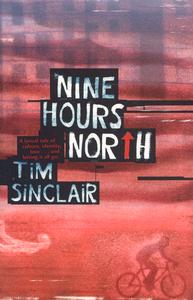
Nine hours north of everything I knew, of all my life that's made sense so far . . . Things stopped making sense from the moment Adam arrived in Japan - the conservative job, the shoebox apartment and the growing weight of his relationship with Sarah.
By the time Marianne arrives, he's been battery-caged for so long it all seems normal - but then she changes everything . . .
A bittersweet novel about finding the strength to move forward.
Nine hours north has just been released this February, published by Penguin and I must confess to be very excited about this book, not only because I know the author (albeit tangentially) as he is the son of my 1st year Biology lecturer *and* the husband of a dear friend of mine who I went to HS with, but also because it's the debut novel by a young Australian - Adelaidean no less!, AND because it's a verse novel. Remember Vickram Seth's 'The Golden Gate' or Matt Rubenstein's 'Solstice' or Dorothy Porter's wonderful 'The Monkey's Mask' and 'What a piece of work'?? Great verse novels, in a genre which is slimly populated but satisfying to read.
I think it's incredibly brave to be a writer, and even more brave to be a poet. Poetry! Who does that these days, when everything is meant to be useful and contribute to production of bright and shiny things that you can eat or wear or drive or renovate? For that reason alone I am committed to buying the work of contemporary poets / poetic fiction (I just made that genre up) writers - good to support the dreamers, so we remember how to dream.
Anyway, this book is set in Japan, characters are early twenties Australians teaching English as part of a youthful adventure away from home post-uni. They are in a relationship but things are getting weary. Captures those few years (longer??) when the acting out of a working life feels like playing dress ups, it can be done with irony, it is still so new, and uni life still feels so close. When you just know that you will never wear a suit and be old and be boring. The interesting thing about their relationship is that they seem to be developing quite different attitudes to their life, about what is important and how to live it.
I must confess that parts were uncomfortable reading for me in terms of candid insight into the mind of a male partner who is increasingly dissatisfied a few years into a relationship - I think I was a bit defensive about his judgement about Sarah. I did also wonder if it was going to be a 2-D 'my girlfriend's so boring I need a wild adventure' story - but it wasn't, it didn't end up being this, the characters fleshed out with much more realistic too-ings and fro-ings of feeling. It effectively built up tension as you wonder what will happen to topple the domestic order. It rolls along, with cycling becoming a theme of the book - Adam and Sarah united in their use of bikes for commuting to work and also as the mode of travel they choose for their long-planned touring holiday around Japan.
Definitely worth a read, and may especially apppeal to those who are into bikes, who have had a 'coming of age' relationship, have visited Japan, who have been confused about their feelings for someone, and who like wry, simply stated poetry. Proof that poetry doesn't have to be abstract and fey and hard to access. Buy a copy! Give a copy to a friend! :)
Authors website
"Olivo Oliva" - Phillipe Poloni
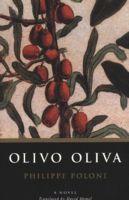 Turns out my local library service runs this you beaut service called 'Book Express' for city commuter types. A stall at the train station complete with network accessed laptop, a friendly and informative person on the other side of the stall, and a bunch of books and audio books to borrow. All this between 5.30ish and 7ish am. And me lugging a laptop and some reading for work but glad of any excuse not to do that and be immersed in fiction instead. Sipping coffee, reading, it’s almost like being on a moving café rather than a mode of transport. Almost.
 I borrowed a couple, one was “Olio Oliva” by Phillipe Poloni (1997 Stoddart publishing). Read it that day, was one of those sparsely type fonted slim books that you just whip through (especially when you are on your derrière for 4 hours with no distractions).
It starts with the relationship between an olive tree and its olives. Describes the anguish of an olive wanting to be free of the tree, the trees contempt for its ‘droppings’, the tree as patriarch. The gist of the story then is boy meets girl, boy beds girl, olive tree drops olive from great heights into the steamy sea of lovemaking below, girl has olivish baby. Sounds a bit like ‘Leolo’ that Italian movie where conception takes place in the back of a tomato truck? Yes, I thought that too. It’s all about the olive in Sicily, the role of landowners versus the landless poor, resentment, fear of losing hold of power, and ultimately revenge. The writing was lovely, sparse and poetic, translated from the Italian by David Homel. It did remind me of Calvino in some of its language but perhaps that is just due to the meandering, observational, dreamy nature of the writing, and the playing with words - or maybe it’s just that these are probably the only Italian authors I’ve read (that’s a bit tragic – so anglocentric in what I read…). It captured a very languid feeling of a slow, hot, worn out Sicily rather well, and gave an interesting picture of the successive waves of invaders that have moved through that part of the world, and the layering of culture and religion that takes place as a result.
Characters? The sicario in the new country. Some quirky ancient craftsmen accompanied by a donkey, who has his own bank account and gets paid the lions share of their fee. Hunchbacked moralists who guard over unwed mothers in crumbling ruins. The patriarch who is superstitious and ruthless in protecting his empire. Some of these characters reminded me of people from Loius de Berniers novels – they are irrational and contradictory and flawed and colourful.
This is a bit like a gentle, lazy, loping fairy tale, which doesn’t deliver much in the way of ‘action’, and everything that happens has already been foretold at the start. Even the end is a kind of poetic anticlimax. However, this is entirely in keeping with the setting of the tale, and what it says are the characteristics of that place – so this kind of works.
It made me want to go lie under an olive tree and eat pasta and drink wine.
‘The young olive tree had a soul. It was possessed of a memory. A kind of heredity. Awkwardly, it paraded the military pride of its ancestors. Poor little tree! It was but a simple domesticated olive producer among the million of other domesticated Mediterranean copies, all planted in rigorously straight rows. No more petalism! Doric temples a thing of the past! Polytheist ceremonies accompanied by chanting and pungent Levantine incense – all obsolete. Its leaf would no longer serve as a model for those early Christian mosaicists who decorated their catacombs, late at night, illuminated by the oil of its fruit. All that had happened, long ago… All that belonged to another time. The scion was a heraldic tree no more, but the object of intensive rationalised agriculture. And the haughty olive tree knew nothing of that!’ (p.4)
Sunday, March 05, 2006
Sunday, February 26, 2006
"The only people for me are the mad ones, the ones who are mad to live, mad
to talk, mad to be saved, desirous of everything at the same time, the ones
who never yawn or say a commonplace thing, but burn, burn, burn, like
fabulous yellow roman candles exploding like spiders across the stars and in
the middle you see the blue centerlight pop and everybody goes "Awww!"
Jack Kerouac - "On The Road"
to talk, mad to be saved, desirous of everything at the same time, the ones
who never yawn or say a commonplace thing, but burn, burn, burn, like
fabulous yellow roman candles exploding like spiders across the stars and in
the middle you see the blue centerlight pop and everybody goes "Awww!"
Jack Kerouac - "On The Road"
Tuesday, February 21, 2006
Good Books on Cat and Girl.
Love this comic. And look, soon appearing in a book! This is now on my ever growing 'when I get paid' wishlist.
Love this comic. And look, soon appearing in a book! This is now on my ever growing 'when I get paid' wishlist.
Monday, February 06, 2006
Art & Lies
Art Objects, Jeanette Winterson

I read these two books recently, in that order. Art and Lies is fiction, Art Objects is a book of short essays, and whilst they cover some similar territory, ideas on what art is and how it fits within life, and in particular within our culture of corporate consumer capitalism, I think that Art & Lies is probably the more beautiful read. That said, all of Winterson's prose is essentially poetry, and I find it a joy to read even when I think she has been opinionated, bombastic or arch - maybe especially then!

Art and Lies had great passages of beautiful prose which I would memorise if I had the dedication to do so. Kind of like the type of literary tattoo I would get it you could print words into the ether around you rather than images into flesh. There is one passage about the sea, in Art and Lies, which is particularly wonderful. the story looks at what it is to be a woman artist (painter, writer) - to grapple with expactations and sexual politics and double standards. One of the characters is the female Picasso in modern day England grappling with family expectations and the presumption of madness, one is Sappho the poet who exists both as the historical figure and modern day lover, one is Handel, a surgeon who loves opera and God and is deemed quaint and archaic by his colleagues.
"There's no such thing as autobiography, there's only Art and Lies"
Handel struggles to feel, to allow expression of his passions, to be authentic to himself in the midst of corporate culture - which has art merely as accessory, gross consumption but no tasting of what is consumed, lack of appreciation, of wonder. He is afforded staus and position, but leaves it to nurture his soul. The women are awash with passion and talent, but constrained by the self-serving interests of father/brother (in Picasso's story) or Church and misrepresentation (in Sapppho's story).
The story weaves around in a way that plays with time and place - gently a story emerges. It is not a linear, pointed, fast and obvious plot by any means, but more like a beautiful symphony which takes you along and connects directly with your subconscious. If you've read other worksby Winterson you wil be familiar with the style. If you haven't, I suggest Sexing the Cherry, or The Passion as great starting points. For the sake of categorisation, some people apply labels such as 'Magic Realism' to her work (see the absolute shocker of an entry on Wikipedia - boy did someone not like this writer when they wrote that!), but this is a descriptor the author rejects.
I think essentially this is a piece on authenticity - of spirit, of being authentic to ones true nature, and of the repurcussions that may transpire as a result of expressing authenticity in an world more comfortable with thoughtless reproduction. It is a pretty damming reflection on how society deals with creative women, and on how muted and rationed feeling and expression is in a culture dictated by the market.
From Art & Lies:
"It is so easy to be a brute and yet it has become rather fashionable.."
"It's comforting, my busy life, left alone with my own thoughts I might find that I have none"
"...Such habits and a contemplative nature, have not fitted me for a world that knows neither restraint nor passion. the fatal combination of indulgence without feeling disgusts me. Strange to be both greedy and dead"
"I confess that I am frightened of the sea.There is the sailor sea and the commercial sea, the oil well sea and the fishy sea. The sea that tests the land through sub-lunary power. The rise and fall of the harbour sea and the sea that exists to make maps look prettier. But the functional sea is not the final sea. There is that other sea simply itself. A list of all the things that the sea does is not what the sea is...."
"Some people find this book very difficult. What do you say to that?
Why should literature be easy? Sometimes you can do what you want to do in a simple, direct way that is absolutely right. Sometimes you can't. Reading is not a passive act. Books are not TV. Art of all kinds is an interactive challenge. The person who makes the work and the person who comes to the work both have a job to do. I am never wilfully obscure, but I do ask for some effort. Certainly Art and Lies is my most closed piece of work. Perhaps it is hermeneutic, though no more so than plenty of books by plenty of guys .It was written at a time when I was looking inwards not outwards. It is thickly layered, concentrated and often dark. But it's a book not a crime. If you don't like it, don't read it." (From the authors website)
Winterson on Art Objects:
"it's a verb not a noun. Art objects to the lie against life that it is pointless and mean. The message coloured through time is not lack but abundance, Not silence but many voices. Art, all art is the communication cord that cannot be snapped by indifference or disaster. Against the daily death it does not die." (From the authors website)
Quotes from the book:
"To suggest that the writer, painter, the musician, is the one out of touch with the real world is a doubtful proposition. It is the artist who muct apprehend things fully, in their own right, communicating them not as symbols but as living realisties with the power to move."
"For the artist,any artist, poet, painter, musician, time in plenty and an abundance of ideas are the neccassary basics of creativity. By dreaming and idleness and then by intense self-discipline does the artist live. The artist cannot perform between 9 and 6, five days a week, or if she sometimes does, she cannot gaurantee to do so. Money culture hates that. It must know what it is getting, when it is getting it, and how much it willcost. The most tyrannical of patrons never demanded from their protegees what the market now demands of artists; if you can't sell your work regularly and quickly, you can ither starve or do something else. The time that art needs, which may not be a long time, but which has to be its own time, is anathema to a money culture. money confuses time with itself. That is part of its unreality." (pp138-9).
Art Objects, Jeanette Winterson

I read these two books recently, in that order. Art and Lies is fiction, Art Objects is a book of short essays, and whilst they cover some similar territory, ideas on what art is and how it fits within life, and in particular within our culture of corporate consumer capitalism, I think that Art & Lies is probably the more beautiful read. That said, all of Winterson's prose is essentially poetry, and I find it a joy to read even when I think she has been opinionated, bombastic or arch - maybe especially then!
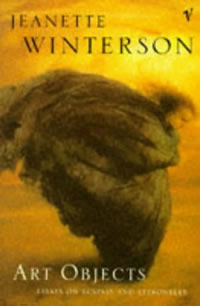
Art and Lies had great passages of beautiful prose which I would memorise if I had the dedication to do so. Kind of like the type of literary tattoo I would get it you could print words into the ether around you rather than images into flesh. There is one passage about the sea, in Art and Lies, which is particularly wonderful. the story looks at what it is to be a woman artist (painter, writer) - to grapple with expactations and sexual politics and double standards. One of the characters is the female Picasso in modern day England grappling with family expectations and the presumption of madness, one is Sappho the poet who exists both as the historical figure and modern day lover, one is Handel, a surgeon who loves opera and God and is deemed quaint and archaic by his colleagues.
"There's no such thing as autobiography, there's only Art and Lies"
Handel struggles to feel, to allow expression of his passions, to be authentic to himself in the midst of corporate culture - which has art merely as accessory, gross consumption but no tasting of what is consumed, lack of appreciation, of wonder. He is afforded staus and position, but leaves it to nurture his soul. The women are awash with passion and talent, but constrained by the self-serving interests of father/brother (in Picasso's story) or Church and misrepresentation (in Sapppho's story).
The story weaves around in a way that plays with time and place - gently a story emerges. It is not a linear, pointed, fast and obvious plot by any means, but more like a beautiful symphony which takes you along and connects directly with your subconscious. If you've read other worksby Winterson you wil be familiar with the style. If you haven't, I suggest Sexing the Cherry, or The Passion as great starting points. For the sake of categorisation, some people apply labels such as 'Magic Realism' to her work (see the absolute shocker of an entry on Wikipedia - boy did someone not like this writer when they wrote that!), but this is a descriptor the author rejects.
I think essentially this is a piece on authenticity - of spirit, of being authentic to ones true nature, and of the repurcussions that may transpire as a result of expressing authenticity in an world more comfortable with thoughtless reproduction. It is a pretty damming reflection on how society deals with creative women, and on how muted and rationed feeling and expression is in a culture dictated by the market.
From Art & Lies:
"It is so easy to be a brute and yet it has become rather fashionable.."
"It's comforting, my busy life, left alone with my own thoughts I might find that I have none"
"...Such habits and a contemplative nature, have not fitted me for a world that knows neither restraint nor passion. the fatal combination of indulgence without feeling disgusts me. Strange to be both greedy and dead"
"I confess that I am frightened of the sea.There is the sailor sea and the commercial sea, the oil well sea and the fishy sea. The sea that tests the land through sub-lunary power. The rise and fall of the harbour sea and the sea that exists to make maps look prettier. But the functional sea is not the final sea. There is that other sea simply itself. A list of all the things that the sea does is not what the sea is...."
"Some people find this book very difficult. What do you say to that?
Why should literature be easy? Sometimes you can do what you want to do in a simple, direct way that is absolutely right. Sometimes you can't. Reading is not a passive act. Books are not TV. Art of all kinds is an interactive challenge. The person who makes the work and the person who comes to the work both have a job to do. I am never wilfully obscure, but I do ask for some effort. Certainly Art and Lies is my most closed piece of work. Perhaps it is hermeneutic, though no more so than plenty of books by plenty of guys .It was written at a time when I was looking inwards not outwards. It is thickly layered, concentrated and often dark. But it's a book not a crime. If you don't like it, don't read it." (From the authors website)
Winterson on Art Objects:
"it's a verb not a noun. Art objects to the lie against life that it is pointless and mean. The message coloured through time is not lack but abundance, Not silence but many voices. Art, all art is the communication cord that cannot be snapped by indifference or disaster. Against the daily death it does not die." (From the authors website)
Quotes from the book:
"To suggest that the writer, painter, the musician, is the one out of touch with the real world is a doubtful proposition. It is the artist who muct apprehend things fully, in their own right, communicating them not as symbols but as living realisties with the power to move."
"For the artist,any artist, poet, painter, musician, time in plenty and an abundance of ideas are the neccassary basics of creativity. By dreaming and idleness and then by intense self-discipline does the artist live. The artist cannot perform between 9 and 6, five days a week, or if she sometimes does, she cannot gaurantee to do so. Money culture hates that. It must know what it is getting, when it is getting it, and how much it willcost. The most tyrannical of patrons never demanded from their protegees what the market now demands of artists; if you can't sell your work regularly and quickly, you can ither starve or do something else. The time that art needs, which may not be a long time, but which has to be its own time, is anathema to a money culture. money confuses time with itself. That is part of its unreality." (pp138-9).
Sunday, February 05, 2006
"Kafka on the Shore" - Haruki Murakami
This is the story of a teenage boy, who runs away from home in an attempt to escape his father's prophesies (curses). The boy also wonders about the fate of his mother and sister, who left when he was four never to be seen again. There is an interlocking story of an old man who has not been "quite right" since an incident when he was a boy during WW2, but gained the ability to talk to cats. A series of events interlock the stories of these two as they both travel from Tokyo to one of Japan's Western islands, introducing new characters along the way who help out the characters in their times of need.
There are interesting twists and contrasts - the simple, illiterate man blindly leading a truck driver who ends up being enlightened by his journey; the man who can only live in the present and the lady who can only live in her memories; Colonel Sanders and Johnny Walker appearing to the book's characters to ensure the carrying out of fated events; night time dreams that run into reenactments of events from many years before; and fish raining from the sky.
I enjoy Murakami books, and this is the third I have read. They all have some common elements - trips into the metaphysical, misfit characters of the Japanese kind, use of simile and metaphor, bold truisms buried in the text, references to whiskey drinking, eating and cooking, music, and graphic descriptions about the male sexual function (wanking, sex, nocternal emissions or fantasizing). [I could do with less on the latter, but then, he's a male author so I expect that he writes with some authority on the topic. It's written in a factual way, as a normal part of the life of the male characters, rather than being in anyway pornographic].
This novel has all the above elements. This had some lovely truisms in it... I marked the pages so I could quote them:
This is the story of a teenage boy, who runs away from home in an attempt to escape his father's prophesies (curses). The boy also wonders about the fate of his mother and sister, who left when he was four never to be seen again. There is an interlocking story of an old man who has not been "quite right" since an incident when he was a boy during WW2, but gained the ability to talk to cats. A series of events interlock the stories of these two as they both travel from Tokyo to one of Japan's Western islands, introducing new characters along the way who help out the characters in their times of need.
There are interesting twists and contrasts - the simple, illiterate man blindly leading a truck driver who ends up being enlightened by his journey; the man who can only live in the present and the lady who can only live in her memories; Colonel Sanders and Johnny Walker appearing to the book's characters to ensure the carrying out of fated events; night time dreams that run into reenactments of events from many years before; and fish raining from the sky.
I enjoy Murakami books, and this is the third I have read. They all have some common elements - trips into the metaphysical, misfit characters of the Japanese kind, use of simile and metaphor, bold truisms buried in the text, references to whiskey drinking, eating and cooking, music, and graphic descriptions about the male sexual function (wanking, sex, nocternal emissions or fantasizing). [I could do with less on the latter, but then, he's a male author so I expect that he writes with some authority on the topic. It's written in a factual way, as a normal part of the life of the male characters, rather than being in anyway pornographic].
This novel has all the above elements. This had some lovely truisms in it... I marked the pages so I could quote them:
"Like someone excitedly relating a story only to find the words petering out, the path gets narrower the further I go, the undergrowth taking over."
" 'From my own experience, when someone is trying very hard to get something, they don't. And when they're running away from something as hard as they can, it usually catches up with them. I'm generalising, of course.' "
" 'Are the Japanese God and the foreign God relatives, or maybe enemies?'
'How should I know?'
'Listen - God only exists in people's minds. Especially in Japan, God's always been kind of a flexible concept. Look at what happened after the war. Douglas MacArthur ordered the devine emperor to quit being God, and he did, making a speech saying he was just an ordinary person. So after 1946 he wasn't God any more. That's what Japanese gods are like - they can be tweaked and adjusted. Some American chomping on a cheap pipe gives the order and presto change-o - God's no longer God. A very postmodern kind of thing. If you think God's there, He is. If you don't, He isn't. And if that's what God's like, I wouldn't worry about it.'
'OK...' "
Wednesday, December 28, 2005

"Food and Cooking" by Harold McGee
Got this for christmas. This is more like a reference book - read bits from time to time, then put it aside for another session. The book is broken down into food ingredient types, for example: dairy, eggs, cereal grains, legumes, fruit, vegetables, meats, alcohol, sugars & confectionary etc.
I have started reading the first chapter about milk & dairy. It starts off talking about the evolution of milk in Mammals, then how and when humans started using milk (with archeaological evidence cited), and how selective breeding and herding started to take place and where (not just cows - buffalo, yak, camel, sheep and goat also). From there it discusses health benefits and shortfalls, lactose intolerance and dairy allergies. Then how the animal produces milk and its components, unfermented products, fermented produces (yoghurt etc) then finally, cheeses. You get the idea.
This is a very detailed book with info on the above type of stuff plus origins of food words from ancient languages and dialects. I have had a flip through the chapter on doughs and batters, and there is detail there on the gluten molecule, how it forms and how it gives rise to dough elasticity for example, and how cooking changes the chemistry and texture of a dough or batter. There is also discussion on how humans might have developed grinding and later milling to produce flour, and how flatbreads would have changed the way grains were eaten, and later evolved to all the other types of breads on the planet today. Haven't even got to noodles and pasta yet. I find this facinating, and suspect this book might stay on the coffee table for many years yet. There aren't any recipes that I can see (maybe a few basics such as custards), but reading it will make you more aware of how not to treat certain ingredients and how our customs for eating things evolved over the past thousands of years.
Good book to request/buy for foodies on that special birthday coming up.
Sunday, December 11, 2005
Zorro - Comienza de la leyenda, Isabelle Allende
I'm only up to page 28 but just wanted to make a quick comment on trying to read in my (hopefully one day) second language. First up, its a giant pain in the arse. But of course, rewarding like most things that require effort. I bought a nice glossy print of the "South American" edition in a frenzied, over-ambitious attempt at immersion in Spanish. Also the shop attendant cornered me immediately after the very sexy poster had caught my eye in Buenos Aires' main shopping mall, and I had a limited repetoir of responses.
Anyway, I'm taking it super slow with of course a companion dictionary to hand. Luckily the edition has nice wide margins as the first 15 pages are covered in scrawled english translations. To begin with I managed 1.5 - 2 pages per night, with perfect quiet and a nice comfortable spot in our apartment. Its an interesting exercise that is a good reminder of what it must be like for kids to learn to read. At first its just a mass of jumbled data, and the effort to unscramble just one paragraph which turns out to be a description of some landscape and layout of a 18th Century mission hardly seems breaking into a sweat over. So I got very disheartened and left it for a month. Now I've tried again in our wintery mountain hostel, and have got to the point where I'm keen to find out the next twist of the story (Allende is good for that), so am encouraged to go again. Having put the pencil away and using a mix of guessing, looking up, asking Chris, and skiping the occaisonal hard sentence, I'm gradually getting faster.
And the most pleasant surprise, being the point of this post, is that the author's voice still rings lound and clear through the text, just like I know and love. Of course, Allende writes her original manuscript in Spanish. Having become familiar with her flights of imagination, her earthy, off-handed descriptions of the foibles of human personalities, rich sensuality often quickly followed by a sharp bit of sature, in English, I am now incredibly impressed with the act of translation in which brings all this through from the original. In this case, its the kind of book I could knock off in English in about a full day and a half of reading (with meals breaks), as it seems to have the rollicking pace of a cheeky adventure story. Also, in plodding along at a snails pace, the mechanics of the writing shows more than usual, because I've got to take the sentences apart to even work out what tense they are in, if they are someone's thoughts, a description, or part of the plot.
So as not to spoil the story.. so far the scene's been set in one of the more humanist missions in California, run by a Spanish monk, an attack by a coalition of the surrounding tribes, defended by the dashing Alejandro de la Vega, and an intruiging surprise.. ! Its exciting and I'm looking forward to the next few hundred pages. At this rate I've calcualted being finished by about August 2007.
I'm only up to page 28 but just wanted to make a quick comment on trying to read in my (hopefully one day) second language. First up, its a giant pain in the arse. But of course, rewarding like most things that require effort. I bought a nice glossy print of the "South American" edition in a frenzied, over-ambitious attempt at immersion in Spanish. Also the shop attendant cornered me immediately after the very sexy poster had caught my eye in Buenos Aires' main shopping mall, and I had a limited repetoir of responses.
Anyway, I'm taking it super slow with of course a companion dictionary to hand. Luckily the edition has nice wide margins as the first 15 pages are covered in scrawled english translations. To begin with I managed 1.5 - 2 pages per night, with perfect quiet and a nice comfortable spot in our apartment. Its an interesting exercise that is a good reminder of what it must be like for kids to learn to read. At first its just a mass of jumbled data, and the effort to unscramble just one paragraph which turns out to be a description of some landscape and layout of a 18th Century mission hardly seems breaking into a sweat over. So I got very disheartened and left it for a month. Now I've tried again in our wintery mountain hostel, and have got to the point where I'm keen to find out the next twist of the story (Allende is good for that), so am encouraged to go again. Having put the pencil away and using a mix of guessing, looking up, asking Chris, and skiping the occaisonal hard sentence, I'm gradually getting faster.
And the most pleasant surprise, being the point of this post, is that the author's voice still rings lound and clear through the text, just like I know and love. Of course, Allende writes her original manuscript in Spanish. Having become familiar with her flights of imagination, her earthy, off-handed descriptions of the foibles of human personalities, rich sensuality often quickly followed by a sharp bit of sature, in English, I am now incredibly impressed with the act of translation in which brings all this through from the original. In this case, its the kind of book I could knock off in English in about a full day and a half of reading (with meals breaks), as it seems to have the rollicking pace of a cheeky adventure story. Also, in plodding along at a snails pace, the mechanics of the writing shows more than usual, because I've got to take the sentences apart to even work out what tense they are in, if they are someone's thoughts, a description, or part of the plot.
So as not to spoil the story.. so far the scene's been set in one of the more humanist missions in California, run by a Spanish monk, an attack by a coalition of the surrounding tribes, defended by the dashing Alejandro de la Vega, and an intruiging surprise.. ! Its exciting and I'm looking forward to the next few hundred pages. At this rate I've calcualted being finished by about August 2007.
Wednesday, November 30, 2005
Hey! A friend from Adelaide came and stayed the other week and it turns out he's just starting to get into reading fiction. I was so excited I was like a librarian, I fossicked in my book shelves and leant him 5 *must reads* (he refused to take any more due to potential OH&S issues with lugging any more around). Made me wonder... what are the must reads?? Which 5 authors would you say were indespensable? And what about wonderful books - any that you think people would be seriously missing out on if they haven't read?
Saturday, October 29, 2005
"Up the Duff" by Kaz Cooke
An hilarious - yet informative - week by week breakdown of pregnancy. Completely lacking in assumptions about the circumstances of the reader - you could be single, married, have a same-sex partner, or whatever, and you shouldn't feel too excluded reading this book (tell me if I'm wrong here, if you have found otherwise). Not like some of the more traditional pregnancy books/mags full of pictures of hetero couples in bike pants rehearsing birthing positions as if they are on a higher plane and coping perfectly well with the totally freaky set of circumstances they find themselves in. (Despite being a hetero-married-up-the-duff woman, that is not the sort of pregnancy book I want to read).
Each week you get a run down of what is happening inside, and amusing fictional diary of a pregnant character to make you laugh, then a factual section that summarises useful info and where you can go to get more information. I got as far as week 36 before the info on giving birth, epidurals and pain was getting a bit much for me - now I'll just wait until I'm ready to read those bits - but the book has a whole lot of helpful prompts... hints that you should organise an appointment something for 4-5 weeks time, that you should think about how you feel about testing for downs syndrome etc, or that you really need to have somewhere sorted for giving birth to the baby soon.
A fun and informative read.
An hilarious - yet informative - week by week breakdown of pregnancy. Completely lacking in assumptions about the circumstances of the reader - you could be single, married, have a same-sex partner, or whatever, and you shouldn't feel too excluded reading this book (tell me if I'm wrong here, if you have found otherwise). Not like some of the more traditional pregnancy books/mags full of pictures of hetero couples in bike pants rehearsing birthing positions as if they are on a higher plane and coping perfectly well with the totally freaky set of circumstances they find themselves in. (Despite being a hetero-married-up-the-duff woman, that is not the sort of pregnancy book I want to read).
Each week you get a run down of what is happening inside, and amusing fictional diary of a pregnant character to make you laugh, then a factual section that summarises useful info and where you can go to get more information. I got as far as week 36 before the info on giving birth, epidurals and pain was getting a bit much for me - now I'll just wait until I'm ready to read those bits - but the book has a whole lot of helpful prompts... hints that you should organise an appointment something for 4-5 weeks time, that you should think about how you feel about testing for downs syndrome etc, or that you really need to have somewhere sorted for giving birth to the baby soon.
A fun and informative read.
Thursday, October 27, 2005
Saturday, October 01, 2005
'Sea Change: Australians in pursuit of the good life'
Cindy Dowling 2004
By working faithfully eight hours a day you may eventuallly get to be boss and work twelve hours a day
- Robert Frost
Just skim read this to return to the library by the due date. Quite liked it.
An overview of trends about work modes in Australia (rise in part-time positions) and social scene-setting, followed by a bunch of case studies about 'downshifting ' (sounds a little like a nightclub in haymarket?) / 'downsizing' (sounds like cosmetic surgery?) and 'voluntary simplicity' movement/s. These case studies were nice - shortish summaries of the why, where and how of major life change that working Australians had taken - often with partner and family - to reduce stress, increase self-sufficiency, increase satisfaction, increase health and reduce impacts on the planet by changing the way they live. The case studies showed a diversity of approaches to this change - different cottage industries and part time work, intentional communities, working from home, volunteer work, growing their own food, learning to mend things, and 'portfolio careers' (bits and pieces of paid and unpaid activities to suit people's interests).
Examples of thoughts from the case studies:
'I would encourage people to follow their dream, for they will not fail. It may take many twists and turns but there is no failure in life, just the journey and the adventure of living. Do no harm to any and walk a moral ground and have respect for your walk and yourself. Like who you are and do not apologise for your dreams.'
(Catherine Johns, left teaching in the city to live off the land and run a pagan retreat for women)
What he avoids is work that he feels is of no benefit to the community or that will dominate his time at the expense of other pursuits..
(About Bob Rich, featured in another case study)
An overarching theme amongst the different stories was learning to live better with less - valuing lifestyle over income. A lot of the people interviewed felt that they were doing something positive not only for themselves and their relationships but also modelling a better life and instilling a better set of values (than had they stayed in full time work in the city) for their children. In that way the movement rejects the notion that self-less people work as hard as they can and make as much money as they can and that selfish, self indulgant, lazy types work less. I am of course especially interested in this from my own perspective of choosing part-time paid work this year. Interesting to look at the costs of full time employment on our bodies, relationships, families and communities versus the benefits we offer through having time available to share with other endeavours.
None of this is new thinking, of course, people have been reflecting on these issues in the west for decades, many people have chosen non-conventional working lives and opted for more sustainable lives. Nonetheless for many of us the currents of convention pulling our attentions and concerns into career and earning potential is quite strong - it takes courage to withstand this and reaffirm different values. The book was a nice reminder of the many different ways we can live out those values.
Cindy Dowling 2004
By working faithfully eight hours a day you may eventuallly get to be boss and work twelve hours a day
- Robert Frost
Just skim read this to return to the library by the due date. Quite liked it.
An overview of trends about work modes in Australia (rise in part-time positions) and social scene-setting, followed by a bunch of case studies about 'downshifting ' (sounds a little like a nightclub in haymarket?) / 'downsizing' (sounds like cosmetic surgery?) and 'voluntary simplicity' movement/s. These case studies were nice - shortish summaries of the why, where and how of major life change that working Australians had taken - often with partner and family - to reduce stress, increase self-sufficiency, increase satisfaction, increase health and reduce impacts on the planet by changing the way they live. The case studies showed a diversity of approaches to this change - different cottage industries and part time work, intentional communities, working from home, volunteer work, growing their own food, learning to mend things, and 'portfolio careers' (bits and pieces of paid and unpaid activities to suit people's interests).
Examples of thoughts from the case studies:
'I would encourage people to follow their dream, for they will not fail. It may take many twists and turns but there is no failure in life, just the journey and the adventure of living. Do no harm to any and walk a moral ground and have respect for your walk and yourself. Like who you are and do not apologise for your dreams.'
(Catherine Johns, left teaching in the city to live off the land and run a pagan retreat for women)
What he avoids is work that he feels is of no benefit to the community or that will dominate his time at the expense of other pursuits..
(About Bob Rich, featured in another case study)
An overarching theme amongst the different stories was learning to live better with less - valuing lifestyle over income. A lot of the people interviewed felt that they were doing something positive not only for themselves and their relationships but also modelling a better life and instilling a better set of values (than had they stayed in full time work in the city) for their children. In that way the movement rejects the notion that self-less people work as hard as they can and make as much money as they can and that selfish, self indulgant, lazy types work less. I am of course especially interested in this from my own perspective of choosing part-time paid work this year. Interesting to look at the costs of full time employment on our bodies, relationships, families and communities versus the benefits we offer through having time available to share with other endeavours.
None of this is new thinking, of course, people have been reflecting on these issues in the west for decades, many people have chosen non-conventional working lives and opted for more sustainable lives. Nonetheless for many of us the currents of convention pulling our attentions and concerns into career and earning potential is quite strong - it takes courage to withstand this and reaffirm different values. The book was a nice reminder of the many different ways we can live out those values.
Friday, September 23, 2005
http://www.bl.uk/onlinegallery/ttp/ttpbooks.html
.....and, they even talk! check em out. i am like a kid all over again (ok, maybe i never stopped being one).
.....and, they even talk! check em out. i am like a kid all over again (ok, maybe i never stopped being one).
Sunday, September 18, 2005
Finished two books in the last two days - both of them thanks to mrrmaid gal (book swapping - one of lifes sweetest pleasures??). One I finished reading up too late in a nun's bath - sounds debauched, really not - she was away on holidays I was being accomodated in Bathurst before a course. That book was 'leaving the saints' by Martha Beck - a book written by a woman brought up in the Church of the latter Day Saints (ie Mormons) who ends up leaving the church - in short because of the stifling power structure of the church as she experiences it (blocking freedom of speech for academics, threatening the livelihoods of those who are excommunicated or seen as dissidents), because of its complete lack of support for women and children survivors of sexual abuse (both due to the patriachal set up of the church which seems to support men over women in general, and because of the extra complication of using religious dogma such as forgiveness and banding together to protect the church to silence victims), and the very shaky and illogical precepts on which the church is built. It was an interesting story of her own spiritual journey, her emotional healing after her abusive childhood, her confusion about what aspects of her background to abandon and what to keep. It gave me a new perspective on life in Utah! Well worth a read - an easy read, lots of interesting historical asides, upbeat and funny in many sections despite the subject material which might sound completely depressing.
The second book I finished last night - listening to it on CD! Yes the Kombi kids have rediscovered audio books and I think I am the most recent recruit! Great idea - I have been listening to stories and painting these last few nights - much cooler than watching the teve I reckon. Aumstead Maupin's 'Night Listener'. It is a bit of a story within a story - a story of him writing the story of him writing the story kind of thing - circularish and interesting in how it plays with which aspects of a writeres life might get included in fiction, which bits might be made up and how fans can get confused by this and think that they know an author just through their character's. It is also a bit of an 'is this a hoax or not?' story as the author gets in contact with a young fan with an awful background who has written his own book. The plot thickens as our author bonds with the boy and then has questions arise about his authenticity. I wont say more, but it is a bit like Peter Carey's 'My life as a Fake' (see below) in the way it kind of develops along two paths - it could be real, it could be made up, you get just enough to keep both ideas seem plausible.. for a while. So in that way it is also about suspension of disbelief - why we sometimes want to believe despite the evidence.
I am about to send both of these books off to a few other people to read before they head back up north - hope that's ok grrls!!
The second book I finished last night - listening to it on CD! Yes the Kombi kids have rediscovered audio books and I think I am the most recent recruit! Great idea - I have been listening to stories and painting these last few nights - much cooler than watching the teve I reckon. Aumstead Maupin's 'Night Listener'. It is a bit of a story within a story - a story of him writing the story of him writing the story kind of thing - circularish and interesting in how it plays with which aspects of a writeres life might get included in fiction, which bits might be made up and how fans can get confused by this and think that they know an author just through their character's. It is also a bit of an 'is this a hoax or not?' story as the author gets in contact with a young fan with an awful background who has written his own book. The plot thickens as our author bonds with the boy and then has questions arise about his authenticity. I wont say more, but it is a bit like Peter Carey's 'My life as a Fake' (see below) in the way it kind of develops along two paths - it could be real, it could be made up, you get just enough to keep both ideas seem plausible.. for a while. So in that way it is also about suspension of disbelief - why we sometimes want to believe despite the evidence.
I am about to send both of these books off to a few other people to read before they head back up north - hope that's ok grrls!!
Thursday, August 04, 2005
Harry Potter and the Half-blood Prince - JK Rowling
Got through this on in a weekend. The 6th part of the Harry Potter saga doesn't disappoint, and like the targeted age group for this book, Harry is a teenager facing typical teenage issues, with evil wizard posses thrown in to the mix. And like many of us in the west, the wizarding community is being bombarded with flyers telling them to be alert, and report any strange magical events to the Ministry.
Like all of the Potter books, they are an easy, entertaining read, and the Author, to my memory, seems to have captured the sorts of issues that kids face and twisted them into a magical setting in a most interesting way. The ending was unexpected, and the uncertainty regarding the goodness or evilness of a key character was laid to rest once and for all....
Everything is Illuminated - Jonathan Safran Foer
I really enjoyed this book. It's funny, sad, beautiful, honest and innovatively written. It's written with several interweaving narration styles, which in itself isn't original, but the premise behind these interconnected characters is that the book is written as if the (Jewish American) Author is researching a novel on a Ukrainian Jewish village from which his grandfather had survived in WW2, although you never get a direct narration from the Author. The Author engages a local tour guide to help him find the locations and hunt for a woman in a photograph who was credited with saving his Grandfather's life. The tour guide's Grandfather also comes along for the journey, and it brings his war time memories flooding back. What the reader is presented with is the writing that resulted from the trip:
- sections of the story written in narrative style from the tour guide (a young Ukrainian man, with adequate english, but dangerously armed with a thesaurus, sustituting inappropriate words from time to time!).
- folktale-style stories from the Narrator, going back to the late 18th Century. Beautifully depicts a village with its own peculiarities and customs, living in relative harmony (bar the odd Pogrom inflicted by the Russians) up until the Germans invade in 1942, focusing on the Author's supposed ancestors.
- Colloquial style letters from the tour guide to the Author, critiquing the Authors made-up folktales along the way, as chapters are sent East across the Atlantic.
Dramas unravel regarding the Authors family history up until and just after the war; the woman in the picture; the tourguide's (non-jewish) family's parallel experiences during the war; and finally the legacy that the war left in both the Author's and the Tourguide's families in the 2 following generations.
Well worth a read.
Got through this on in a weekend. The 6th part of the Harry Potter saga doesn't disappoint, and like the targeted age group for this book, Harry is a teenager facing typical teenage issues, with evil wizard posses thrown in to the mix. And like many of us in the west, the wizarding community is being bombarded with flyers telling them to be alert, and report any strange magical events to the Ministry.
Like all of the Potter books, they are an easy, entertaining read, and the Author, to my memory, seems to have captured the sorts of issues that kids face and twisted them into a magical setting in a most interesting way. The ending was unexpected, and the uncertainty regarding the goodness or evilness of a key character was laid to rest once and for all....
Everything is Illuminated - Jonathan Safran Foer
I really enjoyed this book. It's funny, sad, beautiful, honest and innovatively written. It's written with several interweaving narration styles, which in itself isn't original, but the premise behind these interconnected characters is that the book is written as if the (Jewish American) Author is researching a novel on a Ukrainian Jewish village from which his grandfather had survived in WW2, although you never get a direct narration from the Author. The Author engages a local tour guide to help him find the locations and hunt for a woman in a photograph who was credited with saving his Grandfather's life. The tour guide's Grandfather also comes along for the journey, and it brings his war time memories flooding back. What the reader is presented with is the writing that resulted from the trip:
- sections of the story written in narrative style from the tour guide (a young Ukrainian man, with adequate english, but dangerously armed with a thesaurus, sustituting inappropriate words from time to time!).
- folktale-style stories from the Narrator, going back to the late 18th Century. Beautifully depicts a village with its own peculiarities and customs, living in relative harmony (bar the odd Pogrom inflicted by the Russians) up until the Germans invade in 1942, focusing on the Author's supposed ancestors.
- Colloquial style letters from the tour guide to the Author, critiquing the Authors made-up folktales along the way, as chapters are sent East across the Atlantic.
Dramas unravel regarding the Authors family history up until and just after the war; the woman in the picture; the tourguide's (non-jewish) family's parallel experiences during the war; and finally the legacy that the war left in both the Author's and the Tourguide's families in the 2 following generations.
Well worth a read.
Monday, June 20, 2005
Hi y'all , the booklub has been going off. (I'm sure I posted on here once before...)
I've manged recently to plough through Jared Diamond "Guns Germs and Steel", so am feeling quite righteous and a "big picture" sciencey, non-fiction reader. Jared wrote it in 1997 and its a big favourite of enviro-nerds so I'm a late starter with this one. He has a very strong main thrust is that the reason some well established societies were totally overrun and engulfed others this last few centuries century was not because they were inhenently inferior. The title refers to his summary that the reasons for the decimation of poulations of Aztecs, Indigenous Americans and Australian Aboriginies (to name just a few) was mostly to do with the possesion of firearms, endemdic diseases, technology, and writing by the invaders. For 425 pages he tracks back to find the sources of all these things, and says they are all linked to the first instance of domestic food production and animal husbandry, and that stepping back again these things were a bit like a lucky dip. Some continents happened to have plants and animals that could be farmed and some didn't. And some continents have geography that allows people to move ideas and new innovations around and some don't.
I really enjoyed it but did tend to skim over some of the more in depth methodology parts that science writers love so much. One of his big themes was using some of the observation and deduction methods of "science" to look at broad trends in what is usually classed as "history". Mm, meaty. On reading this kind of chunky treatise, I perveresly wonder what it would take to crunch the ideas down into the scale of say a picture book or comic book. I think with a lot of maps and drawing you could say so much about the picture he paints of the world over the last 13,000 years. It was a fortunate that we are minding many of a neighbour's books at the moment, and this was one of them.
To balance that out one of the trash books in the recently read pile was a 2004 terry pratchett... nerdgrl, signing off.
I've manged recently to plough through Jared Diamond "Guns Germs and Steel", so am feeling quite righteous and a "big picture" sciencey, non-fiction reader. Jared wrote it in 1997 and its a big favourite of enviro-nerds so I'm a late starter with this one. He has a very strong main thrust is that the reason some well established societies were totally overrun and engulfed others this last few centuries century was not because they were inhenently inferior. The title refers to his summary that the reasons for the decimation of poulations of Aztecs, Indigenous Americans and Australian Aboriginies (to name just a few) was mostly to do with the possesion of firearms, endemdic diseases, technology, and writing by the invaders. For 425 pages he tracks back to find the sources of all these things, and says they are all linked to the first instance of domestic food production and animal husbandry, and that stepping back again these things were a bit like a lucky dip. Some continents happened to have plants and animals that could be farmed and some didn't. And some continents have geography that allows people to move ideas and new innovations around and some don't.
I really enjoyed it but did tend to skim over some of the more in depth methodology parts that science writers love so much. One of his big themes was using some of the observation and deduction methods of "science" to look at broad trends in what is usually classed as "history". Mm, meaty. On reading this kind of chunky treatise, I perveresly wonder what it would take to crunch the ideas down into the scale of say a picture book or comic book. I think with a lot of maps and drawing you could say so much about the picture he paints of the world over the last 13,000 years. It was a fortunate that we are minding many of a neighbour's books at the moment, and this was one of them.
To balance that out one of the trash books in the recently read pile was a 2004 terry pratchett... nerdgrl, signing off.
Tuesday, June 14, 2005
Recently read "B is for Burglar" by Sue Grafton. Thanks for the tip-off, Miss J - this was a thrilling over-the-weekend read. Loved the main characters jaded attitute and sarcastic sense of humour, and the attention to detail about the characters in the book.
Now reading:
"The Poisonwood Bible" by Barbara Kingsolver
"Wrong about Japan" by Peter Carey (non-fiction)
"Raw Spirit - in Search of the Perfect Dram" by Iain Banks (also non-fiction, about an author being put in the enviable position of being asked by his publishers to tour Scotland tasting all the different whiskys and writing about them. I read this when I am having a Scotch!!).
Next in queue:
"My life as a fake" (see below)
and then I think it's time for another book by Haruki Murakami - have read "The Wind up Bird Chronicle" and "Norwegian Wood", but we have more in our collection that I haven't read yet.
Then "Everything is Illuminated" by Jonathan Safran Foer.
More than enough to keep my occupied....
Now reading:
"The Poisonwood Bible" by Barbara Kingsolver
"Wrong about Japan" by Peter Carey (non-fiction)
"Raw Spirit - in Search of the Perfect Dram" by Iain Banks (also non-fiction, about an author being put in the enviable position of being asked by his publishers to tour Scotland tasting all the different whiskys and writing about them. I read this when I am having a Scotch!!).
Next in queue:
"My life as a fake" (see below)
and then I think it's time for another book by Haruki Murakami - have read "The Wind up Bird Chronicle" and "Norwegian Wood", but we have more in our collection that I haven't read yet.
Then "Everything is Illuminated" by Jonathan Safran Foer.
More than enough to keep my occupied....
Monday, May 23, 2005
Just read
'My Life as a Fake' by Peter Carey. What do we think of Peter Carey? I have never been a huge fan, and this one probably didn't do much to tip me over the line. I like the paper they used for the cover - that's a bad sign right? Think rah rah Brits in the poetry scene who have an adventure in Malaya and everyone's grubby and tortured or bristling with indignation and drinking tea and upset about their parents and worried about their patrons. As you do. Liked some bits of it - main character not as objectionable as she could be, some nice quotes from other poems. The whole actual premise of the story dragged on a bit though. Wont say more as I know I have just lent it to you Merryrisa!
Lined up next
Murakami 'kafka on the shore"
Chuck Palahniuk "diary"
Patrick Suskind "perfume" (No, I've never read it!)
'My Life as a Fake' by Peter Carey. What do we think of Peter Carey? I have never been a huge fan, and this one probably didn't do much to tip me over the line. I like the paper they used for the cover - that's a bad sign right? Think rah rah Brits in the poetry scene who have an adventure in Malaya and everyone's grubby and tortured or bristling with indignation and drinking tea and upset about their parents and worried about their patrons. As you do. Liked some bits of it - main character not as objectionable as she could be, some nice quotes from other poems. The whole actual premise of the story dragged on a bit though. Wont say more as I know I have just lent it to you Merryrisa!
Lined up next
Murakami 'kafka on the shore"
Chuck Palahniuk "diary"
Patrick Suskind "perfume" (No, I've never read it!)
Wednesday, April 27, 2005

The reason for my black circles
I sat up and read one of my 6 new/old books last night - Working Parts by Lucy Jane Bledsoe. It's a book about a dyke in her early 30's who's a bicycle mechanic and best friends with her colleague (also a mechanic). He wants to open a bike shop with her using his compensation money from a car accident and she initially refuses, not because she doesn't want to but because she's illiterate. So they strike a deal - she'll learn to read if he has his first kiss.
I've always felt really grateful for the ability to read fluently and be able to string 2 or more words together on the written page. I'm someone who skipped over a lot of small childrens books to get into short novels by the age of 7. I remember my favourite activity as a child was reading in the glass section in my dad's tractor behind his seat, nestled in a pile of cushions going around and around the paddocks. And I would sit up till all hours with a torch under my blankets to finish a story cause I just couldn't help myself, reading till after midnight when I was only 10. And not much has changed! If I get really into a book now I'll just read it straight through even if I've got an early shift in the morning, throwing a scarf over the bedside lamp to make it duller for Little Mister.
So I just loved the really visceral description in this book of how it feels to learn to read, the freedom and pride it gives someone who's never had the opportunity and what it means in their life. It's a bit of a tear jerker in a way! I really recommend it to anyone who has someone in their life who has difficulties with literacy, cause I really think it explains so well how they feel and the coping mechanisms they develop to get through life without reading.
Saturday, April 02, 2005
I'm reading (for the 4th time) Survivor by Chuck Palahniuk. I just love Chucks freaky little mind and this book has it all. Cult religion, valium addicted goldfish, mass suicide, inappropriate love interest PLUS housekeeping tips! Who knew that shaved ice will fix those carpet divots from heavy furniture? And that talcum powder lifts those pesky blood stains right out of piano keys? My next book will be a little more academic as I've joined the Sapphic readers club, so be prepared for something a little more D&M dear friends....
Wednesday, March 30, 2005
Quick update of my reading de jour:
- Ok so it's not exactly a book but does reading state of the environment reports count? Air quality indoors - it's the next big thing man...
- Just whizzed through a Book on Chakras! Bless the mountainy bookshops and their love of all things energetic and esoteric. Chakras for the week - throat and heart.
- still going on Nausea - bloody Sartre, funny as all get out but bleak and stark raving mad at times. May be my plodding book of this half of the year
- R is for Ricochet Sue Grafton rocking my world with another schlocky Kinsey Millhone Mystery. Thanks mum for getting me onto true bath reading escapism that doesn't entirely insult your intelligence. Tip for new players - start with A is for Alibi or something down that end of the alphabet for true delightful sparse Californian bad eighties context...
- honky personal development book on inner child work. 'You're saying I have to sit in a chair and role play with myself?? Out loud? For real?' ahem, yeah maybe later. I have learnt that my inner child (oh sorry, 'child within') still throws tantrums and sulks, but generally she rocks. Book not actually as bad as it sounds, useful tool for identifying old inner dialogue that needs spring cleaning. More details on request...
- Birthday book (thanks Aunty B) on bedside table. Next on list.
- Ok so it's not exactly a book but does reading state of the environment reports count? Air quality indoors - it's the next big thing man...
- Just whizzed through a Book on Chakras! Bless the mountainy bookshops and their love of all things energetic and esoteric. Chakras for the week - throat and heart.
- still going on Nausea - bloody Sartre, funny as all get out but bleak and stark raving mad at times. May be my plodding book of this half of the year
- R is for Ricochet Sue Grafton rocking my world with another schlocky Kinsey Millhone Mystery. Thanks mum for getting me onto true bath reading escapism that doesn't entirely insult your intelligence. Tip for new players - start with A is for Alibi or something down that end of the alphabet for true delightful sparse Californian bad eighties context...
- honky personal development book on inner child work. 'You're saying I have to sit in a chair and role play with myself?? Out loud? For real?' ahem, yeah maybe later. I have learnt that my inner child (oh sorry, 'child within') still throws tantrums and sulks, but generally she rocks. Book not actually as bad as it sounds, useful tool for identifying old inner dialogue that needs spring cleaning. More details on request...
- Birthday book (thanks Aunty B) on bedside table. Next on list.
Friday, October 22, 2004
Literature is part of the flow of life. We don’t exist in some simple ‘factual’ way. We exist in virtual worlds made of stories we constantly tell ourselves. It’s made of master stories told by master storytellers or by whole communities, and contains in coded form the experience of our race. It’s a well of resource at which we can drink.
Writer-critic Yap Kun Bek
Writer-critic Yap Kun Bek
Monday, September 20, 2004
"Oryx and Crake", by Margaret Atwood
This book impresses me so much that I am writing about it whilst I am only ¾ of the way through. For anyone who’s watched a bit of Star Trek, or read Iain M Bank’s Science Fiction, you may have been lulled into a false sense of hope and security… that humans will go from strength to strength, that eventually, everyone will have a luxurious standard of living, unlimited by resources, and that we’ll only have clever gadgets and quirks of humanity – or even that of another extra-terrestrials! – to keep us amused.
Margaret Attwood will have you thinking again. This book has more in common with the films “Bladerunner” and “12 Monkeys”. What will happen in the future is still guesswork, but you can tell the author of this novel has spent many hours thinking deeply about humanity and what is going on with technological developments now, and extrapolated these to a frighteningly plausible scenario. I haven’t found any faults in the detail yet – the science isn’t so far out from what it is now that it is unbelievable.
This book has plenty of food for thought… What happens when biological research is allowed to go on unchecked and unhindered by ethics in the profit-driven private sector? When the earth’s resources become limited, how would we react? Will governments or companies play large roles in future societies? What about law and order? Will humans be able to keep up with their own advancements enough to cope with the new boundaries they push? What will teenage boys in the future do to amuse themselves? How many generations does it take to make a species extinct? What are people prepared to ignore in order to have a comfortable life? What balance should we be striving for? Once society becomes fragmented into so many groups, are people capable of pulling together in any way????
This book has many ideas that will stay with you, possibly keep you awake thinking about them. Some “sensitive types” may find this book a bit dismaying at first. Being the type that wants to believe in the goodness of people (within limits!), I was sad that the picture of future society had few if any redeeming features. But then, had the book been written in any other way, it would have had less of an impact. Hopefully I’ll be able to turn this around into an inspiration somehow.
The book is written exceedingly well, and draws you in from the start. At first you are acquainted with an old man on a tropical island, wracked with guilt about something that has happened, possibly surrounded by some indigenous peoples, and using words from their language. Then gradually, by oscillating between the “now” and the “past” in the book, you piece together what has happened. Not a new mode of book writing by any judgement, but the author has artfully used this style to keep you suspended to the end. Despite jumping between past and present, you never feel as if you are left hanging on half the story, as the two are interwoven so well by the narrator. You soon find out that the man is not on a tropical island – he’s in what used to be a city, and civilisation has been ruined somehow.
How? Well it's not nuclear war in this story at least, but go read it and find out. One to add to the compulsory (over 18) reading list.
This book impresses me so much that I am writing about it whilst I am only ¾ of the way through. For anyone who’s watched a bit of Star Trek, or read Iain M Bank’s Science Fiction, you may have been lulled into a false sense of hope and security… that humans will go from strength to strength, that eventually, everyone will have a luxurious standard of living, unlimited by resources, and that we’ll only have clever gadgets and quirks of humanity – or even that of another extra-terrestrials! – to keep us amused.
Margaret Attwood will have you thinking again. This book has more in common with the films “Bladerunner” and “12 Monkeys”. What will happen in the future is still guesswork, but you can tell the author of this novel has spent many hours thinking deeply about humanity and what is going on with technological developments now, and extrapolated these to a frighteningly plausible scenario. I haven’t found any faults in the detail yet – the science isn’t so far out from what it is now that it is unbelievable.
This book has plenty of food for thought… What happens when biological research is allowed to go on unchecked and unhindered by ethics in the profit-driven private sector? When the earth’s resources become limited, how would we react? Will governments or companies play large roles in future societies? What about law and order? Will humans be able to keep up with their own advancements enough to cope with the new boundaries they push? What will teenage boys in the future do to amuse themselves? How many generations does it take to make a species extinct? What are people prepared to ignore in order to have a comfortable life? What balance should we be striving for? Once society becomes fragmented into so many groups, are people capable of pulling together in any way????
This book has many ideas that will stay with you, possibly keep you awake thinking about them. Some “sensitive types” may find this book a bit dismaying at first. Being the type that wants to believe in the goodness of people (within limits!), I was sad that the picture of future society had few if any redeeming features. But then, had the book been written in any other way, it would have had less of an impact. Hopefully I’ll be able to turn this around into an inspiration somehow.
The book is written exceedingly well, and draws you in from the start. At first you are acquainted with an old man on a tropical island, wracked with guilt about something that has happened, possibly surrounded by some indigenous peoples, and using words from their language. Then gradually, by oscillating between the “now” and the “past” in the book, you piece together what has happened. Not a new mode of book writing by any judgement, but the author has artfully used this style to keep you suspended to the end. Despite jumping between past and present, you never feel as if you are left hanging on half the story, as the two are interwoven so well by the narrator. You soon find out that the man is not on a tropical island – he’s in what used to be a city, and civilisation has been ruined somehow.
How? Well it's not nuclear war in this story at least, but go read it and find out. One to add to the compulsory (over 18) reading list.
Subscribe to:
Posts (Atom)